New App to Clean Metadata More Easily

Sergio de los Santos    20 November, 2019

We are not going to repeat the dangers of metadata, since it has been discussed for quite some time now. However, we can try to make its management and cleaning simpler.

Some time ago, we launched our bots for Metashield to be used on Telegram, Slack or Skype. Well, now we have developed an app for Android intended to provide more possibilities and formulas to access Metashield.

You already know Metashield. In essence, it is an in-house technology to analyze and clean metadata used in many of our products. Although metadata seems to be an “old” problem, it is still useful when analyzing filtered data – for instance, remember the Osama bin Laden’s hard drive files case that we already discussed. Metadata was also a key element to find out WannaCry’s author: we discovered how the author operated as well as its default language in Word. This time we’re announcing an app already hosted on Google Play, intended to make metadata cleaning on any document or media file even simpler.

It is easy to use and does not need a great explanation. You can watch how it works in the following video.

https://youtu.be/OlhhveV9wX4

This tool was announced at the Security Innovation Day 2019 and may be downloaded from:

https://play.google.com/store/apps/details?id=com.elevenpaths.metashield

It is still on the “early access” stage, so if you detect any issue please let us know.

Our vision of Aura: more than just a digital assistant

Jose Palazón    15 November, 2019

This week I participated for the first time in the Telco AI Summit, which took place in London. During the presentation entitled “Our vision of Aura: much more than a digital assistant” I was able to tell more than 200 attendees about Telefónica’s comprehensive digital transformation process to provide intelligence to the three Platforms it already had and the creation of the 4 Platform to reinforce Telefónica’s capacity to collect, store and analyse customer data.

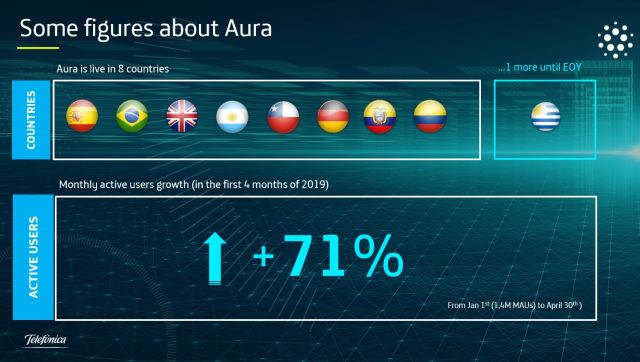
Thanks to this initiative, Aura, Telefónica’s IA, was launched in six markets: Spain, Brazil, United Kingdom, Argentina, Germany and Chile in 2018. Aura was born so that the company’s customers can use a natural language, obtaining answers in real time, and always personalized related to the products or services that the company has contracted with the company.

Aura is available through Telefónica’s own channels such as mobile apps (My Movistar, My 02 or Meu Vivo Móvel), websites or the Movistar Home device and also through social channels such as Facebook Messenger, Whatsapp or Google Assistant.

Aura is born with super powers

  • SIMPLIFY: talk to technology and make things happen.
  • ENRICH: transform data into profit insights.
  • EMPOWER: control your data (transparency, consents)
  • DISCOVER new experiences (of TEF and third parties)

Since its launch, Aura has evolved enormously, in 2019 it has reached new markets such as Ecuador and Colombia and will soon be available in Uruguay. In addition, it is already integrated in more than 30 global channels to be more relevant to our users. It has more than 1,000 usage cases and 3 million active users per month. In addition, Telefónica is making a very strong commitment to bring AI to the home of Spaniards. Recently the opening of the home ecosystem has been announced so that third parties such as Air Europa, Atlético de Madrid, Iberia or LaLiga can develop unique experiences called “Movistar Living Apps”.

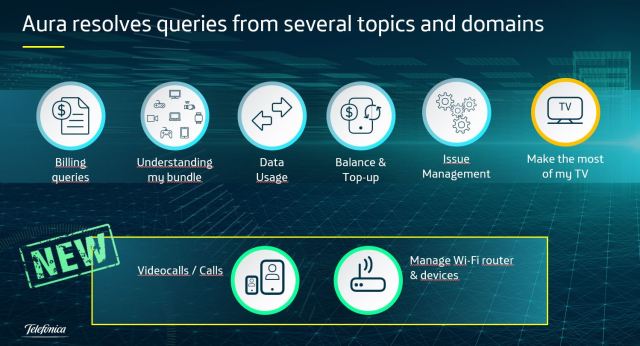
Note that Aura is available in the UK through the mobile application “My 02“. Specifically, they can talk to the virtual assistant through voice or text and see their invoices, see the products and services contracted, see the use of data or answer more than 100 generic questions, among other features.

Attendees were delighted with the initiative and understood the innovation that Telefónica has brought with Aura. A new relationship model based on trust that means treating our customers in a unique and special way. Indeed, Aura is much more than a digital assistant.

SMASSA Success Story: Intelligent Parking Services

AI of Things    15 November, 2019

Today we bring another success story from the public sector: the example of SMASSA, the Sociedad Municipal de Aparcamientos (Municipal Parking Company) whose mission is to solve the parking problems that exist in the city of Malaga. The public body has managed to make use of data analysis to increase its operational and business efficiency in all its lines of activity

This project follows the initiatives to transform the city of Malaga into a Smart City and aims to contribute to the improvement of urban traffic management and parking solutions in the city, using Big Data solutions.

The challenge was to turn SMASSA into a data-oriented organization that could take advantage of the functionality of an intelligent city and activate the four levers of the strategy: digitalization, operational efficiency, sustainability and external monetization.

The solution proposed by LUCA was developed through a consulting project that has designed how SMASSA should articulate its data strategy over the next four years.

The process of a gradual and progressive evolution towards becoming a data-driven organisation must define different initiatives in the short, medium and long term. This includes advanced visualisation for KPI reporting, advanced segmentation to offer new services to the user and circular management of vehicle scraps.

Through LUCA’s consulting service, we help companies and public administrations extract the value from data in their digital transformation process, so that they adapt to the new ecosystem and make the most of new business models and decision-making systems.

To learn more about LUCA success stories, visit Webpagecontact us and follow us on TwitterLinkedIn YouTube.

We Announce Our Digital Operation Centers, Where All Our Digital Services Are Focused

ElevenPaths    14 November, 2019
  • The Telefónica Cybersecurity Unit holds its VII Security Innovation Day, under the motto ‘Guards for Digital Lives.’
  • With speakers such as Chema Alonso, Pedro Pablo Pérez, Julia Perea and Ester Tejedor, among others; who provide an overview of the company’s digital security innovation offer.
  • Telefónica brings together in a single Digital Operation Centers (DOC) in Madrid all the cloud services, cybersecurity, Big Data and Internet of Things of more than 1,500 major clients from companies and the Spanish Administration.

Madrid, November 13, 2019.- ElevenPaths, the Telefónica Cybersecurity Unit, holds its VII Security Innovation Day, our in-house event on innovation and security known worldwide. Under the motto Guards for Digital Lives,this event is based on the dystopic scenario augured by the film ‘Blade Runner’ for November 2019. Over the event, ElevenPaths shares its vision of future cybersecurity trends in the market and presents its main strategic lines for the coming years

The event is opened by Pedro Pablo Pérez, CEO of ElevenPaths and CEO Business Security Unit of Telefónica. He provides a brief summary of what will be told throughout the event. A fun summary full of similarities between the event and the movie Blade Runner.

Then they take the stage Raúl Breton (SOC Manager for Telefónica España), Ester Tejedor (Telefónica Global SOC Manager), Miguel Ángel de Castro (SOC Architect) and Carmen Torrano (AI Expert).

They tell us how old, manual and unautomated operation centers have become the future and current centers integrated with digital services such as Big Data, Cloud, IoT and Digital Workplace, plus automation and Artificial Intelligence, as well as the development of the DOC (Digital Operations Center) for the future. This DOC integrates both service automation and orchestration, threat detection and response management, outstanding information on them and advanced incident analysis ⸻all this managed by Artificial Intelligence.

It’s time to talk about start-ups and innovation centers located in different points of the country. Rames Sarwat (VP of Strategic Alliances, new products and Chief Security Ambassadors) and Paloma Castellano (Director of Wayra Madrid Telefónica) tell us how through open innovation Telefónica is committed to technological start-ups with the aim of creating innovative projects. The three guest start-ups are:

  • Balbix Inc: This start-up is located in Silicon Valley and operates in the field of prediction, performing analyses of the cybersecurity state and predicting how we may be attacked.
  • Hdiv Security: Its purpose is to protect web applications and APIs, being a complete solution that covers security errors and business logic flaws on the SDLC (Software Development Life Cycle).
  • CPI Consulting: This cybersecurity company is specialized in Wi-Fi network protection, providing specialized solutions in Wi-Fi and Bluetooth protection.

On the other hand, they highlighted the relevance of the recently opened innovation centers such as C4IN and Tegra, located in Spain and whose aims are both to create technology, disseminate and raise awareness of cybersecurity, as well as to recruit specialized talent. In the coming months a new center will be opened in Valencia, Soth (Security of Things). ElevenPaths plans to continue opening more centers in the coming years, both in Latin America and Europe.

After the coffee break, it’s time to talk about how resistance against distributed denial of service attacks is intended to be improved. Alejandro Ramos (Security Operations Director) and Gloria Nieto (Telefónica’s Network Security Manager) tell us how thanks to the continuous testing we perform we are improving the response and prevention of DDoS attacks.

During the round table on innovation and diversity in the field of cybersecurity the importance of plural teams to strengthen and go further is stressed. Julia Perea (Digital Security Director of Telefónica España), Juan Cobo (Global CISO of Ferrovial), Natalia Moreno (CyberThreats Security Analyst of Telefónica) and Laura Castela (Head of 42 Madrid Fundación Telefónica) speak about the importance of diversity among their teams and how thanks to collaboration each member achieve better their goals.

The Innovation and Labs team, led by Sergio de los Santos (Innovation and Labs Director of ElevenPaths), Yaiza Rubio (Technical Lead Network Tokenization Telefónica), Claudio Caracciolo (Head of Chief Security Ambassadors & Lab Coordinator) and José Torres (Tech Lead Innovation and Lab Team ElevenPaths) announce once again new tools:

  • IDoT: IoT identification through CapaciCard technology and Telefónica’s PKI so that the systems inherit credentials from both the device and the user who is using it at the moment.
  • Rosetta: System to connect security to any instant messaging channel such as WhatsaApp, Telegram…
  • Diario: Tool to detect malware in documents intelligently without compromising their content.
  • MAD: Tool to detect advertising aggressiveness in terms of intrusiveness in Android applications before installing them.

Finally, to close this event Chema Alonso (Chairman of ElevenPaths and Chief Data Officer of Telefónica) shows during his presentation ‘Keep Always Alert!’ several live demos focusing on privacy and APT. Naturally, it couldn’t miss a demo of the star tool of the Cybersecurity Unit: our FOCA (called for this occasion FOCA GPS).

Read the full informative notice here.

The 6 key conclusions of the user experience of Internet of Things in Spain

Beatriz Sanz Baños    14 November, 2019

According to the study Things Matter 2019 the connected car is one of the engines of the IoT

87% of those who use IoT declare that they wouldn’t give up their benefits once they are already part of their lives. This is reflected in the Things Matter report which shows the importance that IoT is progressively acquiring in the lives of Spanish users and companies in different sectors of industrial, commercial or institutional activity. 

The Internet of Things area of ​​Telefónica, in a partnership with Ipsos, have launched the second edition of the Things Matter report. If you like to be up to date with technology, if you are thinking of integrating intelligent products or services into your business, if you are an IoT ecosystem partner, you cannot miss it!

What are the 6 key conclusions of the Internet of Things we find in this report? 

IOT IS CONSOLIDATED AS A SHIFT LEVER OF DIGITAL TRANSFORMATION

Be it companies, institutions or consumers, the adoption of IoT progresses decisively in all the environments analyzed in the Things Matter report. All of the technology development managers interviewed show a clear intention to increase the variety and quantity of IoT solutions that they will integrate into their respective organizations.

THERE IS 66% MORE OF IOT CONSUMERS

Consumers increasingly use connected devices and their applications. The market is beginning to meet this interest differently depending on the sector. Those that respond with greater agility to the expectations of the users (price, compatibility between devices, ease of use, etc.) are the ones that offer clearer growths. 

THE CONNECTED CAR IS ONE OF IOT’S GREAT ENGINES

The connected car has tripled its presence since the publication of the previous Things Matter, partly thanks to the initiatives of some car manufacturers.

MATURE THE INDUSTRIAL USE OF IOT

All those responsible for companies interviewed for this report see IoT as an unstoppable trend, regardless of the sector and the level of technological sophistication they are in. It can be said that Spanish industries already have knowledge of IoT and that they have passed the test phase to enter a new one. This phase demands more developments and concrete applications of IoT projects and solutions.

SUSTAINABILITY AND SECURITY GAIN WEIGHT IN THE ADOPTION OF IOT

As IoT grows, users’ confidence (more than 50%) grows in terms of security. Energy efficiency and the sustainability of IoT devices and solutions appear as a priority both industrially and personally.

THE INTEGRAL USER EXPERIENCE IS KEY

A connected solution is much more valued when it is integrated into the entire user experience. Examples are the driving experience provided by the connected car, or the approach to connectivity from beginning to end in a factory.

Thanks to these 6 key conclusions, which are included in the Things Matter report, we can know the impact and reception generated by the Internet of Things so far, in order to continue on the path to digital transformation.

A transformation that has only just begun and that will connect people and companies with the things that really matter to them. 

Telefónica receives the award as a leading AI company at the GLOTEL Awards thanks to Aura

Miryam Artigas    13 November, 2019

Last week, Telecoms.com, the digital transformation news platform, held the seventh edition of the Global Telecoms Awards (GLOTEL Awards) in central London. Like every year, experts from around the world came together to recognize excellence and innovation in the telecommunications industry.

Among the nominees, Telefónica was recognized as a leading company in Artificial Intelligence (AI) thanks to Aura in the category “Advancing Artificial Intelligence”, surpassing other companies such as Nokia, ZTE, fonYou or Jio and Guavus, among others.

This recognition gives value to the development achieved by Aura, the Artificial Intelligence of Telefónica, since its birth in 2017. The project, which is in continuous evolution, already has presence in eight countries, has more than three million active users per month, is available on up to thirty different channels and has more than 1,000 use cases.

Aura: a relationship based on trust

Aura is the result of the constant development and innovation led by Telefónica. Its mission is to create a new customer relationship model based on trust, allowing new forms of commitment and interactivity with users, adapting to their expectations so that they can obtain personalised and immediate responses, using natural language. 

Therefore, some examples of the actions you can perform with Aura include being able to check your balance, contract services, check how many megabytes you are contracted or see the invoice for the month, among others. Aura is already transforming data into knowledge and creating enriched experiences for customers in a natural and simple way. It is already available in the United Kingdom, Germany, Brazil, Argentina, Spain, Chile, Ecuador, Colombia and soon in Uruguay. And it can be found on Websites, mobile applications, Brazil’s call center, Movistar Home, Facebook Messenger, Google Assistant and Whatsapp. 

In addition, in Spain, we have been committed to bringing AI into the home through the “Home as a Computer” vision, opening up the ecosystem to the most relevant companies so that they can create unique experiences for their clients, taking advantage of Movistar’s leadership in the home.

The AI is still exploring all its capabilities, but what we can already say is that the user will continue to be at the centre of all the innovation and digital transformation carried out by Telefónica.


Aura website |Twitter | YouTube | LinkedIn

The RAE launches LEIA with Telefónica, Google, Microsoft, Amazon, Twitter and Facebook

Richard Benjamins    13 November, 2019

Last Friday, Chema Alonso and I had the opportunity to attend the closing session of the 16th Congress of the Association of Spanish Language Academies (ASALE) in Seville organised by organizado por la Real Academia Española (RAE). During the event, presided over by the King and Queen of Spain, the LEIA (Spanish Language and Artificial Intelligence) project was presented, a very exciting plan that has been supported and promoted by Telefónica since its inception. The aim of LEIA is the defence, projection and correct use of the Spanish language in the field of Artificial Intelligence and current technologies.

The LEIA project also has the collaboration of leading technology companies such as Google, Microsoft, Amazon, Twitter and Facebook, which like Telefónica with its Artificial Intelligence Aura, are opting for the use of AI in virtual assistants such as Alexa and Cortana in their services to enrich the relationship with their customers. This has a clear impact on the language used by these services and these companies do not want to miss this opportunity to take advantage of technology to promote the correct use of the Spanish language.

In the event, these companies together showed a video with some of the tools that already exist or that will be developed in the context of LEIA as a product of the interaction of Artificial Intelligence applied to language with the resources of the RAE. In the case of Telefónica, through Aura in Movistar Home, customers can resolve any queries they may have about spelling, grammar or foreign words, providing information that motivates them to learn and enjoy the language from the comfort of their own home.

Telefónica’s collaboration with the RAE began with the participation of José María Álvarez-Pallete, Chairman & CEO of Telefónica, in the 8th International Congress of the Spanish Language held in Cordoba, Argentina, on March 27. During his speech he called attention to the rapid evolution of technology and stressed the importance of promoting the use of Spanish in this technology so that it is not relegated to second place to other languages such as English, and the need to train algorithms with the appropriate data to preserve the use of correct Spanish.

Chema Alonso emphasised in the framework of the event that “we are exposed to an unprecedented technological avalanche, we have to ensure that Artificial Intelligence not only speaks Spanish so that it is an inclusive technology that benefits all Spanish speakers, but also that it speaks it correctly. It is therefore very positive that through LEIA we can now take advantage of all the linguistic resources of the RAE”.

In addition, Telefónica and all the technological partners have made our collaboration in the project official by signing an agreement in which we undertake to use the RAE’s resources such as dictionaries, grammar and spelling in the development of our voice assistants, word processors, search engines, chatbots, instant messaging systems, social networks and any other tools, as well as following the criteria for the correct use of Spanish, approved by the Royal Spanish Academy.

The RAE was founded more than 300 years ago to maintain the unity of the Spanish language. With LEIA, the aim is now to achieve the same for the Spanish of machines.

I would like to conclude the article by mentioning the special thrill I felt when I heard the King say the name I chose for the project.

Efficient and responsible milk production

Beatriz Sanz Baños    8 November, 2019

We have a new example of how technology can help us form a better society in which the production and consumption of milk is carried out in a sustainable and respectful way for the environment and the animal fauna.

Milk-producing companies have an important challenge ahead: to meet the demand of milk from a society in continuous growth that demands a higher consumption of food for subsistence at an increased rate. 

On the other hand, the growth of cities has created a lower availability of land for livestock and the depopulation of rural areas has reduced the workforce available to work on farms. In addition, professionals in the sector fear that the effects of climate change will affect global food production.

Sectors such as dairy farms need all the possible help that technology can provide, and the Internet of Things (IoT)is beginning to affect their production. 

How does the Internet of Things influence milk production? 

Many milk producers already use sensors with IoT connectivity to gather information that may be useful to improve the animal’s welfare, feeding, or milk quality. Through a wearable device in a collar, in the tail or in the ears, farmers can know what is the ideal time to milk or if they suffer from any disease. These devices cause no harm to the animal. In this way, an individual, personalized, more effective and faster treatment can be applied. 

Once the animal has been is connected with IoT, the second phase is oriented towards the collection of the data captured by the sensors, which once integrated into the industrial management platforms allow for real-time decision making.

Finally, the data collected is used to perform an analysis that helps farmers to make more efficient decisions in the management of their herd. In addition, it promotes the welfare of animals because they get less sick and produce higher quality food, with the consequent cost savings and increased benefits that this entails.

We are facing a new example of how IoT can help us create a better society in which the production and consumption of food is carried out in a sustainable and respectful way with the environment and with the animal fauna. 

*Image: @solominphoto

Big Data, the fuel for Digital Banks

Olivia Brookhouse    4 November, 2019

In 1981, Bill Gates said “640KB will be enough for anybody”. Surpisingly, it was hard even then, to imagine where we would be today; in a sea of data. Big data is fuelling the world of business, driving human decision making and building machine learning systems which have become essential components to success in the growing sector of digital banking, particularly in Monzo and Revolut. Big Data, as the name suggests, provides 1000’s of metrics which inform many real decisions, so how has Data ensured the continuing success at these innovative companies?

Monzo

Monzo, founded in 2015 by 5 young men who had previously worked for Starling Bank provided a truly unique banking experience than any on the market at the time. Monzo is valued at $2.5 billion, thanks to its effortless user experience which customers can access through the app and recently developed web. The service facilitates many processes such as bill splitting, expense tracking by activity, mobile to mobile repayments, direct debits and many more functions.

Big Data and Artificial Intelligence play 2 crucial roles in the daily success of the bank, improving the customer experience and informing internal processes which inturn help shape the direction of the company.

Neal Mathia, Monzo Data Scientist

Because 3,000 people join Monzo every day, it is vital the app can provide accurate and timely responses to all queries. Therefore, Big Data and AI are particularly important to ensure automated help content is accessible, comprehensive and timely. With the use of word embedding and document similarity, algorithms can compare word content and phrase patterns to detect queries of a similar nature and help future customers find answers. Big Data facilitates this self-serve data analytics as machine learning depends on diverse data to improve. Monzo uses Big Data to analyse card usage, demographics and many more data points to provide insights to “enable better decisions faster”, improving its operational efficiency.

Revolut

Revolut, Monzo’s fintech twin, also relies on Big Data to fuel its decision-making processes. Launched by Nik Storonsky and Vlad Yatsenko in July 2015, Revolut had a clear goal: to transform the financial sector. Users can open a current account through the app in under a minute, helping customers avoid long lines in banks. They can pay overseas in 150 currencies without charges and hold and exchange 24 currencies. Even more, its free to send domestic and international money transfers with real exchange rates, a feature which Monzo lacks. Revolut, like Monzo mirrors many unique qualities, easy and functional banking in the palm of your hand.

Revolut is extremely data-driven, and we needed a universal database that could keep up. Moreover, reports that previously took hours to generate can be loaded in seconds. We have a much better grasp of our company KPIs and industry trends.

Abhi Thanendran, lead data scientist at Revolut.

Like Monzo, this has only been possible due to data storage capabilities. Revolut uses Exasol’s in-memory database as its central data repository. An Exasol cluster is now incorporated within the Google Cloud Platform, providing a central repository for all data requiring analytics throughout the business.

LUCA

At LUCA, we work with companies in the financial sector throughout their transformation process towards becoming data-oriented organizations with specific solutions for each business area and issue. In a highly competitive environment, differential data, Big Data, Artificial Intelligence and IoT have become essential allies for companies in the financial sector. Check out our industry page to find out more.

To stay up to date with LUCA, visit our Webpage, subscribe to LUCA Data Speaks and follow us on TwitterLinkedIn YouTube.

Smart gas stations and how to find them

Beatriz Sanz Baños    31 October, 2019
In the last few years, gas stations started to offer travelers a wide range of possibilities beyond mere refueling. This increases competition between service stations, which is forcing these facilities to look for innovative solutions that offer more facilities to users, and because of that they become intelligent gas stations.

To achieve this objective, an automated service system has been developed at some gas stations thanks to Internet of Things (IoT) technology.

With IoT as an ally, we can know the status of a service station in real time through the integrated monitoring of all gas station systems such as the HD video system, alarms, sensor notifications, visualization of sales made, device status monitoring, etc.

How do you get all the information? A series of sensors are located in different places such as surveillance cameras, alarms, lighting or supply systems. All these parameters are collected, analyzed and sent to an app or platform, so that the customer has at all times information about the nearest stations, the services available to each of them or fuel prices fluctuations, among others.

On the other hand, the personnel of the service station can do an integral follow-up of all aspects of their establishment: price modification, lighting regulation, improvement of lighting conditions, sales display or control of doors and alarms.

In the end these solutions serve both the customer and the owners of the establishments.

The inclusion of IoT allows you to optimize the operation of the service station and maximize the knowledge that you have about the state of the gas station.

It also improves the customer experience and allows you to choose the option that better suits you. In addition, this monitoring also favors energy efficiency and facilitates keeping tabs on the number of vehicles that pass through the dispenser throughout the day and of the users who consume another type of service such as shop, cafeteria, car wash, etc.

The recollection of this information is useful when managing marketing campaigns and to design promotions for the sale of fuel, it helps measuring traffic and the busier hours which allow us to plan campaigns strategically. It also offers data about the parking time of each vehicle in comparison to the duration of the refueling, this helps keeping tabs on the waiting time of the vehicles that enter and are in the waiting line. This data also permits making accurate forecasts of human resources needs and reinforce the staff during peak hours.

This information will improve the user experience in the service areas, optimize operations, detect incidents and achieve a greater success. An IoT solution that favors service stations, but also the customer. Smart gas stations that help connect people with the things that really matter to them.