
Would you let Artificial Intelligence run Christmas?

Olivia Brookhouse    20 December, 2019

Artificial Intelligence and Big Data are transforming the workplace, providing real time insights to optimize decision making. Meanwhile at home, AI embedded home devices and online applications can accurately predict our wants and needs, assisting in many daily tasks. So, we want to put Artificial Intelligence to the test, to reduce some of the stress on Christmas Day. From choosing presents, to generating innovative recipes to writing new Christmas songs, AI has it covered. The question is, would you let Artificial Intelligence make the decisions for you this Christmas?

AI, the present giver

One of the hardest tasks is finding the perfect gift for someone without letting your own likes and interests cloud your judgement. How many times have you received the “perfect gift” but could never imagine yourself using or wearing it? We have found a solution.

There are hundreds of websites that attempt to select the most appropriate presents based on personality type and the results are scarily accurate. Giftgen provides many options to external websites so that you can find and buy presents very easily. Do you think a machine knows our friends better than we do?

AI, the chef

AI is not just assisting choose presents, but to cook too. The BBC collaborated with 2 teams of Computer Scientists to see how AI could reinvent Christmas dinner recipes. The team from the University of Stanford had previously developed an innovative algorithm for their app which created exciting recipes from left-overs in your fridge. The other team of scientists, from the University of Illinois, had already developed a similar algorithm. Their neural network was capable of creating a recipe using the ingredients of a dish but in the style of another cuisine. The two teams combined their expertise for the Christmas period.

The deep neural network was fed thousands of recipes to learn various concepts such as grilling and chopping. The system is then able to make connections between the actions and the food produced, but the teams did not want the machine to simply replicate previous recipes so they built a reward system which trained the system to invent a creative new recipe. The neural network was able to produce some interesting recipe ideas:

  • Turkey croquettes
  • Spanish tortilla casserole
  • Zabaglione brown bread
  • Spiced apple crust
  • Toffee wine spaghetti

Whilst it created some unique and creative ideas, some seem more appetizing than others.

AI, the singer

Redpepper, a creative agency in the US, decided to feed 230 Christmas Songs to a Neural Network to produce a truly unique Christmas song. The old classics of Last Christmas by Wham, Do they Know it’s Christmas? by Band Aid and All I want for Christmas is you by Mariah Carey can get anyone singing but the AI rendition might be less successful.

AI, the perfect helper

We visited the North Pole to see how Santa has turned to Big Data and AI to revolutionize some of his processes:

The Xmas Chatbot was launched earlier this year which can simulate a realistic conversation with Santa to discuss literally anything. With Natural Language Processing (NLP), the AI powered Chatbot can understand, respond and become more intuitive as more interactions occur. The Big Data generated by conversations generates real time analytics to drive decision-making, allowing better customer profiling and demand forecasting. The Xmas Chatbot has a built in Christmas spirit calculator with incorporated ‘naughty or nice’ parameters to prioritize certain children.

The Intelligent list reader uses NLP technology to analyse hundreds of lists in seconds to identify key patterns. The two systems generate 100’s of metrics which can intelligently segment the population and generate the most accurate present choices. The AI present selection strategy permits intelligent demand forecasting to minimize waste and maximise customer satisfaction.

A chat with Santa

Why did you feel it was vital for The North Pole to undergo a digital transformation?

Santa Claus, CEO at The North Pole

“With Christmas spirit at an all-time low and customer satisfaction proving harder to achieve each year, we turned to AI and Big Data to revolutionize the present selection processes and achieve an omni-channel personalisation.”

Were you experiencing problems with previous methods?

“The long supply chain from present selection, production, quality control to sleigh meant that presents had to be chosen months before the big day to ensure production was not overstressed in the weeks before Christmas. This meant that the head present team had to predict what kids want before they even wrote their Christmas list. That’s why we have started using the Xmas Chatbot and the Intelligent list reader.”

How do you think the new AI powered systems will help optimize processes at The North Pole?

Simply, the new digital methods will allow intelligent present prediction to maximise customer satisfaction therefore boost belief. The north pole is no ho ho ho exception to the digital transformation.

Santa Claus, CEO at The North Pole

The North Pole is looking to digitalize all processes by 2025. They have invested in IOT devices to track sleigh routes and reindeer performance this Christmas. IOT sensors will send precise information back to base to allow the design of smart routes next year.

To stay up to date with LUCA, visit our Webpage, subscribe to LUCA Data Speaks and follow us on TwitterLinkedIn YouTube.

The trip experience starts at the airport

Beatriz Sanz Baños    16 December, 2019

Madrid, December 6, 2019, 11:00 a.m.

César starts his vacation today. He is very excited because it will be the first time he travels to Asia. He begins an exciting journey where he will discover Vietnam and Cambodia. We can see how he crosses the security control of Terminal 4 of the Adolfo Suarez Barajas airport in Madrid and heads towards the T4S terminal.

Once he leaves the automatic train, which connects both terminals, he appears in front of the Dufry store. Normally, César would run through the store, but there are two hours left before he has to board the flight, so he decides to cross it calmly looking for some Dufry bargain. He becomes aware of the multitude of screens around him. The lighting, music and sound create such an environment that he feels like he is inside a show.

César goes to the perfume area and realizes that the messages on the screens are changing. “It seems as if the room is speaking directly to you and telling you just what you need,” he thinks.

The automation of the platform allows the communication to be adapted to the languages ​​and tastes of the passengers who go to their boarding gate. The technology allows us to know which areas are the most visited, what we look for the longest, what makes us “click” or what does not interest us.

Finally, we see how César finds the product he wanted and approaches the cashier area to pay. That’s where he begins the experience of his dream trip; at the airport Dufry store.

Learn about the complete success case and the experience of César from the  protagonists of the project in the following video

Transform the store to transform the shopping experience

Internet of Things solutions personalize the advertising shown in the store according to the profile of those who are travelling to the boarding gate. So we go from transforming the store to transform the shopping experience.

In the Internet of Things area of ​​Telefónica we accompany companies like Dufry on their journey towards digital transformation. This is how we have given the clients of Dufry, one of the most important Dufry chain stores in the world that has 2,200 stores in 64 countries, a unique experience while they shop in Dufry stores.

All the technological solutions installed are integrated in the smart Spotdyna platform of Telefónica.

Based on the data IoT collects locally, each store can adjust their settings to the specific needs of the moment with changes in audio, video, lighting or messages.

Once the data is collected, it is processed on the platform they operate in the cloud. And finally, the analytical part of the platform is carried out, where the retailer can know both the anonymized data related to the business itself and what happens in the store as well as the operating parameters of the devices that are integrated into the platform.

This way we can have the precise information to save time for the traveler and improve their experience while they go to their next destination.

Dufry stores are already connected with people, a clear advantage over the competition that will allow them to position themselves as a leaders in digital retail.

Do you also think that the stores speak to you and help you in your purchase?

Transformation of customer service and sales in Germany with Aura

Sarah Rojewski    12 December, 2019

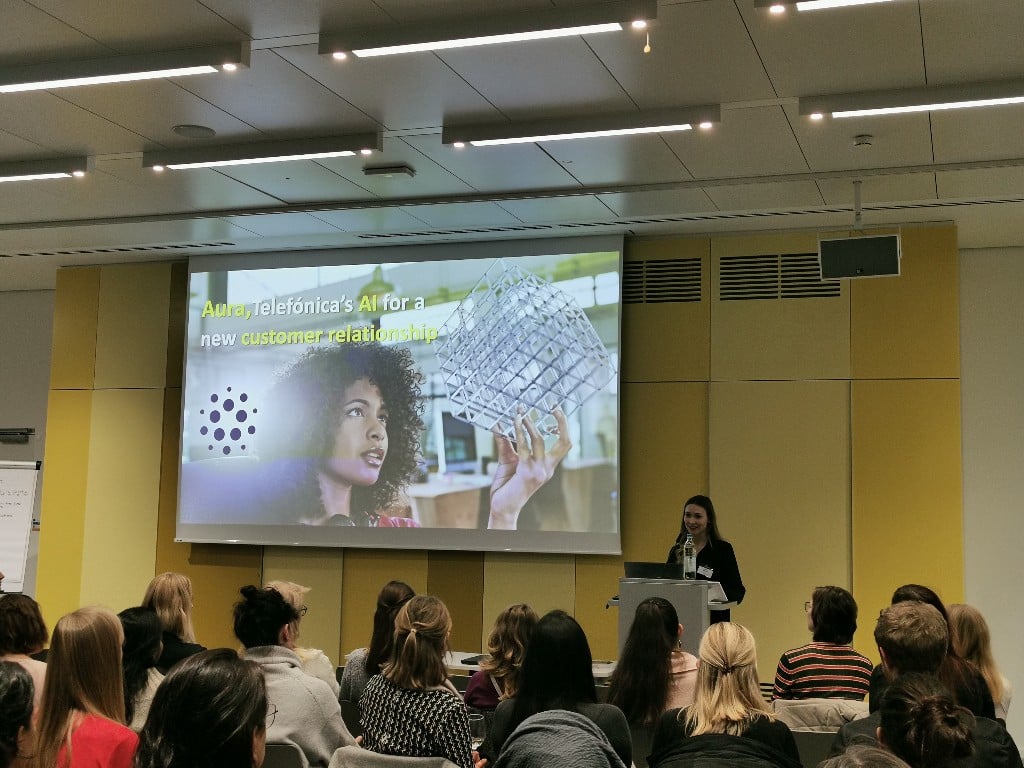
I was invited to the event “Women in AI & Data” organized by databricks and hosted by Microsoft in Munich. It seems like a trendy topic but the founder invited women not to talk about the phenome of more women in AI and data but about their achievements, current project and goals. Because women in AI is nothing new – At least at Telefónica.

So I focused on my vision to transform and digitalize the customer service and sales service for Telefónica Germany with Aura the Company’s global Artificial Intelligence. Our aim is to create a whole new customer relationship built on trust.

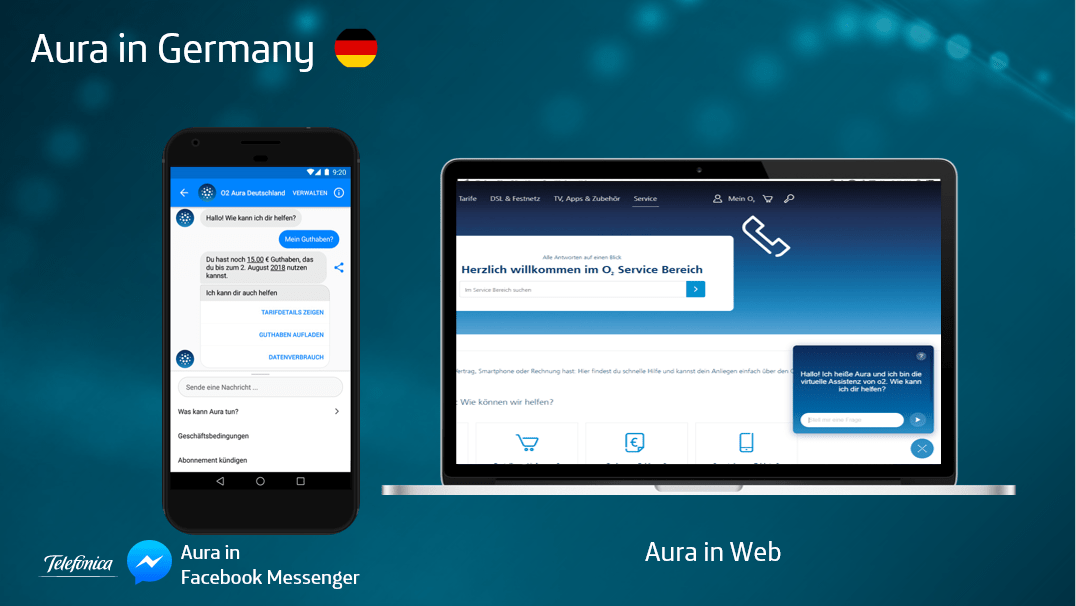
Aura is available in two channels in the Germany market already. Via the social channel Facebook Messenger and the service area of the o2 online web portal all o2 customer can address any kind of question, issue or request towards Aura. Thanks to natural language processing Aura is taught the language of humans so that our customers receive their solution without any detours.

Aura is accessible for everyone and can answer more than 350+ questions about o2 services and products. Additionally, customers receive real-time personalized information on their tariff, data volume, prepaid balance and can even solve their request of a balance to-up end to end.

In 2020 Germany will focus on the integration of Aura in WhatsApp so that we can meet our customers where they are in their private channels. On top of the accessibility, Germany is working on numerous enrich use cases that will transform data into insights to increase the benefit for each single customer.

This is all possible because of the digital transformation process to provide intelligence to the three Platforms it already had and the creation of the 4 Platform to reinforce Telefónica’s capacity to collect, store and analyse customer data.

After the talk many of the 100 attendees approached me to express their inspiration by our vision of Aura but also to exchange their thought and idea on the usage of AI.

Aura is our only customer facing intelligence and I’m proud that I was able to not only talk about the innovation that will change our whole business but also to represent all incredible women working on the project in eight countries all over the world.

If you want to know more about Aura in Germany click here.

Success Story: LUCA Transit and Highways England

AI of Things    11 December, 2019

The transport industry is very receptive to the application of Big Data and Artificial Intelligence strategies, as there are clear use cases that can maximize a companies’ efficiency and improve infrastructure planning. Read in this post about the success story of Highways England to see how this company is making the most out of its data.

Highways England is responsible for the daily operation, maintenance and improvement of the English motorways. In total, Highways England supervises more than 6900 km of roads which play a crucial role in the country’s economic performance

Thanks to advanced data analytics, Highways England has improved its efficiency and is able to generate higher quality data. Time spent collecting data has been reduced from 6 months to 7 days, resulting in a significant reduction in working hours and an annual saving of millions of pounds in data collection costs.

Highways England Transport Optimisation Project

In order to ensure the operability of it’s roads, Highways England must collect a large amount of data. Previously, this process was arduous and costly in time and money. LUCA has worked closely with Highways England to obtain data more accurately, securely and affordably using mobile network insights. Thanks to our state-of-the-art LUCA Transit technology, Highways England now has access to our anonymised database, which contains over 4 billion network events generated every day by O2 customers. This data allows us to extract valuable insights for infrastructure modeling and planning.

In the video below, Dave Sweeney, LUCA’s Commercial Manager for Public Sector and Transport in the UK, explains how the use of Big Data and Artificial Intelligence helps Highways England and other organisations in the tourism and transport sectors:

https://youtu.be/mhGgCuzruDE

To learn more about LUCA success stories, visit our webpagecontact us and follow us on TwitterLinkedIn YouTube.

Success Story: Using Big Data to improve Tourism with Iberostar

AI of Things    10 December, 2019

In today’s data story, we talk about some of the main applications of Big Data and Artificial Intelligence within the tourism sector. In this case, the hotel chain, Iberostar, has been able to solve a vital business need, to gain a complete understanding of the profile of its clients to target them effectively. This has been achieved thanks to insights provided by new data sources.

Iberostar has been able to extract vital information from the insights provided by LUCA about those who move around the company’s premises, such as their psychographic profile, place of residence and their most visited locations, all from aggregated and anonymised telco data.

Iberostar has used this information in two ways: firstly, to inform geomarketing processes to redistribute sales teams to travel agencies in areas where there was a high proximity of potential clients. Secondly by identifying customers tastes, hobbies and places of origin… of not only current customers but external audiences, Iberostar could also optimize their ecommerce processes by personalising the experience.

https://youtu.be/DYcFJ56U3cU
Oscar Luis González explains the Iberostar Project with LUCA

The experience with LUCA has been very profitable, we are very satisfied and we believe that it represents a very successful application of Big Data in the world of tourism

Óscar Luis González, Global Marketing Director at Iberostar Hotels & Resorts

With LUCA crowd analytics solutions, such as LUCA Tourism, we gain a complete understanding of the offline and online target audiences of our clients, always ensuring privacy and data security by adhering to the regulations in each country in which we work. These insights, together with those already obtained by the client on their online channels, allow the optimization of brand presence.

To keep up to date with LUCA visit our website, subscribe to LUCA Data Speaks or follow us on TwitterLinkedIn or YouTube .

Artificial Intelligence in the Industrial Sector: the success story of Repsol

AI of Things    5 December, 2019

Although technological advances have been left behind in recent years, the industrial sector presents opportunities for developpment in the field of Big Data and Artificial Intelligence, and also in terms of efficiency and new sources of income.

In this data story, we talk about Repsol, a global and integrated company in the energy sector. They have initiated a comprehensive digital transformation of the entire company as a lever for its strategic plan.

In a company like Repsol, the impact of the widespread application of Big Data and Artificial Intelligence is very important. It also has a direct impact on the income statement.

Juan José Casado, Data Analytics & AI Director de Repsol

Repsol is committed to ensuring profitable growth to lead the energy digitial transformation process. In this regard, consultancy and analytical work which LUCA carries out is particularly relevant.

In the context of digitalization, Big Data and Artificial Intelligence have permited the exploitation of thousands of data points collected over the years in their production processes. Achieved through analytical models developed by LUCA, it solved detected problems in each of the business areas.

Thanks to the results and insights extracted from the different projects Repsol’s decision making has been enriched. This makes its processes more agile and efficient, its planning tighter and its customer satisfaction higher.

In this interview, Juan José Casado, Data Analytics & AI Director of Repsol, explains the magnitude and details of this work:

https://youtu.be/Y0K8zzbfHs8
Juan José Casado talks about the company’s transformation project during LUCA Innovation Day 2018.

This project is one of many successful efforts aimed at facilitating operational excellence, optimizing resources and raw materials, improving productivity in the plant and improving the quality of the final product. Finally, increasing customer satisfaction was possible thanks to an optimal knowledge of them.

To stay up to date with LUCA, visit our Webpagecontact us and follow us on TwitterLinkedIn YouTube.

IoT arrives inside the volcanoes

Beatriz Sanz Baños    29 November, 2019

Thanks to the installation of sensors inside the crater, the information collected in real time about temperature, humidity and atmospheric pressure, can be accessed. In this way, you have almost total control of the different parameters of the volcano.

Volcanic eruptions are a phenomenon sometimes difficult to predict. Although eruptions have been reduced in recent years compared to the last century, there are many active volcanoes that pose a danger to the surrounding population.

Fortunately, solutions have been found that allow diagnosing movements that announce imminent danger. Internet of Things (IoT) has revolutionized volcanology reaching a step beyond traditional methods.

IoT gets inside the volcanoes

Due to the installation of sensors inside the crater, you can access the information collected in real time about temperature, humidity and atmospheric pressure, so that you have almost total control of the different parameters of the volcano. This is how IoT reaches the interior of the volcanoes.

Volcanic eruptions are a phenomenon sometimes difficult to predict. Although eruptions have been reduced in recent years compared to the last century, there are many active volcanoes that pose a danger to the surrounding population.

Fortunately, There are solutions that allow diagnosing movements that announce imminent danger. Internet of Things (IoT) has revolutionized volcanology reaching, a step beyond traditional methods.

Seismographs, geophysical and geochemical techniques can detect changes within the volcano and allow the measure changes in magma and flow through calorie and gas detectors. The problem is that volcanic areas are often remote and inaccessible, which entails great difficulties for communications and feeding of permanent surveillance equipment. It is necessary to design a low energy consumption system with long range communications. Technology has managed to combine these characteristics and offer efficient solutions to these phenomena thanks to the Internet of Things.

How does IoT help diagnose possible natural disasters caused by volcano eruption?

Thanks to the installation of sensors inside the crater, experts can access the information collected in real time about temperature, humidity and atmospheric pressure, so that you have almost total control of the different parameters of the volcano.

These sensors installed, encapsulated and hermetically sealed to protect them from the high temperatures that are reached, both inside and in the areas close to the volcano, which can reach around one thousand degrees, have low consumption and long-range capabilities with month-long batteries. Sensors gather information on the ground helping to anticipate the volcanic crisis.

But all this information would not help if they were not transmitted to where they can be analyzed. That’s where the different IoT networks come into play. When connected, the sensors can send the collected data to be processed.

Finally, these data are analyzed from all possible angles and thus obtain conclusions to make one decision or another.

At the moment, there is no exact formula to predict the specific moment in which a volcano will erupt, although in the last half century different highly effective systems have been developed that continue to evolve today. IoT has broken into the world of volcanology generating advances, contributing to the prediction of volcanic eruptions and avoiding major disasters.

Technology advances and with it increases the quality of life of those who have it within reach. It not only generates connections and offers the possibility of relating and expressing oneself, but also provides, through these solutions, greater security in situations that, until now, were beyond human reach. IoT is a resource at the service of humanity that makes the world a safer place.

The Big Data behind Black Friday

Olivia Brookhouse    29 November, 2019

It is often the products that seem to have “come out of nowhere” that suddenly experience rocket sales and have everyone talking. Whether its health fads such as kombucha, trainers as heavy as bricks labelled the ‘chunky trainer’ or shapewear designed to help you resemble a Kardashian, we’ve seen it all. So how do companies know what’s going to sell and how to sell it?

With large supply chains, companies must be able to prove the future demand and therefore success of a product before it goes to market, and this is where Big Data can play an increasingly bigger role in predicting consumer behaviour. This is particularly important for the biggest shopping day of the year, Black Friday.

What is Black Friday?

The first record of the phenomenon of Black Friday began in Philadelphia in the US in 1952, the day after Thanksgiving. It has since evolved into the biggest shopping day of the year worldwide. In the UK in 2018, 64% of the population bought something on Black Friday equating to 42.5 million people and in Spain, 55.7% of the population participated, totalling 26 million people. The top-selling products on Black Friday are clothes, cosmetics, jewellery, shoes and electronics. With the incentive of getting a bargain, spending on Black Friday last year was on average £315 in the UK and €210 in Spain per person. However, the UK is providing better deals; with an average discount of 63% per product compared to 47% in Spain.

Whilst Black Friday began on local highstreets, the use of brick and mortar stores has reduced significantly in recent years. On Black Friday in the UK in 2018, 64% of shoppers made purchases both offline and online, 24% just online and 12% just in shops. In Spain, 43.4% of shoppers made purchases both offline and online, 40.22% just online and 16.3% just in shops.

Brands have had to react as consumer habits have changed. Because of the internet, the 21st century consumer is less loyal to specific brands and led primarily by price. Due to the availability of information online, consumers are more equipped than ever before to compare products across 100’s of brands. Because of this, platforms such as Amazon and ASOS are able to dominate in their respective markets because their platforms are able to showcase many cheap comparable brands.

How does Big Data predict consumer trends?

Previous marketing strategies included monitoring social media or analysing surveys without the ability to store, combine or optimize these data sources together. Big Data and AI allows companies to harness data from thousands of sources that can predict future purchase habits with a high degree of accuracy.

Algorithms are applied to find patterns within the mass of data, to provide insights which inform both internal decision making and improve the customer experience. This means companies are able to harness data from years of Black Friday sales to accurately select products and discount rates which will attract the masses.

Machine learning software is built within recommender systems on websites which, based on customers previous purchases, can predit what customers will want to buy next, offering them more in-tune suggestions. Internal decision making is no longer based on innacurate surveys on small focus groups but instead on human behaviour in real time.

The old methods that were invented before the digital era are not agile, precise or predictive enough

Tim Warner: Pepsico

It is vital that large companies are able to predict the popularity and therefore profitability of new products because large supply chains restrict them from introducing new products quickly. For many, this means deciding Christmas product ranges 9 months before the holiday season has started.

Start Ups like Black Swan are disrupting the way ordinary market research is done, analysing consumer purchase behaviour on a large scale to predict consumer trends for their clients. Unlike before, social media permits the mass spread of consumer trends promoted by influencers and celebrities alike. Some of the most common trends at the moment follow big social movements such as Veganism and Sustainability and there will definitely be an increase in related products this Christmas.

Big Data for Advertising

Whilst Big Data is vital to provide insights to design product ranges, it can also inform Advertising and Sales strategy. At LUCA we help our clients, with the use of anonymised and aggregated data to optimize their decisions and save costs. LUCA Business Insights solutions help locate prime locations for shops and advertisements to target the intended audience. LUCA can also provide insights within the retail location in order to optimize merchandise and displays to attract the desired client. This is particularly important at Christmas where many stores will compete to have the best window displays so companies must be showcasing the correct products for each location. By identifying how people behave in and around the retail points, brands can optimize their offline services.

https://www.youtube.com/watch?v=e5BMTDm3ffk

To stay up to date with LUCA, visit our Webpagecontact us and follow us on TwitterLinkedIn YouTube.

The Smart mining revolution

Beatriz Sanz Baños    22 November, 2019

The integration of IoT in smart mining manages to connect its employees with their work environment, providing different benefits that reduce the percentage of accidents.

Since its inception, safety has always been one of the major concerns in mining. Although security measures have increased in the past years, they still do not seem to be enough to remove this problem that causes serious accidents.

To mitigate the risks to which workers are exposed, mining companies are incorporating Internet of Things (IoT) technology into their processes. This technology allows companies to identify and reduce possible damage to personnel that, until now, were almost inevitable. In this way, an improvement in working conditions is achieved allowing anticipation of possible incidents and increasing the safety of workers.

The integration of IoT in smart mining manages to connect its employees with their work environment, providing different benefits that reduce the percentage of accidents.

How do you get it?

Internet of Things, through the installation of various sensors, allows the collection, processing and analysis of the data so it the variables can be studied later and the worker has all the information available at any time.

Mine workers carry a wearable device that integrates sensors that detect and collect everything that happens underground as well as in open pit mines, and send it in real time to a data center. On the one hand, this system allows the tracking of each miner and work machinery, avoiding personal accidents and possible collisions between vehicles. On the other hand, it makes a prediction of possible problems, such as the collapse of a well, proactively responding to the problem.

It is essential to take special care with the air conditions inside the mine. In this way, through a system of sensors that measure air toxicity, miners can know when it is safe to return to the mine, for example, after an explosion that can produce harmful gases. In this way, not only is security improved, but time is optimized by avoiding long waits which increases production.

Companies that have used this technology have already reduced the risk of disease by 40%, equipping their employees on their drilling rigs with mobile devices that track their activity and exposure to dangerous products, ensuring that each worker has the necessary time to rest.

In the Internet of Things area of ​​Telefónica and through our IoT Activation Program, we collaborate with EnGiDi, creator of a device aimed at improving the occupational safety of workers in hazardous jobs and large infrastructures by monitoring their movements in real time. EnGiDi is able to measure the thermal stress to which the worker is exposed, the height to which he is or to warn of falls that he may suffer, with the aim of improving occupational safety. In addition, they have an alarm button to alert of risky situations.

Thanks to NB-IoT connectivity, it is possible to send the data to a digital platform for real-time visualization by the occupational risk control units, thus being able to study the behavior patterns to implement more efficient work routines from the Security point of view. All this helps to prevent mishaps and reduces reaction times and accident intervention, something that can be decisive in saving people’s lives.

By connecting each worker with their environment, Internet of Things improves security by studying the risks, incidents and potential accidents. In addition, it saves time and costs for companies, significantly improving the working conditions of people working underground and transforming occupational accidents into a problem of the past. A breakthrough to help smart mining and ultimately connect people with what really matters to them.

How Telefonica has implemented the first automatized SDN network

Rocío Muñoz Paul    22 November, 2019

Much research and case studies have been put into the latest technologies as applied to telecommunications networks for automation and operational efficiency purposes aimed at the needs of future 5G networks and service provision in the B2B sector.

What is more difficult to find are demonstrations in real environments that can verify that all the theories and tests being carried out by experts in this field can actually become a reality.

Today we would like tell you about one of these deployments which also has the added value of being the first in the world ever brought to bear.

In order to visualise the scope of this demonstration in a real environment it is first necessary to understand what SDN technology is used for.

How SDN networks work

A Software Defined Network permits the E2E control of a network in an intelligent, centralised way using software applications. SDN technology facilitates the consistent management of networks in which complex technological components coexist.

On this occasion and as we have already said, we also add complexity by using components from different suppliers (multi-vendor) which requires full integration through open standardised interfaces.

“The implementation of open standard interfaces will speed up the introduction of new applications for network automation and optimisation,” says Javier Gavilán, Director of Core, Network and Transport Platforms at Telefónica Global CTIO

Telefónica has applied this technology for the first time in the world, in a commercial network in Colombia with four different suppliers: Infinera, Nokia, Huawei and ZTE, achieving the management of a multi-domain (different suppliers) and multi-layer (Optical and IP) unified network.

World’s first implementation in Colombia

“It is the first step on the evolutionary path of the transport networks, which allows us to automate processes and consolidate a medium-term horizon and, with it, the development of more streamlined services for our customers,” says Felipe Cucalon, CTO of Telefónica Colombia.

Among the initiatives that the company is promoting in the industry there are 90 defined case studies, in which the application of SDN technologies offer notable advantages when it comes to provisioning, operating and planning an operator’s transport network.

This first commercial-based deployment has contemplated two of them, the provision of services and the visibility of the complete network topology so as to notably facilitate network planning.

The objective is to continue moving forward with other case studies such as performance management, inventory and traffic engineering optimisation, in addition to having an evolutionary model that allows us to continue progressing thanks to the incorporation of more vendors and operators interested in joining these initiatives.