The Big Data hiding behind Halloween

Olivia Brookhouse    31 October, 2019

Big Data and Artificial Intelligence are shaping the future of business with data insights, personalised content and improved user experiences and Halloween, one of the biggest consumer holidays, is no exception. The data is not only being used to inform companies on consumer habits and trends but to help generate costume ideas, design candy routes and most importantly, scare.

Halloween spending in the US peaked last year at an incredible $9 billion, with an average spend per person of around $86.79 on costumes, masks, candy, decorations and food. 30% of this spending starts in September, 40% within the first two weeks of October and the rest in the final run up to the 31st. People spend the most money on costumes, but not just for themselves, for their pets too…
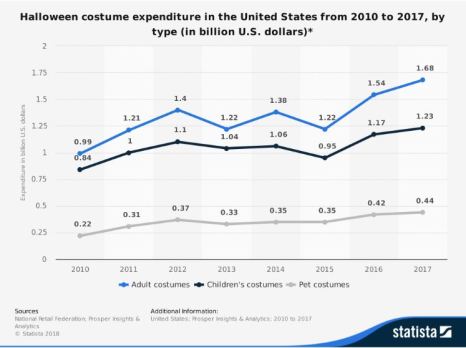
The 5 most popular costumes amongst adults last year were, Witches, Vampires, Zombies, Pirates and, Avengers. Amongst children the costumes of choice were Princesses, Superheroes, Batman, Starwars characters and Witches. Finally, owners dressed their pets as Pumpkins, Hot Dogs, Bumble Bees, Devils and Cats. One of the biggest dilemmas every halloween is what to wear and how to be original in a sea of witches and ghosts. Well AI and Big Data can stop your anxiety about what to wear with costume generators.

What should I wear?

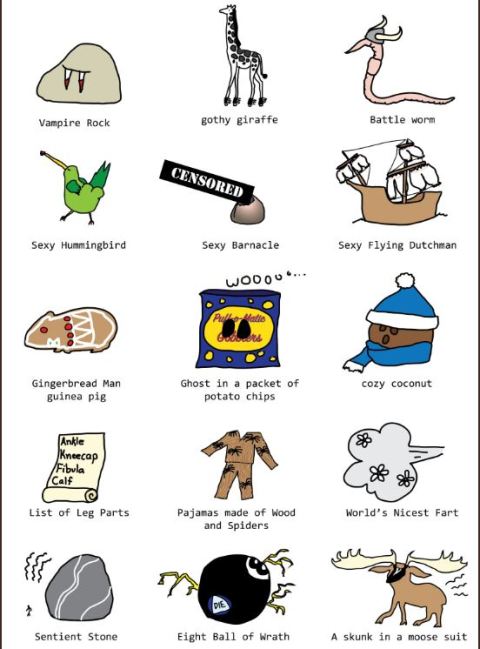
Janelle Shane, a research scientist and soon to be author shared how she used a bot to generate costume ideas. She built a unique neural network which can produce costume ideas, many of which had never been worn before. She fed the system 4,500 costume names and whilst it produced some crazy results at first, it soon learnt that a sexy lamp might not be all too sexy. Some of the most innovative ideas included a the following…
Machines that scare

Whilst personalised advertising finds the best way to capture our attention and compel us to buy a product, at Halloween the aim is to scare. A team of MIT media lab scientists designed a “hot or not” nightmare machine to create zombified versions of photographs. Each time someone rates a picture, the information helps the algorithm learn which factors in these images induce fear. The system slowly improves to ensure 100% scare rate.

The extra information in how humans perceive horror can be exploited to make even scarier faces

Pinar Yanardag, a postdoc at the MIT Media Lab.

A design agency is using AI to design scary Halloween masks. Using a general adversarial network (an algorithm implemented in machine learning systems) two systems work together, constantly improving to create the mask. Whilst one half generates Halloween masks, the other half judges how well it has performed. It continues until it produces the desired result. The Neural network was supplied with 5,000 images of Halloween mask examples on which it based its terrifying creations. Whilst each mask is based off the data it has been supplied, each result is unique. What if the system learnt to produce what each of us found the most terrifying. Do we need AI to make Halloween scarier or, is part of the fun being creative?

Trick or Treating with Data

So now we have our scary masks and unique outfits, how can Big Data perfect trick of treating. Abdul Rehman, a Data Scientist was asked by his 12-year-old son how he could get more candy than the previous year. As a Data Scientist he was keen to optimize his son’s route to ensure maximum time and sweet efficiency. From the 117 houses he visited, he collected his own data which he later complemented with public data. He was able to create a database with information on:

  • Demographic of house members; name, age and political affiliation
  • Gender of children in house
  • Rent and socioeconomic status

There was a strong correlation between age and generosity:

  • Wife aged 41 – 50 and Husband aged 51 – 60 = 100% candy rate.
  • Wife > 51 = 25% candy rate.
  • Either couple > 71 = Very low candy rate
  • Parents with young children = High candy rate. (On average they spend $10-30 more on sweets than those without children)
Abdul Rehman

There was no strong correlation between rent or birth location and their generosity, proving that purse strings do not govern the holiday spirit. Newcomers to the area were very generous so make sure you visit them to get the most sweets.

The data also provided insight into the type of sweets given away by each household. The houses with girls were likely to give away Hershey, Twix and Dove whereas houses with boys offered KitKats, Snickers and M&M’s. From the information he was able to design a route which favoured the sweets that his son like, avoiding those which he doesn’t.

Abdul Rehman

To stay up to date with LUCA, visit our Webpagecontact us and follow us on TwitterLinkedIn YouTube.

EasyDoH Update Hot off the Press: New Improvements and Functionalities

Innovation and Laboratory Area in ElevenPaths    28 October, 2019

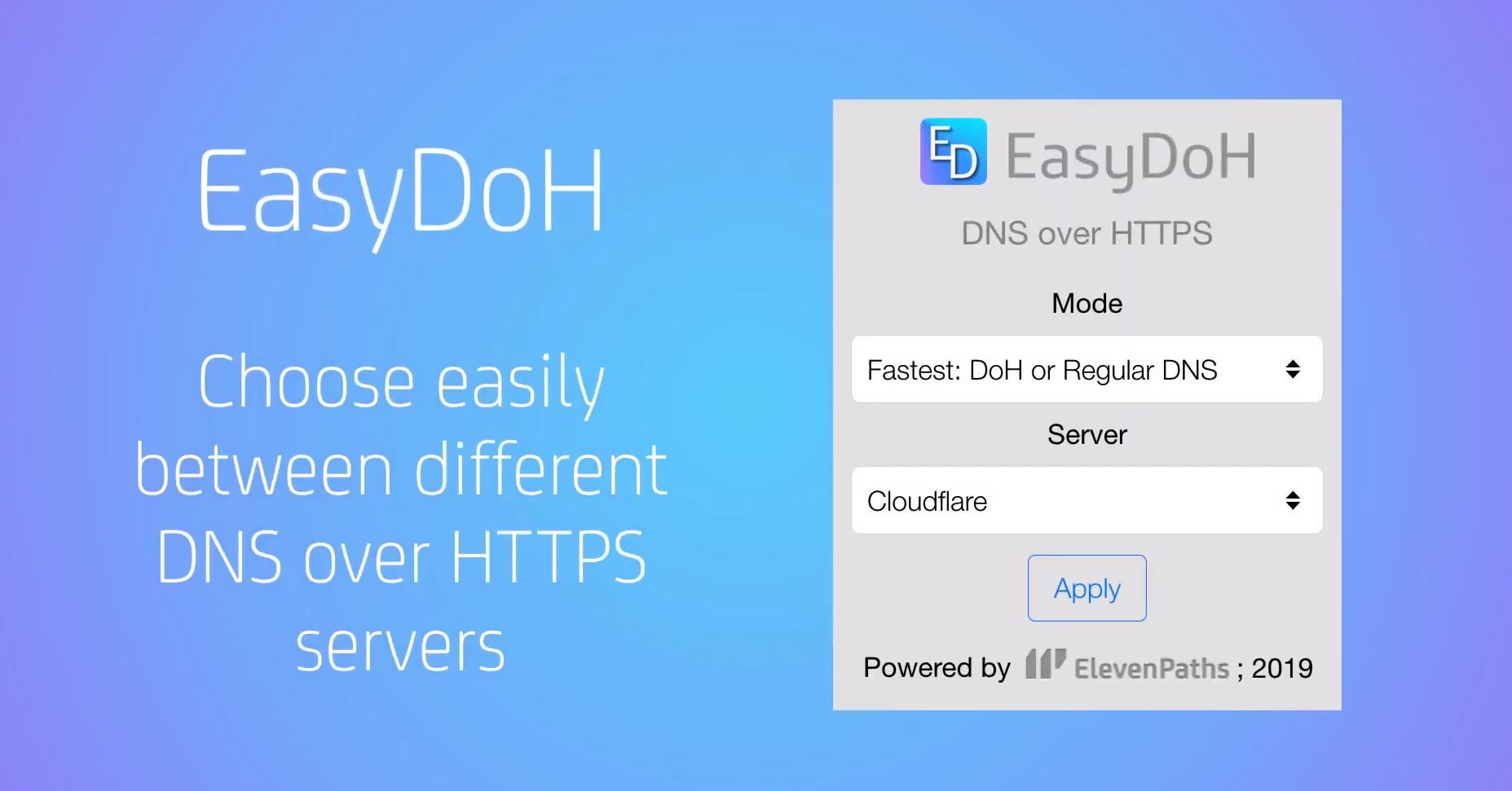
Just a few weeks ago, we launched EasyDoH: an extension for Firefox that simplifies the use of DNS over HTTPS. We have been asked about its improvements and several have expressed their interest in its features. To address these ideas, we have improved the program so that it may be used more conveniently.

About EasyDoH

This extension is quite simple. EasyDoH is a Firefox extension that allows you to easily choose between different DNS over HTTPS servers. Currently, Firefox works with Cloudflare as its default DoH server, and allows to modify it by using some confusing configuration parameters. EasyDoH makes this configuration simpler and shows more alternatives to using different DoHs depending on your needs.

Some of the parameters are hidden within about:config menu. Thanks to EasyDoH, such parameters are just one click away. You can choose to use only DoH, the fastest server between DoH or regular DNS, etc.

One last thing: just a script file is needed. Since Firefox extensions do not allow file modification, we need a little script to achieve this and change DoH’s internal configuration. No worries, source code is here.

Improvements

Essentially, we have undertaken three improvements:

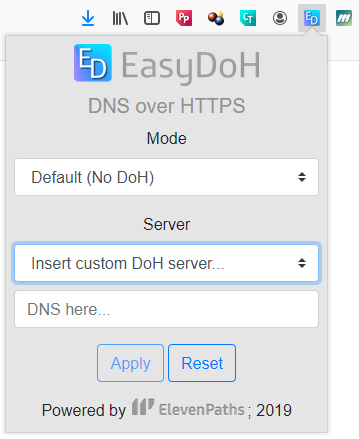
  • Now you can add a server manually. It is no longer a closed list. You have an input field where entering the URL of your favorite DoH server. Firefox will be configured with such server and you may change it whenever you wish.
  • The previous version (although the DoH server was configured with other server) always showed the configuration ‘by default’ offered by Firefox with Cloudflare. It is no longer the case, now the configured server is showed.
  • The list of DoH servers available is now loaded from a dynamic list on GitHub. This will make it easier to update the servers as they appear.
  • Fixed uninstaller.

Thanks for using EasyDoH. We hope you will find it useful. It may be downloaded it from https://easydoh.e-paths.com

The heart of the airports pumps with IoT

Beatriz Sanz Baños    25 October, 2019

The total number of travellers in air transport increases each year in a remarkable way, giving rise to an expanding panorama of trips, comings and goings, and visits to hidden places. Thanks to technological progress distances are getting shorter and shorter and we are able to travel more kilometres in less time. Airplanes are the fastest transport today – they allow us to move from one continent in the same time as a bus trip to a nearby city – but they have not yet achieved the convenience and speed that travellers have on land.

At Telefónica, we believe in the enormous potential that technology can offer people and society. Technology must improve our lives by uniting people with the things that really matter to them. To this end, the Internet of Things is contributing to improve the user experience at airports, to increase operational efficiency, and generate new revenue.

The great advance with the smart airport is in the integration of the different parts of the airport ecosystem through the development of digital solutions, energy and acoustic sustainability, and excellence in the quality of passenger service.

AENA (Spanish Airports and Air Navigation) has established in its 2018-2021 Strategic Plan the project to move towards smart airports (Smart Airport) based on the following axes:

1. IMPROVED USER EXPERIENCE

IoT at airports is primarily consumer oriented. It tries to streamline processes and simplify protocols to achieve a better user experience. How? By accelerating the entry and boarding procedures, offering personalized information in real time to travellers or establishing shorter and faster routes for users within the terminals.

The Dulles International Airport in Dallas was the first to implement the veriScanen system at its entrance doors. The program performed a biometric analysis of the passengers’ faces, and then collated the information collected by the cameras with the passport photograph, or the images collected in customs control in the case of foreign passengers. This system has been implemented in many airports recently and it has already replaced the traditional system with a success rate of 99% accuracy in its detection. In addition, it reduces the boarding time of passengers by half and offers a bonus for security as it is capable of detecting false passports.

2. EFFICIENCY INCREASE

The application of the Internet of Things in airports can also mean an increase in operational efficiency, facilitating the organization of personnel and maintenance of machinery, and consequently improving performance and cost savings in technical maintenance. It is applicable, for example, to the maintenance of carts and the monitoring of baggage systems by installing sensors that provide data like their location and performance levels, and then send them to a central server from where they can be managed. It will not take long to get on-track automation processes so that autonomous vehicles will deliver the luggage, clean the waste or carry out the refuelling.

The application of IoT technology in areas with lot of traffic of large quantities of people, such as airports, is increasing. Improving the user experience and respect for the environment have become the primary objectives of the Internet of Things, which will help to achieve with its digital solutions and process optimization. 

The highlights of LUCA Innovation Day 2019. What did you miss?

AI of Things    23 October, 2019

The third edition of LUCA Innovation Day took place on Wednesday the 16th of October, in which we presented the advances developed over the last year by the data unit and showcased the new lines of activity provided by Telefónica in its B2B offer, supported by the new technologies of Big Data and Artificial Intelligence.

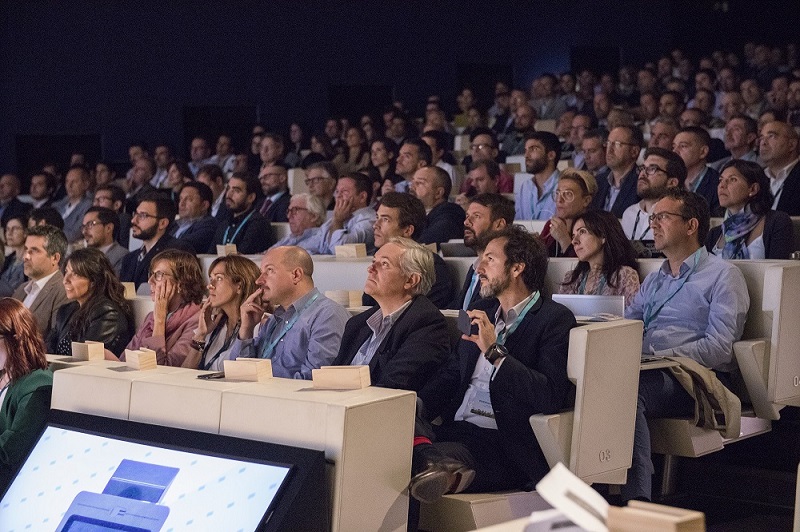
Under the theme “Artificial is Natural”, the Telefónica Auditorium opened its doors last Wednesday at 15:30 to welcome more than 450 attendees. They were shown how the difference between the natural and the artificial loses importance when they share the same purpose: to facilitate people’s lives

For the third consecutive year we were able to completely fill every seat in our main Auditorium, as well as the auditorium in the Demos Centre, set up specially for the occasion. In addition to our streaming broadcast, for the first time we retransmitted the event on our internal platform, where 7,500 employees followed the event from anywhere in the world.

PHOTO 1: Full capacity at LUCA Innovation Day 2019 with more than 450 attendees.
PHOTO 1: Full capactity at LUCA Innovation Day 2019 with more than 450 attendees

Adrián García Nevado, Adrián García Nevado, Director of Major Clients and Central Territory, Telefónica España, was in charge of opening the event, highlighting how the future of companies and organizations is closely linked to how they are capable of facing their digital transformation.

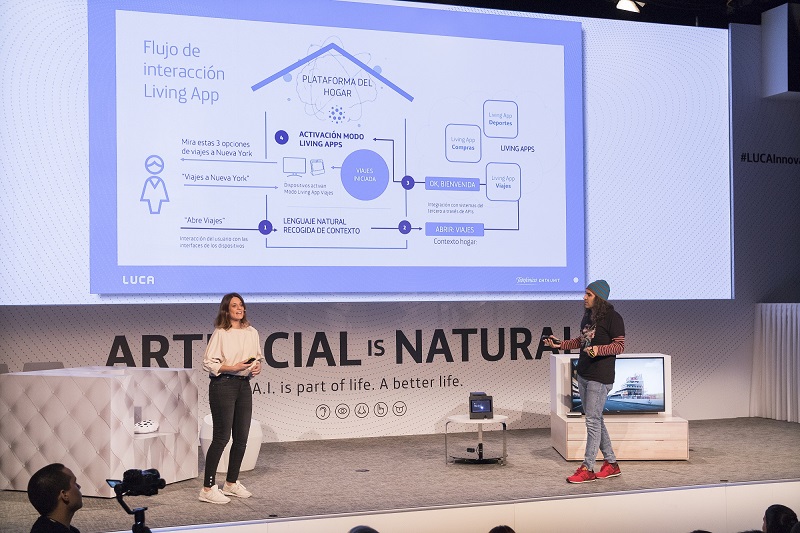
During the first part of the event, Telefónica’s CDO, Chema Alonso presented one of the group’s new stakes: Movistar Living Apps, which will help companies transform digitally by offering services in the home. With the collaboration of Telefónica’s CDO Service Designer, Ana Molina, they explained to us how the platform works and how it makes it possible for our partners to offer unique and differential experiences in order to bring greater value to their customers.

“The use of Artificial Intelligence has allowed us to transform ourselves as a company. Now we want to help businesses build their own Artificial Intelligence”

Chema Alonso

In this way, users will be able to enjoy all kinds of services related to travel, sports or online shopping from the ecosystem of their home, thus facilitating their digital life.

PHOTO 2: Chema Alonso and Ana Molina during their presentation of Movistar Living Apps.
PHOTO 2: Chema Alonso and Ana Molina during their presentation of Movistar Living Apps

After their presentation, our CEO, Elena Gil, took to the floor to give us an overview of what we have achieved over the years: more than 620 projects for more than 340 clients within more than 14 different sectors across 18 countries around the world.

In addition, she told us how LUCA makes Artificial Intelligence accessible to all companies, adapting to any client, regardless of their line of activity or sector. To atest to this, we invited Antonio Ortiz Jaén, Corporate Digital Manager of Mahou San Miguel, a leading company in beer production in Spain, who gave us his testimony of how our collaboration, based on Artificial Intelligence has helped them to develop a decision-making strategy that allows them to meet their objectives.

Artificial intelligence is becoming more and more natural in our daily lives and what we want is for it to become more natural in companies as well.

Elena Gil, CEO of LUCA  

Another new solution presented by our CEO Elena Gil, was the AI Wizard, a tool to improve the conversion of marketing campaigns. It consists of a bot that complements campaigns and through which companies can provide more information and direct customers to complete the purchase process.

To round up this first half, Mikel Coira, Global Head of Big Data Solutions at LUCA, introduced us to the new way of doing Machine Learning, LUCA Suite, which reinvents the way of working with data.”It arose from the need to overcome one of LUCA’s biggest challenges, to grow at the same rate as projects were growing… and from the difficulty of communicating the results of Machine Learning to the client,” says Mikel.

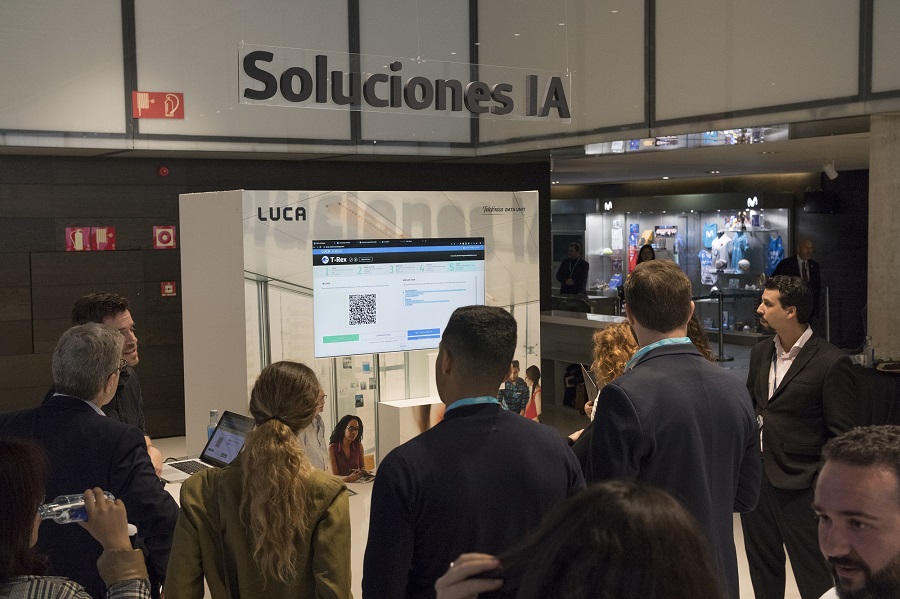
The interval followed, where attendees could enjoy a variety of stands according to different sectors. In them, our product experts explained the new solutions we are developing and allowed the customer to experience the new technology.

PHOTO 3: During the coffee, attendees were able to experience new technologies

The second part of the event started with our Global Director of Big Data, Carlos Martínez and the Director of Companies of Telefónica Spain, Marisa Urquía. They wanted to highlight how, at LUCA, we help to extract the value from the data by developing companies’ service offerings and thus accelerating the digital transformation process of their corporate clients.

They wanted to complement their claims with testimonials from several clients such as Iberostar Hotels & Resort or intu, in addition to the participation of Angel Martin, Deputy Director of Energy Management at UFD Distribución de Electricidad of the Grupo Naturgy who shared with us how LUCA is helping them in their digital transformation process.

https://youtu.be/NYfdB4JYrPs

Who likes sports? With this question began the last presentation of the day with Pedro Alarcón, our Head of Big Data for Social Good and Sports Analytics at LUCA. He wanted to tell us about LUCA’s involvement in Sport Analytics projects with large teams, generating insights that optimize the effort and performance of athletes. To do this, he was fortunate to have Miguel Ortega, Director of Operations and Business Development of Movistar Estudiantes and Jorge Sanz, Director of the Movistar Team women’s team. No pudo faltar el testimonio de la jugadora de Bádminton Carolina Marín: “… performance controls, data analysis and the support from my team and Telefonica benefits me greatly, so I want to thank you all for your support…”.

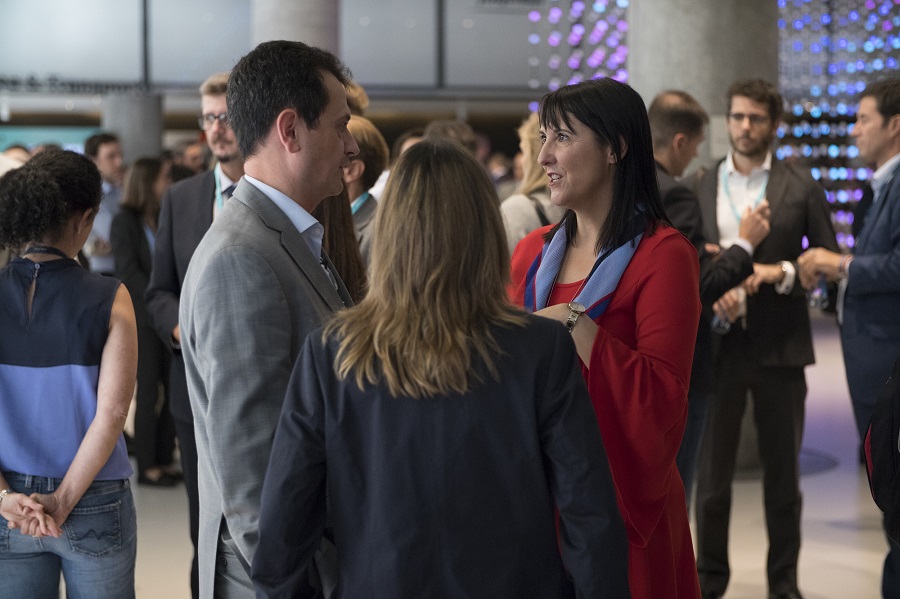
To finish on a good note, the attendees enjoyed a cocktail in the demo area where they could also continue experimenting with new technologies, learn more about the speakers and even share their experiences of the event and more.

PHOTO 4: Our CEO Elena Gil, conversing with the attendees during the cocktail

We ended yet another year at LID where Artificial Intelligence becomes part of the corporate strategy in the digital transformation of companies. Thank you for joining us in this process!

To keep up to date with LUCA visit our website, subscribe to LUCA Data Speaks or follow us on TwitterLinkedIn or YouTube .

Google report 17% of Microsoft vulnerabilities. Microsoft and Qihoo, 10%

Innovation and Laboratory Area in ElevenPaths    22 October, 2019

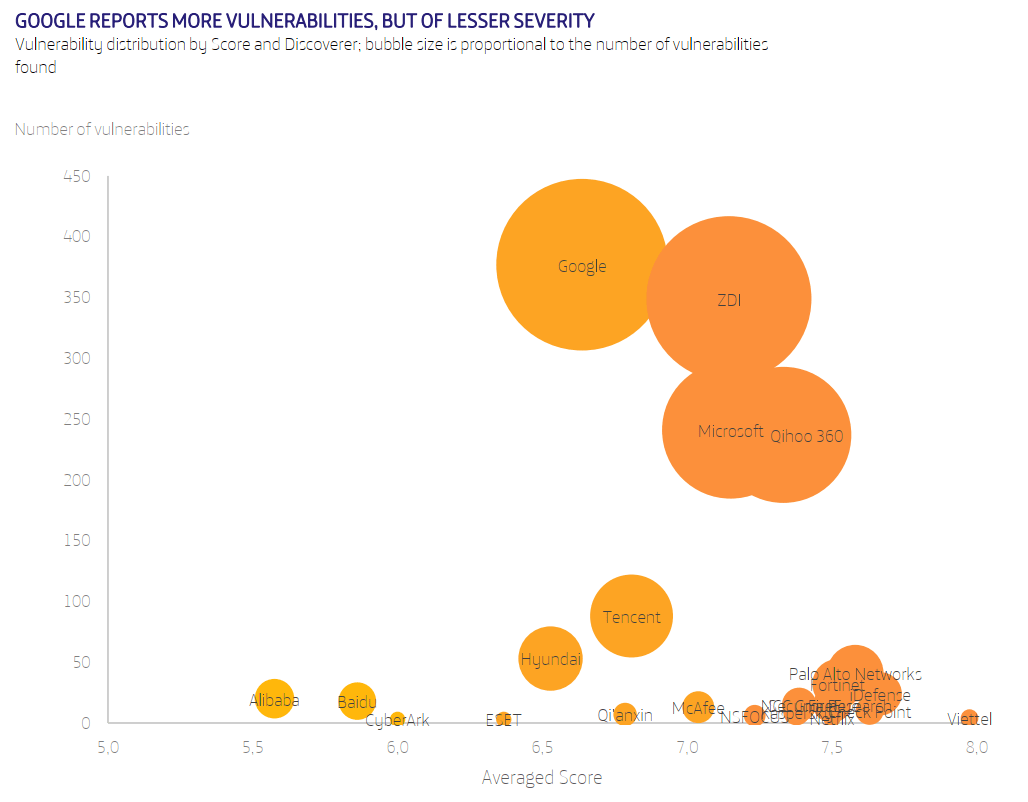
Who finds more vulnerabilities in Microsoft products? What percentage of vulnerabilities are discovered by Microsoft, other companies or vulnerability brokers? How many flaws have unknown discoverers? Over this report we have analyzed the data of the last three and a half years with the aim of understanding who fixes what in the world of Microsoft products as well as the severity of these flaws. Thanks to this report we will gain an interesting insight into who really investigates Microsoft products, reports them in a responsible manner, as well as how many vulnerabilities are attributed to someone and how many are not (which might suggest that they are discovered by attackers).

Over this report we will address the doubts as to how many flaws Microsoft detect in their own code, how severe they are, the trend they follow and how many flaws are found by third parties either through recognition programs or their own means.

We have performed a very simple analysis. We have collected and processed all the information of attributed CVEs from March 2016 to September 2019. The source of information has been mainly the following webpage:

These are the attributed vulnerabilities (that is, the ones reported by a given identifiable user, either individual or company). In 2019 (until September), we have analyzed 621 attributed vulnerabilities. 607 in 2018, 593 in 2017 and 310 in 2016 (only since April). This represents a total of 2,131 vulnerabilities analyzed. From all of them, we have extracted their severity through the NIST’s official CVSS.

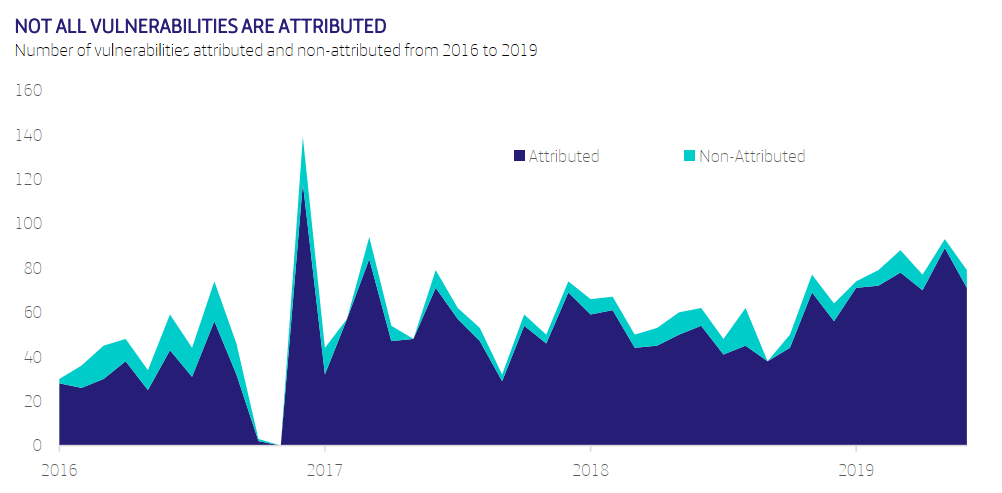
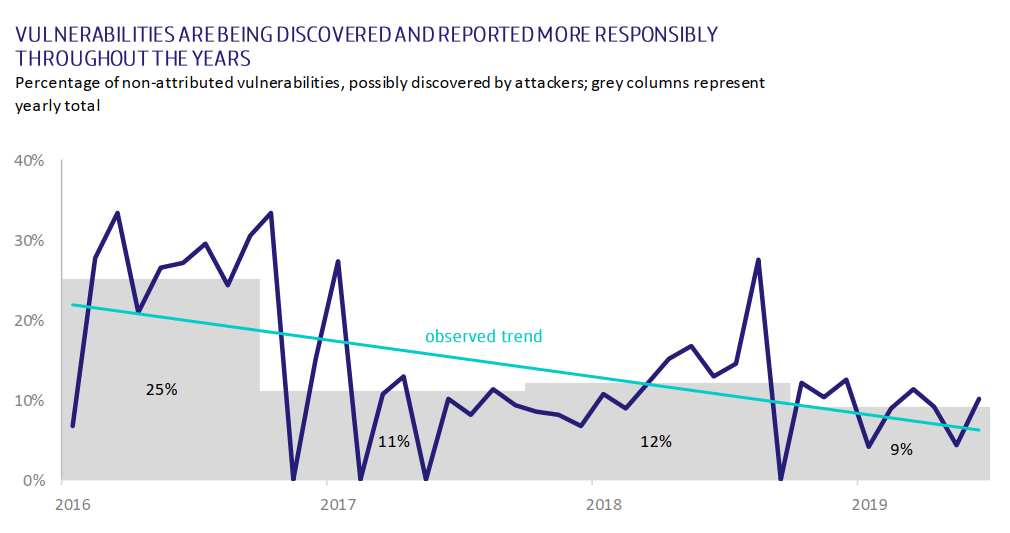
Nevertheless, these figures do not represent the total number of flaws discovered every month or year. Actually, we have also considered those flaws that were not directly attributed. We understand that most of these flaws may come from vulnerabilities found in 0-days or under other circumstances where the author is not known (and the vulnerability has not been reported anonymously). In such cases, Microsoft do not attribute the finding to anyone in particular. This difference between attributed and ‘non- attributed’ vulnerabilities (which is not the same as ‘anonymous’) is represented in the following chart.

Executive Summary

  • Google report over 17% of the vulnerabilities found in Microsoft products. Around 25% of the flaws are reported by the category ‘other’, that includes small companies that do not usually report, or freelance analysts.
  • The third position is for Microsoft, since they detect more than 10% of their own flaws. They are followed very closely by the Chinese Qihoo 360, which nevertheless find more severe vulnerabilities than Microsoft.
  • NCSC, iDefense and Check Point often report vulnerabilities with a severity over 5. In general, almost half of them are granted a severity degree of 8.
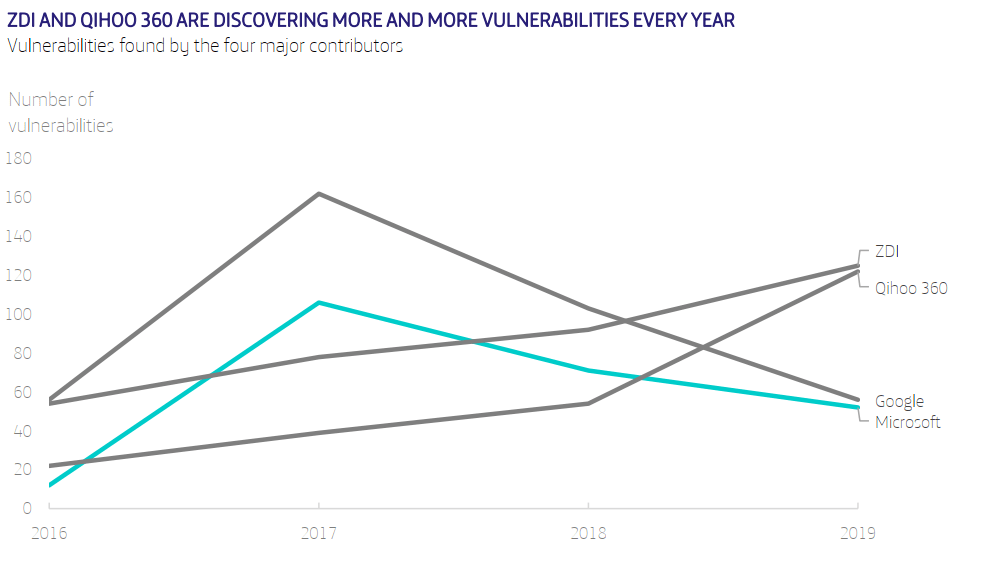
  • In 2017 and 2018, Google led the number of vulnerabilities fixed in Microsoft products. Since 2016, the flaws found by Microsoft have been on the increase. However, during 2019 Qihoo 360 and ZDI have found a great number of vulnerabilities.
  • Only 2% of attributes vulnerabilities are of maximum severity.
  • In 2016, 25% of vulnerabilities were not attributed to anyone in particular. In 2019 (until September), only 9% of the vulnerabilities did not have a specific author. This may suggest that the number of flaws responsibly reported might have improved.

We may conclude that most of the vulnerabilities found in Microsoft (most of them with a severity of 8) are discovered by four main actors: Google, Qihoo, ZDI (that include independent researchers) and Microsoft. Over the last years the roles have changed, since Google and Microsoft have handed the first positions over to ZDI and Qihoo. It must be also noted the significant drop of non-attributed vulnerabilities (which are found and reported in a non-responsible manner). From 25% in 2016 to 9% in 2019, which means a better vulnerability management ⸺indeed via platforms as ZDI, where researchers are rewarded and encouraged to report vulnerabilities in a responsible way.

Movistar Living Apps, a new technological experience in the home

Óscar Mancebo    22 October, 2019

The fact that Artificial Intelligence is revolutionising and transforming the telecommunications sector is nothing new. Users, accustomed to dealing with virtual assistants and chatbots, increasingly rely on digital transformation.

Anticipating the needs that this transformation would require, a few years ago Telefónica began a digital transformation process to provide intelligence to the three platforms it already had. Building on the provided capabilities, the 4th platform (Cognitive Power) was created to reinforce Telefónica’s ability to collect, store, analyse and understand customer data in real time, and give our customers personalised experiences.

Once this fundamental aspect was guaranteed, another objective was tackled: to humanize technology. It was with this idea in mind that Aura, Telefónica’s Artificial Intelligence, was born. Our customers were the first to test it, using voice and natural language to facilitate their interaction with the Company’s services. Today, Aura is successfully implemented in eight countries with more than four million active users per month.

It’s time for companies to take a step towards AI

Following these trends and this learning experience, and as the main supplier of technology in Spanish homes, Telefónica wants to offer key partners, such as Air Europa and Atlético de Madrid the opportunity to be present in their customers’ homes through Movistar Living Apps.

This is what Chema Alonso explained within the framework of the LUCA Innovation Day held on 16 October. An event in which the importance of the digital transformation of companies in terms of offering services in the home was highlighted.

Chema Alonso, Telefónica’s Chief Data Officer: “With the transformation promoted within Telefónica regarding the use of Artificial Intelligence, we can share our knowledge with our clients, helping them to build their own Artificial Intelligence and create experiences on our other strategic pillar: the home”.

This at-home platform provides our partners with capabilities that make it possible for them to reinvent the user experience in accessing digital services at home, and do the things they need to do in a new way from the comfort of the living room. These apps, available in November, are not downloaded, but rather they are on the TV and can be accessed remotely (remote enabled) and through Movistar Home (voice enabled). Users will be able to enjoy services related to travel, sports, or online shopping.

https://youtu.be/sAQL3DSgDBk

These unique experiences have also been integrated into Movistar services to make the Company’s customer’s digital lives easier.

Far from wanting to see it as an extra channel, the technological partners who have already opted for Movistar Living Apps have dedicated their efforts to offering unique and differential experiences in order to provide greater value to their clients. Movistar Living Apps makes it possible for these partners to be integrated into the ecosystem of the home, and to leverage all the devices, services, and resources we have at home to facilitate those decisions where they occur.

The future of #ArtificialIntelligence is already here. Shall we build a new relevant experience using voice?

Find your next destination with Air Europa

One of the companies that has committed itself to this ecosystem is the Spanish tourism giant Globalia through its airline: Air Europa. In this regard, Air Europa’s value proposition consists in offering different flight options in order to inspire and facilitate travel searches for its clients. Through Aura you can enjoy the experience of choosing a destination in a totally different way.

For Jose Carlos Díaz Lacaci, Group Director of Transformation, “joining the Movistar Living Apps project is a further step towards improving the customer experience, which we consider to be key to the transformation process in which we are immersed. Specifically, we offer Air Europa’s nearly 12 million customers the possibility of booking their flights or selecting their seats by voice, in a simple manner, and without leaving their sofa at home. In addition, the application of artificial intelligence will allow us to customise the customer’s trip according to their preferences and in real time.

Live the passion of the stadium with Atlético de Madrid

Simply by saying “OK Aura, open Atlético de Madrid” the user will be able to access exclusive Atlético de Madrid content: the analysis of the most recent match according to its featured players, the key facts of the next match, the most spectacular videos of the players, and interviews with team members.

René Abril Martín, Atlético de Madrid’s Director of Technology and Digital Development: “We have a spectacular atmosphere during games in our stadium. That’s what we want to bring to every home through the Aura Artificial Intelligence. This project is part of the relationship of trust that we have with Telefónica as a global technological partner”.

These cases of Air Europa and Atlético de Madrid are just two examples of what the Movistar Living Apps will offer us. You can find more information on the Aura website if you also want to develop your own.

Artificial Intelligence, doing more than humanly possible since the Greeks

Olivia Brookhouse    18 October, 2019

Many of those working in the world of Artificial Intelligence acknowledge the 1950’s as the birth of concepts such as Machine Intelligence and Artificial Intelligence with the creation of the ‘Turing Test’ by Alan Turing. In a previous blog post we talk about the importance of these early developments to the progress of machine learning technologies now. Whilst these years mark the start of AI as we know it today, ideas about creating artificial life were imaginable long before technology was even invented.

Throughout history new developments have been vilified for “going too far” and adding unnecessary complications to our lives. However, in many writings from ancient times, we can see that humans have always dreamed of pushing the limits of nature, from what is humanly and biologically possible. Maybe it’s within our nature to surpass it.

Ancient examples

Ideas of artificial life feature in many ancient texts from Ancient China, Hinduism and Ancient Greece. Dr Adrienne Mayor, a Historian of Science, has studied many examples of how ancient civilisations envisaged the concept of technology. The etymology of Biotechnology is the word Biotecnin from Ancient Greece. It means to be made by craft and not formed naturally. They imagined, even in a pre-industrial society, the idea of human like technology. To bend the rules of nature long before it was possible.

The Odyssey is a 12,000-line poem spanning years of Ancient Greek history, myth and legend, written in the 8th century BCE. The author was, in theory, a blind man Homer, although nobody knows if he was real or legendary. Although the stories have altered and changed over time many elements still stand out, envisaging how to imitate, augment and surpass nature.

Some examples include ships guided by “thought alone”, presenting an ancient vision of driverless cars.  Hephaestus, the working god makes automatic gates, self-moving carts, eagle like drones, crews of golden servants who had reason, mind and strength beyond humans. They possessed all the divine knowledge of the gods, imitating a large data system.

You can find similar stories of autonomous vehicles and artificial life in Hindu myths.

No single civilisation had a monopoly on ancient dreams of advanced technology. Whether one looks at Greek, Etruscan, Egyptian, Hindu, Islamic, Chinese, or any other ancient culture. Myths about artificial life all contemplate what wonders are possible if only one could possess the divine creativity and abilities of the gods.

A research scholar at Stanford University, Adrienne Mayor

Can bots write Greek Plays?

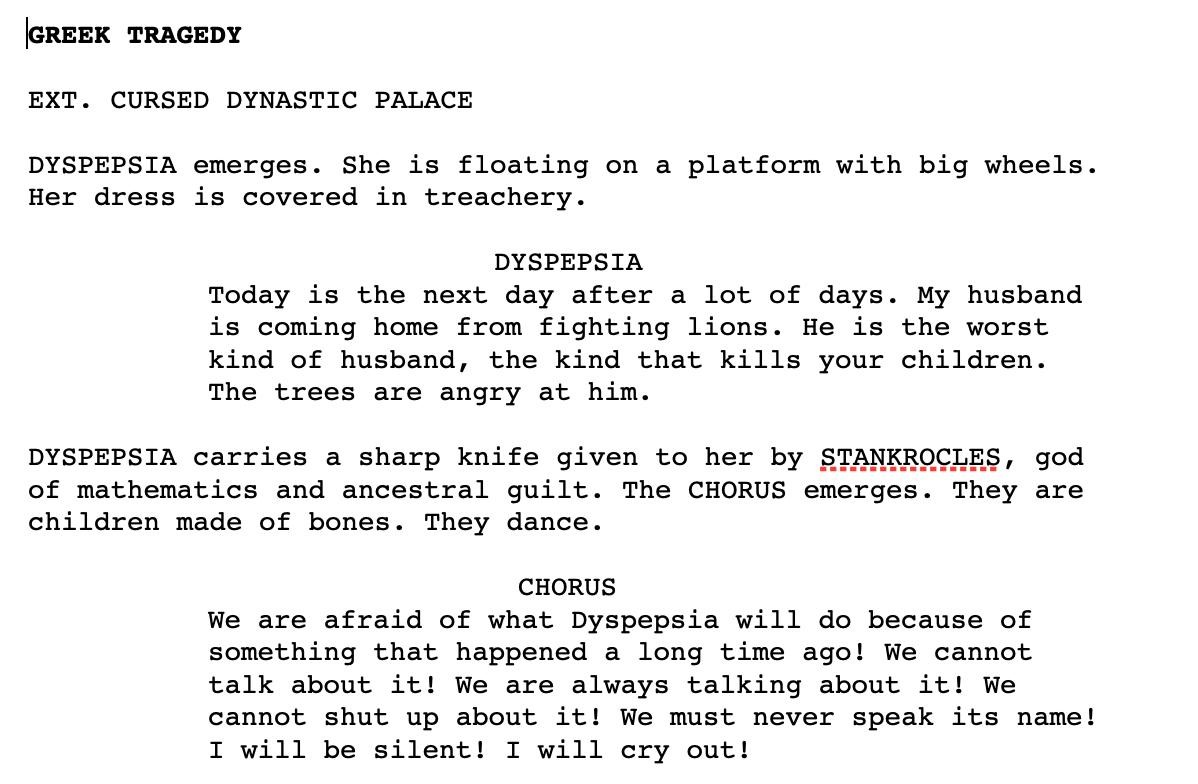
Whilst the Greeks dreamed of replicating AI, AI is yet to perfectly replicate Ancient Greek culture. Spencer A.Klaven tweeted a 2 page play his AI system created after supplying data from 1,000 hours of Greek tragedies. It produced an amusing result.

@spencerKlavan on Twitter

Whilst this bot was less successful, other companies are employing the use of AI to write creative content. Using natural language generation, AI systems can replicate writing styles to produce poetry, social media posts or even financial reports. The technology was used to create an almost award winning novel, The Day a Computer Writes a Novel.  Scarily accurate are bots at replicating content that it is often unnoticeable who or what has written it. This Website allows you to guess whether a human or bot has written a poem.

To stay up to date with LUCA, visit our Webpage, subscribe to LUCA Data speaks. Follow us on TwitterLinkedIn YouTube.

IoT and everything under control

Beatriz Sanz Baños    18 October, 2019

With the advent of Iot technology, big companies of hardware (components) and software (programs) have had to develop and adapt new products for these devices.

The components become loT

How far has the Internet of Things influenced the creation or adaptation of these solutions? For example, Samsung. The Korean smartphone corporation not only manufactures mobiles; it has also started to develop its components in order to rely less on external brands.

Months ago, the company introduced his new processor model, Exynos iT100, specially designed for devices connected by Internet of Things. The processor has ability to work at extreme temperatures, from -40 degrees to 125, a lot of gadgets loT installs outdoors just occur with security cameras or irrigation sensors. It also integrates processor and memory in a chip. Thus, saving of space to be integrated into reduced mechanisms.

Qualcomm, the popular Snapdragon chip producer for mobile, also offers hardware ease Iot connections. Their big bet is mobile connectivity, which apply in many cases of use, including vehicles and drones. Iot mobile uses the same infrastructure and connects to the same public network as our mobile phone, without having to deploy a private network for Iot devices. In this area, the C-V2X (Cellular Vehicle to Everything), will be the future of connectivity for the autonomous car and will increase safety, as we saw in Telefonica’s project to prevent road accidents. Thanks to this equipment, vehicles communicate with each other and with everything around them, improving road safety and prediction.

Software to control them all?

The elements connected to the Internet of Things also need an operating system from which their performance can be monitored and managed. This gives engineers and developers the chance to access a platform that allows them to put the ideas into practice and make the most of them.

Surely you sound like Mozilla is the browser Firebox, an option chosen by many users before Google Chrome broke into the market. After two years of research and development, the company launched the WebThings Gateawaysoftware.

Through a simple interface, Webthings acts as an universal system from which you can organize access and control of various Iot devices without the need to use specific applications from the provider. So, instead of installing a mobile app for each, you use this unified interface. It detects existing Iot devices in your network and voilà!

Windows 10 Iot Core is the best of giant Microsoft to enter the world of connected things. This operating system is not a version of the Windows desktop that we can find on the computer, but an interface made by developers for developers.

Users who install this system have the benefits of Windows in terms of experience and connectivity in the brand’s cloud. It can be installed on smaller devices, even without a display, and provides information on connection, update and protection of devices. They have recently added to their catalogue the IoT Core Services version, the model of payment by subscription in the cloud with updates for 10 years and evaluations of the device state of health. 

However, according to the Iot Developer Survey 2019, the most common used operating system on IoT devices is FreeRTOS. It´s a real-time operating system very simple to use and with free license. It provides a unique and independent solution that adapts to different architectures. In addition, it facilitates the programming, connection and administration of connected devices.

Simple a matter of time before the most prominent brands of components and systems joined the Iot revolution and to helped put into operation the connection of elements that, a few years ago, we couldn’t imagine they could be connected to the Internet. Therefore, they have one more piece of the gear to reach the connected world.

Artificial Intelligence in small and medium-sized enterprises

Richard Benjamins    15 October, 2019

We hear of increasingly more applications of Artificial Intelligence ranging from improved medical diagnosis to autonomous vehicles to automatic translation to voice recognition. But when we look at the companies behind the development or use of those applications, we mostly see large companies, and a few technological start-ups. Most AI applications are currently developed or used by GAFAM[1], BAT[2] or the top 50 of national large enterprises listed on the international or national stock exchange. Think about the best facial recognition programs that are currently provided as a service by Amazon, Google and Microsoft. Most of those services are used by large organizations, both private and public. But what about the use of advanced AI technology for small and medium enterprises (SMEs), representing often the large majority of the economy, at least in terms of employees?

AI in Spanish SMEs

In this post, I describe AI in Spanish SMEs, dealing with questions such as:

  • Are SMEs aware of AI?
  • Do they know what it is useful for?
  • Are they aware of the risks?
  • Do they have access to the right skills?
  • What about usage in different sectors?

I have the honour to teach an AI class to more than 250 Spanish SMEs in the context of the DigitalXBorder program, an ambitious program to help SMEs in their digital transformation with participation of experts from Google, eBay, Amazon, Telefonica, Salesforce, Microsoft, etc, etc. AI is one of the around 25 topics of the course. The course takes place in more than 25 cities in Spain with about 30 SMEs participating in each city over the course of three years.

The AI course consists of a bit of history and definitions of AI along with emblematic examples (General Problem Solver, ELIZA, the Turing Test), enterprise AI examples, ethical challenges, and what this all means or can mean for SMEs, who usually have less data, less budget and little access to the right skills. The course ends with practical examples of Machine Learning as a Service, allowing any SME to do Machine Learning on their own data sets within minutes or hours. If you are interested in the full course, here you can access its four videos (in Spanish).

At the start of the program, I designed a simple questionnaire to get a better understanding of the state of play of AI in SMEs. Now that the first year of the course is over, I analyse the initial findings covering 7 cities and more than 50 SMEs. This is of course a small sample, so the interpretation is more qualitative than quantitative.

Questionnaire results

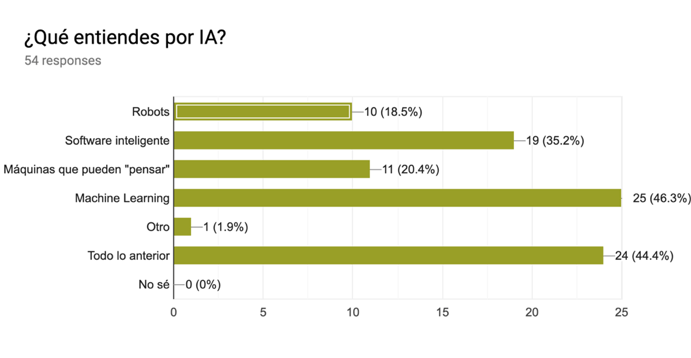
Following are some of the results. Except for one, all SMEs have heard of AI. Asked about what SMEs do understand by AI, the answers are not surprising. Machine Learning and intelligent software are at the top, followed by “thinking machines” and robots. A significant part also considers that AI can refer to all of the above (see Figure 1).

Figure 1 What do SMEs understand by Artificial Intelligence? Robots, Intelligent software, Thinking machines, Machine Learning, Other, All of the above, Don’t know.

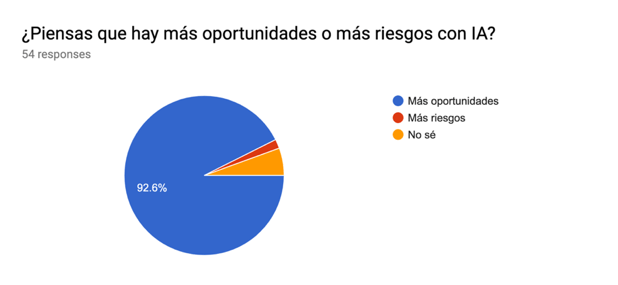
About 80% of the participants know about some AI use cases. And 75% is aware of the risks associated with this technology (bias, undesired discrimination, explainability, future of work). The large majority, however, believes that the opportunities significantly outweigh the risks (Figure 2).

Figure 2 Do you consider there are more opportunities or risks related to AI? More opportunities, more risks, don’t know.

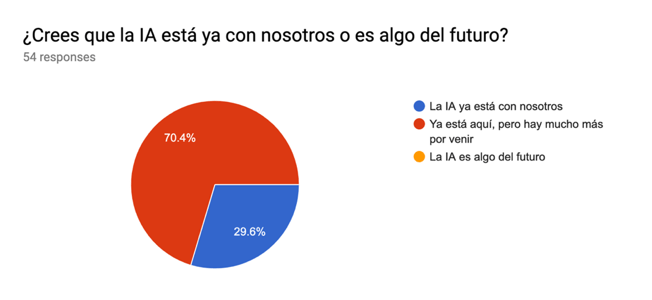
Most SMEs think that AI is already here, but that much more is to come. No one thinks that AI is only something of the future (Figure 3).

Figure 3 Do you think AI is already here, or is something of the future? AI is already here, AI is here but much more to come, AI is for the future.

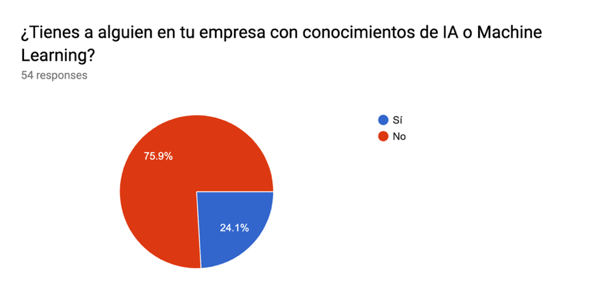
However, the main challenges that SMEs face is to have access to the required technical skills such as data engineering, analytics and machine learning. More than 75% of the SMEs do not have access to the right knowledge (Figure 4). Obviously, that hinders the uptake of AI.

Figure 4 Do you have someone in your company with knowledge of AI or Machine Learning? Yes, No.

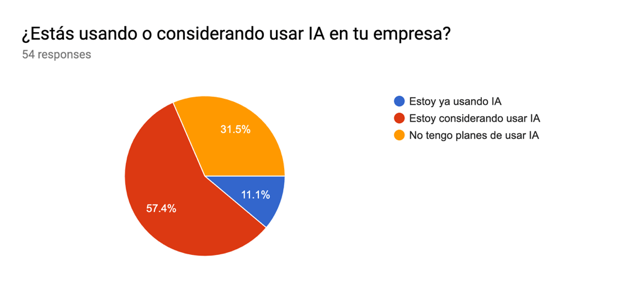
Asking whether SMEs are actually using AI, about 30% state that they are. Almost 60% has plans to use it, and only a bit more than 10% has currently no plans to use it (Figure 5).

Figure 5 Are you using or considering using AI? I am using AI, I am considering using AI, I have no plans to use AI.

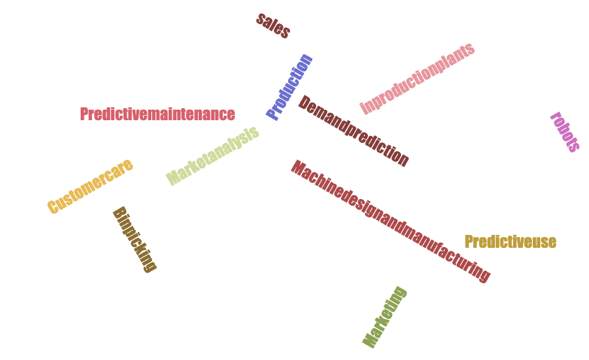
When asked what problems they solve or plan to solve with AI applications, usual applications were reported like improving sales, market understanding, predictive maintenance, machine design, etc.

Figure 6 Implemented and planned AI use cases in Spanish SMEs.

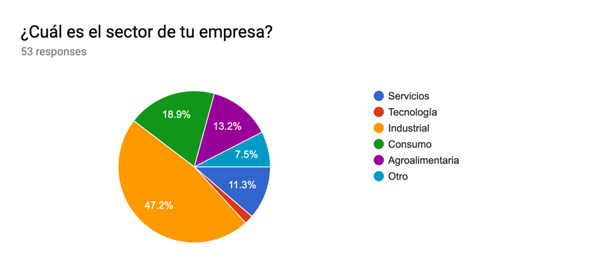
Given the large variety of sectors where SMEs are active, a broad categorization has been used including services, technology, industry, consumer, food & agriculture, but almost 50% is from the industrial sector.

Figure 7: To what sector does your SME belong? Services, Technology, Industry, Consumer, Food & Agriculture, Other.

Conclusions

In summary, we can see that there is high awareness of Artificial Intelligence in SMEs in Spain; several uses cases are known; and over 70% are implementing AI or planning to do so. But we also learned that the main challenge is to have access to the required AI skills such as Machine Learning, or even simpler “analytics” skills.  This does not mean, however, that SMEs cannot start using AI. There are increasingly more tools available that offer Machine Learning as a Service through intuitive graphical interfaces, allowing non-data scientist to apply, evaluate and execute Machine Learning models directly on excels with data from the SMEs.

As with many new technologies, first applications are pioneered by innovative early adopter enterprises. But when solutions are becoming more mature and automated, they come within reach of smaller organizations. This is the “normal” democratization process of new technology, and it will be no different with AI, which is reaching increasingly more SMEs.

If you prefer to read this post in Spanish, you can find it here:

https://empresas.blogthinkbig.com/la-inteligencia-artificial-en-pequenas-y-medianas-empresas/
Spanish version

To keep up to date with LUCA visit our website, subscribe to LUCA Data Speaks or follow us on TwitterLinkedIn or YouTube .


[1] Google, Amazon, Facebook, Apple, Microsoft

[2] Baidu, Alibaba, Tencent

Leave a Comment on Artificial Intelligence in small and medium-sized enterprises

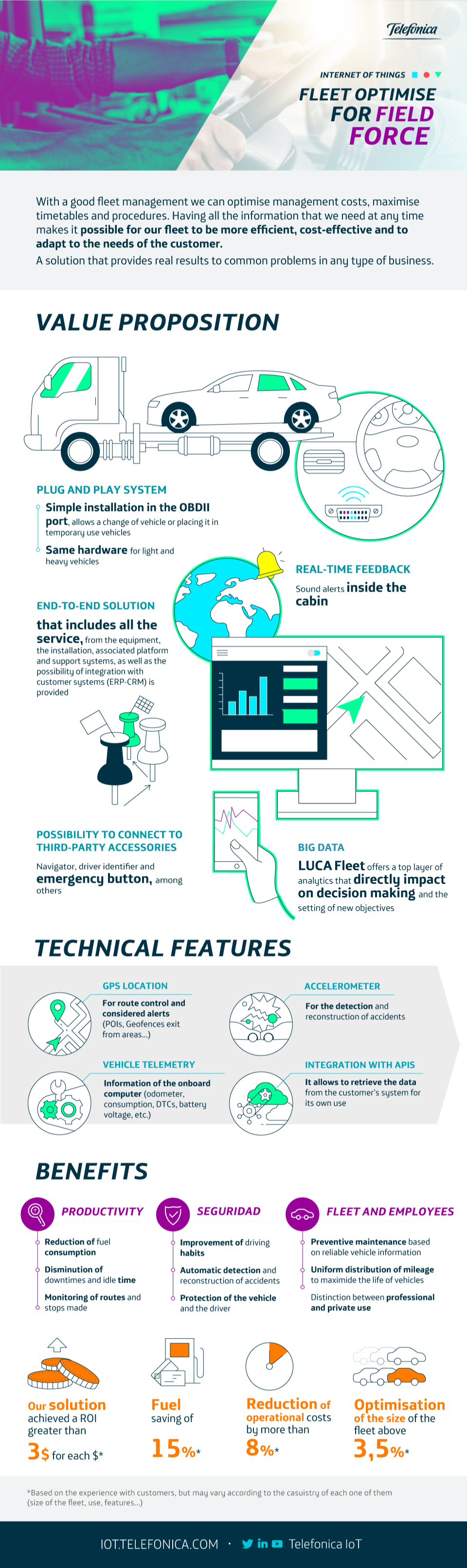
Fleet Optimize for Field Force

Beatriz Sanz Baños    11 October, 2019

Smart driving has become a priority for users and companies that want to go further. Can you imagine increasing the profitability and safety of your fleet of vehicles by simply installing a smart device? That is now possible thanks to Fleet Optimize, Telefónica’s B2B service for fleet management.