New Global DDoS Threat Report

ElevenPaths    3 February, 2020

Globally, Distributed Denial of Service (DDoS) attacks have become more prevalent, powerful and sophisticated. Attackers continue to see great success from using DDoS attacks as a major attack vector to achieve their objectives.

It is estimated that approximately 7.7 million new devices are added to the Internet everyday of which, a significant number of devices are either deficient or even non-existent with any preferred levels of security. These devices end up being controlled by cybercriminals who in turn weaponize them in order to unleash cyberattacks in an unprecedented order of magnitude.

Telecom service providers play a significant role in delivering availability and performance on your networks, by protecting your Internet traffic from impending DDoS attacks. They have deployed capacity and capability to deliver proactive mitigation and protection against DDoS attacks. With data from this report, local expertise, services and partnerships, businesses are still able to protect themselves and reduce the risk of having online business disruptions.

The alliance of large communications companies from various regions that form the TSA (Telco Security Alliance), together with partners like Netscout, bring comprehensive and reliable information that helps us all to understand the DDoS landscape. We share this knowledge to raise awareness and at the same time help businesses and institutions to deal with this type of threat. The sophisticated attack methods that are being reported by TSA SOC (Security Operation Centers) teams, along with growing regional geopolitical issues predict a challenging 2020 for us all.

The Global DDoS Threat Report 2019 provides detailed expert analysis of the global DDoS threat landscape and provides factual data on monitored global and regional attacks seen by Netscout’s Advanced Threat Level Analysis System.


ElevenPaths recognized by Check Point Software Technologies as a CloudGuard Specialized Partner

Pablo Alarcón Padellano    3 February, 2020

Organizations are used to dealing with cybersecurity incidents on their own networks, but new risks and threats aimed at the public cloud mean that organizations need to take steps to bake in security from the onset. They don’t have full access to security data, as this is controlled by the cloud provider, and existing security teams need new skills and tools. Moreover, business leaders should challenge their teams on whether they are prepared and capable to manage and respond to security attacks in the cloud.

To help our customers overcome these challenges, ElevenPaths, Telefonica Cyber security Unit, has developed a portfolio of Cloud Security Services, both Professional Services and MSS. We have launched ElevenPaths Cloud MSS, which includes Check Point’s CloudGuard Dome9 as a managed service for offerings that require a comprehensive software platform for public cloud security and compliance orchestration. And today we are proud to announce that we have been recognized by our Strategic Partner Check Point as a CloudGuard Specialized Partner.

This CloudGuard Partner Specialization recognition is based on our solid knowledge and technical certified skills necessary to support, install, deploy, or manage Check Point’s CloudGuard solutions within our Customers security environment, thus becoming the first CloudGuard Partner Specialist in Spain.

This year, misconfiguring cloud environments was one of the main causes for a vast number of data theft incidents experienced by organizations worldwide, according to recent Check Point’s 2020 Cyber Security Report, which describes the key security and related trends that Check Point expect to see during 2020. The magnitude of cloud attacks and breaches has continued to grow in 2019. As organizations increase their security awareness, the threat actors adopt more advanced ways to exploit cloud-based assets.

Moreover, according to Check Point’s 2019 Cloud Security Report, which describes among other things the leading operational cloud security headaches, 67% of security teams still complained about lack of visibility into their cloud infrastructure, security, and compliance, and setting consistent security policies across cloud and on premise environments and a lack of qualified security staff tie for third place (31% each). And precisely lack of experience and qualified security staff (26%) was one of the biggest barriers to wider public cloud adoption cited by respondents.

If you are looking for an expert managed security service provider (MSS/MDR), (i) with strategic collaborations with Amazon Web Services (AWS), Microsoft Azure, and Google; (ii) with  the expertise and operational maturity on cloud-native services and security features; and (iii) with certified specialization on Check Point’s CloudGuard solution to support your secure digital transformation, our ElevenPaths’ cloud security team is well prepared, certified and skilled to help you achieve and maintain regulatory compliance and improve your security posture. Our Cloud MSS powered by CloudGuard Dome9 enables visibility, control, integration, incident response, and various tiers of support that most IT teams fail to provide, and we already have joint references in highly demanding sectors such as banking. Together we are stronger.

Apple introduces up to 14 signatures in XProtect given the malware flood for Mac

Sergio de los Santos    3 February, 2020

Shlayer malware is on one out of ten Mac computers. And it has been like that for two years. It is malware that mainly attacks the advertising system. Given this overwhelming statement (10% of infected operating systems and a campaign that has been going on for two years now) we considered one question: what is the operating system doing to defend itself? We are aware that XProtect, the built-in anti-malware software, detects poorly and badly. But how has it responded to an epidemic of such dimensions?

Shlayer Trojan

We won’t well on its functioning because already provides all the details. It is interesting to know that it usually pretends to be a Flash update that downloads an encrypted file. This, once decrypted, downloads the real Trojan with curl.

This image has an empty alt attribute; its file name is sl1.png

Code from the image will deobfuscate a file that will end up doing something like this:

This image has an empty alt attribute; its file name is sl2.png

This in turn will lead to the installation of the most aggressive adware. This simple behavior has given users more than a headache for two years now. By the way, that curl -F0L is their “trademark”, because they are not usual curl parameters.

What is XProtect

XProtect is a basic signature-based malware detection system that was introduced in September 2009. It constitutes a first approach to an antivirus integrated into MacOS. Currently, XProtect has some more signatures that may be clearly found (malware name and detection pattern) in this path:

/System/Library/CoreServices/XProtect.bundle/Contents/Resources/

XProtect contains signatures on the one hand, and Yara rules on the other hand (it is defined by XProtect.plist and Xprotect.yara on that directory), and with both systems malware is detected and defined. GateKeeper is supported by both; it monitors and sends it to them. The list XProtect.plist is public. Number 3 from the URL refers to Mountain Lion. When 2 is modified, Lion signature file may be viewed, and 1 corresponds to Snow Leopard. Apple does not seem keen to talk too much about it. Let’s go forward with the initial question.

Another complementary script to the most popular malware for Mac

Has Apple taken the matter into their own hands?

Yes, but only recently, when they introduced several Yara rules to detect these signatures (which in principle are a mystery and no details are offered about the rules). For example, on January 22nd the following 4 rules were introduced: MACOS.8283b86, MACOS.b264ff6, MACOS.f3edc61 and MACOS.60a3d68.

A few days before, on January 7th, 3 additional signatures or Yara rules were introduced: MACOS_5af1486, MACOS_03b5cbe and MACOS_ce3281e.

And in December, 7 more were introduced: MACOS_9bdf6ec, MACOS_e79dc35, MACOS_d92d83c, MACOS.0e62876, MACOS.de444f2, MACOS.b70290c and MACOS.22d71e9.

This results in a total of 14 signatures in two months. Considering that in 10 years they accumulate a little more than 100 signatures, it may be concluded that they have worked hard in the last months. It is not usual to have so many signatures in such a short space of time, so yes, it seems that they are lately worried about malware on Mac. Now we ask ourselves another question:

Are these rules effective?

With these Yara rules of XProtect we have performed a retrohunting in VirusTotal to see since when malware of this type exists. This is an investigation that involves searching back in time for files that meet certain Yara rules. VirusTotal will give back as many samples that meet these rules and will give us an idea of ​​how many have appeared over time.

Over 1,000 samples were found in less than three months. The interesting point is that there are samples since well before December 2019 (when they began to introduce detection rules in XProtect). This suggests that in some way these protection rules added by Mac during these months are late.

Exploring the results of the retrohunt, we located samples that were not hunted by antiviruses. In principle, we thought that these were false positives, but a subsequent analysis showed that they are rules for detecting browser plugins and specific adware, such as: WharkikeEngineFilesContentBenefitsForwardOpen-extension… This leads us to an interesting conclusion: XProtect detects adware (search engines mainly) not detected by any antivirus. However, it seems that some false positives have crept into (we believe that the mdworker_share module is sometimes detected as a false positive).

Again as a curiosity, a thousand samples in about 70 days gives us an average of almost 15 samples uploaded to VirusTotal per day. Most samples are detected because they are the decryption script showed in the image above. This is an early stage of the attack, which may be positive.

Conclusions

Indeed, it seems that XProtect (in a totally opaque way) has moved up a gear and in a few days has created more detection rules than ever. These rules are hunting a lot of malware at their earliest stage, and even do a better job than antiviruses.

Nevertheless, we have a big “but”. The rules are late and, in addition, open to the attacker. They will be tempted to go unnoticed just by looking at what XProtect detects and modifying when necessary. This doesn’t mean they are bad, but easily bypassable.

For example, if we analyze some of the strings on which they rely to detect malware, we see how it does it:

This image has an empty alt attribute; its file name is sl4.png
Example of one of the 14 Yara rules introduced

Whose strings may be translated into this:

This image has an empty alt attribute; its file name is xp12.jpg

They in turn are commands usually used by malware, and by simply modifying one byte the rules could be bypassed.

Autonomous Vehicles: when will they be a reality?

Olivia Brookhouse    31 January, 2020

It seems like we’ve been waiting years for autonomous vehicles, with big corporations promising “next year” every year. In 1925 Francis Houdina paraded the first radio-controlled car around the streets of Manhattan as if by magic. 95 years on, how close are we to driverless vehicles?

The advancement in the technology has been profound from where we started to where we find ourselves now. Truly autonomous vehicles do not currently exist, and the closest prototypes are only permitted on the roads as test vehicles which are required to have a human present, just in case. However, the number of companies dedicated to producing the first fully autonomous vehicles and investment in innovation means the technology is evolving every single day.

Levels of Automation

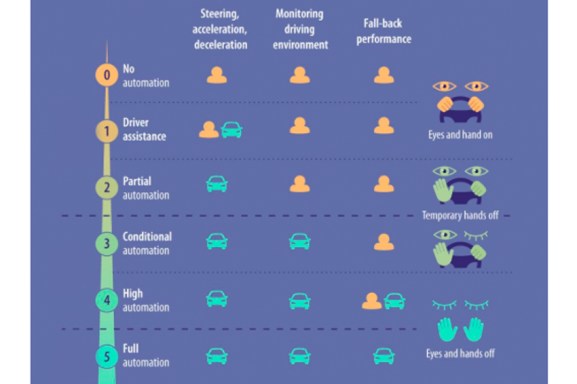
It is important to clarify the different stages of automation which can explain where we are with the technology. Experts believe we are currently between level 2 and 3 of automation and full automation, where we can completely hand over control, is decades away. In many cars, we can hand over control for basic manoeuvres such as steering, acceleration, deceleration and parking. This allows passengers to have their hands off the wheel only temporarily.

Autonomous vehicles stages
Source: EU News

Level 3 vehicles are semi-autonomous. Tesla released its semi-autonomous vehicles on the road in 2015, but the emphasis should be on the word semi rather than autonomous. The auto-pilot feature of its electric vehicles helps with semi-autonomous driving which will monitor the cars surroundings, help the vehicle stay in its lane, warn about potential hazards and automatically apply the brakes if needed. However, the cruise control function still requires the driver to remain alert just in case. The hype generated around autonomous cars leads many to believe the technology is more advanced than it is which can be dangerous.

There must be NO ‘mode confusion’, where the driver thinks the car is in control and the car thinks the driver is in control

Robert Broström, Volvo’s senior technical leader

The path to level 5 automation

Companies are generally following 2 approaches to reach level 5 automation. Some, such as Ford and General motors with their partnership with Cruise are building a self-driving car from the ground up, whereas others are developing the brains that could drive any vehicle. Google’s Waymo was one of the first companies, back in 2009, to start developing this software and its vehicles are in use on it’s closed campus’ and in testing conditions on the road.

When many companies declared 2020 as their golden year for releasing autonomous vehicles at the start of the previous decade, they did not realise the extent of the challenges they would face over the following years, mainly concerning perception and prediction systems which pose problems for safety and liability.

Perception and prediction

Developing proficient perception and prediction software is vital to ensure that the vehicle can monitor its own driving environment and has also been one of the biggest hurdles for companies.

Tesla this year acquired a specific object identification AI start-up called Deep Scale to help improve its perception system. However, identifying the obstacles correctly is only half the task, predicting how they might interact with the vehicle is another.

  • 3 dimensional maps highlight important information about the road including traffic lights, signs, road markings, pavements, camber, crossings and other features
  • Possible hazards and objects will also be highlighted such as pedestrians, cyclists, other vehicles, road work. Waymo cars can see up to 300 metres away
  • The software then predicts the movements of each object based on its current trajectory and speed, recognizing how different objects move.
  • The system will then adjust the cars movement, speed and direction to ensure a safe journey

The software must encounter every situation imaginable in order to learn how to ensure the safety of its passengers. Whilst some companies are spending hours testing cars on the roads and in controlled campuses, others are simulating real life driving situations within the cloud. Without accurate systems, many will not feel comfortable putting their safety into the hands of autonomous vehicles.

The question of safety

90% of road accidents are caused by human error. Tesla have highlighted the need for autonomous vehicles to reduce this driver error, even saying that it is “irresponsible” to not have them out on the road. However failures of prediction and perception systems have then led to accidents.

“You’re probably safer in a self-driving car than with a 16-year-old, or a 90-year-old. But you’re probably significantly safer with an alert, experienced, middle-aged driver than in a self-driving car”

Researcher in autonomous technoology, Brandon Schoettle

But remaining alert on very long journeys can be a difficulty. Autonomous vehicles would dramatically reduce crashes where drivers :

  • Become distracted by another passenger
  • Start using their mobile phone
  • Are intoxicated, incapable of operating vehicle
  • Are not paying attention

Despite the number of crashes every year caused by human error, crashes caused by autonomous vehicles are given more publicicity. This generates bad public opinion, despite the thousands of incidents that were probably avoided because of semi-autonomous systems. Just one crash raises major questions on safety and liability.

Who is responsible for a fatality caused by an autonomous vehicle?

Future applications

The world has a long way to go before it trusts the technology and can over the wheel to the machine. Governments and Automotive companies will have to work in harmony to make autonomous vehicles a reality by the end of the decade.

In 2020 we can expect to see a big increase in testing hours to improve perception and prediction systems. The first examples of autonomous vehicles will disrupt the logistics market as a means to improve delivery services. Lyft and Uber have already announced that they expect to see autonomous fleets of vehicles incorporated into their services by the end of the year. However, autonomous vehicles for individual consumers may be a long way away.

The next decade promises exciting things for the development of AI, in all industries and in every part of our lives. Follow us on Twitter to make sure you don’t miss anything our series of #LUCAtothefuture. Read about the ethical issues which accompany the development of many of these technologies.

To stay up to date with LUCA, visit our Webpage, subscribe to LUCA Data Speaks and follow us on TwitterLinkedIn YouTube.

#CyberSecurityReport19H2: Qihoo is the company that most collaborates in the reporting of vulnerabilities in Microsoft products

ElevenPaths    28 January, 2020

Currently, there are a number of reports addressing trends and summaries on security. However, at ElevenPaths we want to make a difference. Our Innovation and Labs team has just launched another release of our own cybersecurity report, summarizing the most significant information from the second half of 2019. The report’s philosophy is providing a global, targeted and useful vision on the most relevant data and facts on cybersecurity. It is addressed to cybersecurity professionals and enthusiasts, in a simple and visually-appealing format.

Given all the above, this report aims to summarize latest information on cybersecurity (ranging from security on mobile phones to cyber risk, from the most relevant news to the most technical ones and the most common vulnerabilities), while covering most aspects of the field, in order to help the readers to understand the risks of the current outlook.

The information here presented is mostly based on the collection and synthesis of internal data that have been contrasted with public information from sources considered to be of quality. Let’s examine below some points that we consider important.

#CyberSecurityReport19H2: some data

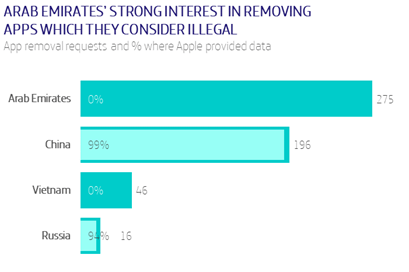
After analyzing Apple’s transparency data, we may conclude that some governments request “too often” access to data, but also argue that justice may work in a more agile manner in these countries, or that fraud is based more on these locations. Interpretation is free. What does seem clear are some conclusions based on these data. For instance, the interest of the Arab Emirates in removing applications that they consider illegal, even if no removal request has been granted. Moreover, it is curious that Australia, Germany, the US and South Korea are the countries that request the most personal data.

Arab Emirates interest in removing apps

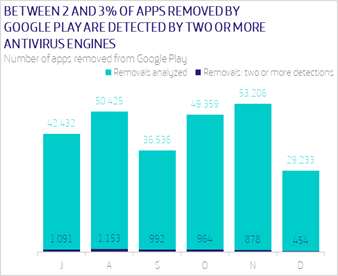
Between 2% and 3% of the apps removed by Google Play are for malware

Over this period, Google Play has removed around 250,000 apps from the market. Every month, between 2% and 3% of them are detected by two or more OPSWAT Metadefender antivirus engines.

apps removed by google play

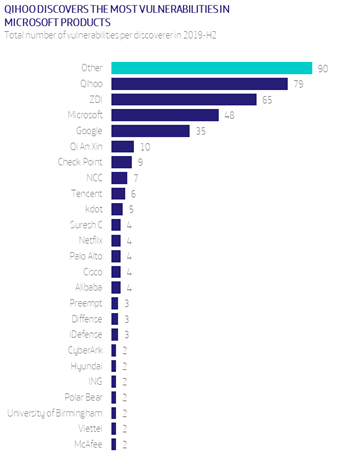
Qihoo is undoubtedly the company that most collaborates in the reporting of vulnerabilities in Microsoft products: they report over 20% of the flaws

Around 23% of the flaws found in Microsoft products are reported by the category ‘other’, which includes small companies that do not usually report, or freelance analysts. The third position is for Microsoft, since they detect more than 12% of their own flaws. Google finds 9% of the flaws.

qihoo discovers the most vulnerabilities in microsoft products

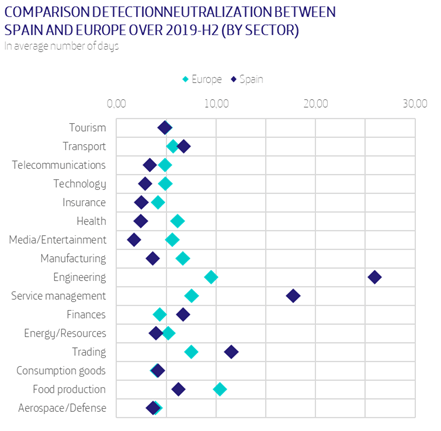
The engineering sector, lagging behind Europe in general

According to BitSight, the European engineering sector need about 9 days on average to neutralize a threat, while in Spain they need about 25.

comparison detection neutralization between spain and europe

More conclusions

During this second half of the year, 198 CVEs for iOS have been patched. 13 were critical and 6 of them allow arbitrary code execution.

A total of 463 vulnerabilities for Android have been published. 15 of them with a base CVSS score equal to or greater than 9, together with the possibility of executing arbitrary code.

Conficker goes down but remains, according to BitSight, one of the most aggressive threats detected in all sectors.

Download the full report here:

Telemedicine, the new age of Healthcare

Olivia Brookhouse    17 January, 2020

Healthcare always seems to lag behind other consumer technology, lacking innovation and remaining inefficient. This is partially due to regulatory restriction but also an unwillingness to adapt and innovate by healthcare professionals. Telemedicine is starting to infiltrate this industry, providing remote care via mobile phones and diagnosing diseases using Artificial Intelligence. If intelligent speakers can tell us how to bake a cake, why can’t they tell us how to get better?

The core aim of Telemedicine is to make quality healthcare affordable and accessible all over the world, to work in harmony with doctors and subsidise the areas where there are healthcare shortages.

AI Chatbots for primary care

Telemedicine start-ups are changing the game in areas where healthcare is hard to access and very expensive. In India, for every 1,000 citizens, there is only 1 doctor but 700 mobile phones. Instead of investing in expensive infrastructure, companies are taking advantage of the infrastructure we already have in our pockets, our phones.

Artificial Intelligence applications, such as Babylon’s interactive symptom checker, which has been developed by qualified doctors and computer scientists using deep learning. The chatbot provides a platform to establish a likely diagnosis and build a digital twin of your health profile, all from the comfort of your mobile phone.

  • The system will then automatically put you in touch with a specialist within 24 hours via a video call to discuss the symptoms further.
  • Using Natural language processing, the system can scribe the conversation, suggesting further questions to ask, possible causes and treatments.

AI is not a threat to the medical profession; it just became the best assistant

Remote patient monitoring

In 2020, experts believe we will start to see the introduction of remote patient monitoring (RPM), thanks to hospital at home devices. This will help monitor chronic conditions and elderly patients to support their in-person care. Wearable IoT devices can monitor heart rate and blood pressure, sending data in real time to healthcare providers.

In the future we can expect to see the introduction of IoT ingestible devices to provide highly accurate data on patient’s insulin levels for diabetics, vitals levels, active infections etc. They currently face many challenges to ensure ingestible are safe to ingest and can continue functioning without losing charge or breaking within the human body.

Applications for diagnosis and treatment

We have also started to see the incorporation of AI software within hospitals to improve the accuracy of diagnosis. Just a few days ago, Googles DeepMind AI software was able to identify breast cancer more accurately than radiologists proving that doctors must start incorporating these Artificial Intelligence technologies into their practices or fall behind. Allowing AI to automate laborious processes, means doctors can focus more on care advice and treatment.

 The human like qualities that doctors provide; reassurance, care and empathy cannot be replicated by an app.

Telesurgery

The technology enables expert surgeons to operate from the other side of the world with highly intelligent robotics connected to the internet.

5G is expected to accelerate the capabilities in telesurgery as it relies on extremely fast internet speed to provide accurate haptic feedback. If there is even a slight delay in what the remote surgeon can feel via the robot hands, there is a high chance of error. It is expected to reduce the second latency period from 0.27 to 0.01 seconds!

The next decade promises exciting things for the development of AI, in all industries and in every part of our lives. Follow us on Twitter to make sure you don’t miss anything our series of #LUCAtothefuture. Read about the ethical issues which accompany the development of many of these technologies.

To stay up to date with LUCA, visit our Webpage, subscribe to LUCA Data Speaks and follow us on TwitterLinkedIn YouTube.

Our Telegram channel CyberSecurityPulse has already a webpage

Innovation and Laboratory Area in ElevenPaths    14 January, 2020

Our Telegram channel CyberSecurityPulse has exceeded all our expectations: it already has more than 3000 subscribers. Considering it is a Telegram channel in Spanish addressing cybersecurity news not so generic, synthetic and, to top it all off, without a headline … we are surprised and pleased. Users have asked us for a website with the contents to be able to consume and reference them more easily… And here it is.

https://cybersecuritypulse.e-paths.com/index.html

#CyberSecurityPulse was born as an ElevenPaths mailing list where news on cybersecurity was recapped twice a month. But as of January 2019, it becomes an output Telegram channel where we publish a summary of the news that we consider most interesting in the world of cybersecurity. In 2020 subscribers will also have a webpage to read the news, and what’s more: news will be available in Spanish and English.

It is not a summary of news from the blog (that’s what our Twitter is already for), but an additional channel that will keep you updated on the most interesting or relevant news about cybersecurity. They are accompanied by a summary or reflection on the highlight of the issue from our point of view, always preferably technical. News has no title or headline to encourage full reading (and is usually around 300 words maximum).

The frequency of publication will be as demanded by the news, with special focus on relevant vulnerabilities, news about cryptography, interesting alerts and facts, as well as reflections that we believe that they deserve to be shared.

What to expect from Artificial Intelligence in 2020?

Olivia Brookhouse    10 January, 2020

At the end of 2019 we launched our new Twitter campaign, #LUCAtothefuture to explore various Artificial Intelligence technologies to see how they will advance this year and beyond. It is not hard to predict that 2020 will be a big year for AI, just as previous years have been. It was accepted as a necessity by many industries in 2019 but we are starting to see its incorporation into every area of our lives.

AI is no longer a disruptive technology, but instead the basis for success.

In 2020 we will see AI start to become prevalent not only in the business world but also in our day to day lives, if it hasn’t already. On our poll on Twitter, we asked you to rank the fields in which you would like to see developments in Artificial Intelligence:

Telemedicine

Telemedicine refers to the practice of caring for patients remotely using using various connected services. The term is also used to refer to the use of advanced AI and Machine learning software to diagnose diseases. Telemedicine is vital to provide quick diagnosis and treatment when face-to-face communication is not available. Just a few days ago, Googles DeepMind AI software was able to identify breast cancer more accurately than radiologists proving that doctors must start incorporating these Artificial Intelligence technologies into their practices.

Companies like Gyant are developing an AI medical chatbot which, with the use of patients records, can provide appropriate care advice with very good results (patient satisfaction rate 4.9 stars).

Read our post about Telemedine in more detail.

What should we expect in 2020?

  • Telemedicine reaching more vulnerable communities, replacing in person visits
  • Wider use of video conferencing in developed countries
  • Improvement of AI medical advice chatbots
  • Introduction of virtual chronic disease management with the development of hospital-at-home devices.

Delivery Drones

Whilst military spending will probably remain the main contributor to drone spending, many diverse industries are beginning to realise the usefulness of IOT drones, from stock management, to photography to pizza delivery. Delivery drones, also referred to as UAVs (Unmanned Ariel vehicles,) are disrupting the logistics market and replacing traditional transport methods. The technology can also be used to transport medicine and supplies to dangerous areas.

Amazon announced at its AI conference in June 2019 that drone deliveries would increase the efficiency of its delivery service enormously and that they expect to roll out Amazon Air fully in 2020. We should expect other major companies to follow closely behind.

What should we expect in 2020?

  • Wide use of delivery drones by big companies to deliver packages to homes, particularly in the US
  • Improvement in drones’ range to reach remote areas
  • Increased regulatory scrutiny

Autonomous vehicles

We’ve been expecting the release of autonomous cars for many years now, but how close are we to it becoming a reality?

The technology is thus far restricted to specific manoeuvres such as steering, acceleration and deceleration and any other automation of vehicles can only be conducted on closed campuses. The main obstacle to many companies is improving the accuracy of perception systems, allowing vehicles to understand its environment.

Tesla this year acquired a specific object identification AI start-up called Deep Scale to help move from level 2 automation to level 3 where vehicles are completely responsible for monitoring the driving environment. Elon musk commented that their cars are “able to drive from one’s house to work, most likely without interventions, but with supervision.

Read our post about autonomous vehicles in more detail

What should we expect in 2020?

  • Increase in testing hours to develop perception machine learning systems.
  • Development from level 2 automation (Vehicle assistance automation) to level 3 and 4 (self-driving vehicles)
  • Increased discussion of liability issues

Robotic assistants, physical and virtual  

Although some Sci-fi films in the last 20 years have presented their negative vision of robotics, in reality, robotic assistanc in both physical and virtual terms can help us in many areas of our lives.

Japan have announced that robots will play a major role in the 2020 Tokyo Olympics; some will be used to collect and distribute sporting equipment; others will allow individuals to attend the event virtually.

Over recent years we have started to see the incorporation of AI powered smart speakers into our homes all primarily voice activated. Also, AI chatbots are improving customer experiences for many industries. This delivers quick and intelligent responses, reducing the workload for customer service handlers. Telefónica, whose Artificial Intelligence, Aura, is present in 8 countries with more than 1,300 use cases, offers personalized and immediate responses to its customers within their homes.

The area of robotics is growing at an exceptional rate, becoming more intelligent every day but companies are mainly relying on Artificial Narrow intelligence to perform specific tasks. Whilst Artificial general Intelligence remains in its infancy, some experts believe we are still at least 50 years away from human-like robotics.

At CES 2020 in Las Vegas, Samsung presented their new home robotic helper

What should we expect in 2020?

  • Increased focus on Artificial General Intelligence
  • Development of physical home assistants by Big Tech to perform routine tasks
  • Workplace digital assistants to perform routine tasks
  • 50% of searches performed with voice
  • Intelligent chatbots assiting customer service roles

The next decade promises exciting things for the development of AI, in all industries and in every part of our lives. Follow us on Twitter to make sure you don’t miss anything our series of #LUCAtothefuture. Read about the ethical issues which accompany the development of many of these technologies.

To stay up to date with LUCA, visit our Webpage, subscribe to LUCA Data Speaks and follow us on TwitterLinkedIn YouTube.

Going to the bar with Artifical Intelligence

Olivia Brookhouse    26 December, 2019

The average adult spends 2 months of their life queuing at bars and pubs for drinks and at Christmas these queues can seem even longer. Whilst some of us are patient, it is estimated that the average adult is only happy to wait up to 8 minutes to place their order, putting pressure on establishments to optimise their services. For bartenders, the challenge to pour pints quickly means they are often unable to identify who is next in line to be served, meaning certain customers are left waiting far longer. But a new Artificial Intelligece technology developed by DataSparQ is about to make going out a stress free experience, eliminating queue jumpers and making getting numerous drinks a lot easier.

The product developed by DataSparQ, which uses facial recognition technology, identifies those who arrived first and places customers into a digital queue, making it harder for queue jumpers to skip ahead. The digital queue is projected onto a screen above the bar so that customers can identify where they are in the queue and therefore how long it will take to order a drink. The list is also displayed behind the bar for the bartenders. Being too small or shy to push your way to the front are now irrelevant thanks to the intelligent system developed by DataSparQ.

The technology developed by DataSparQ is simpler than those installed in security systems as it able to detect faces within the live video stream but it is unable to recognize the identity of the customers as it does not have access to this data. Recognizing a face is a face and not an orange is a long way away from recognizing a face is a face and therefore who it belongs to. This is the difference between facial detection and facial recognition.

Facial recognition technology uses Machine Learning, specifically Deep Learning to identify or verify a person from a digital image or video. Deep Learning algorithms consist of many layers of neurons tied together, forming a virtual neural network. Each face has 80 distinguishable characteristics that make it unique, including the distance between your nose and brows and the shape of your mouth which the algorthm will turn into a mathematical code. The analysis of these individual feautures is turned into code, formed by mathematical formulas similar to that of a fingerprint, but far more complex.

Facial recognition technology is often the subject to controversy for being too intrusive. In many cases the technology has not been developed with diverse enough data sources and therefore the algorithm is unable to recognize all ages or races. The EU has promised to take a strong stance on the issue to adhere to their General Data Protection Regulation (GDPR), to protect citizens from the growing use of surveillance technology in public spaces, especially security firms collecting and storing unlimited amounts of data.

However, the product developed by DataSparQ promises to delete all data after 24 hours and therefore does not have the ability to identify any of the faces. EU legislation to ensure the correct use of facial recognition will mean those companies who are developing innovative and useful applications of the technology such as DataSparQ are not viewed in the same way as those abusing it.

To stay up to date with LUCA, visit our Webpage, subscribe to LUCA Data Speaks and follow us on TwitterLinkedIn YouTube.

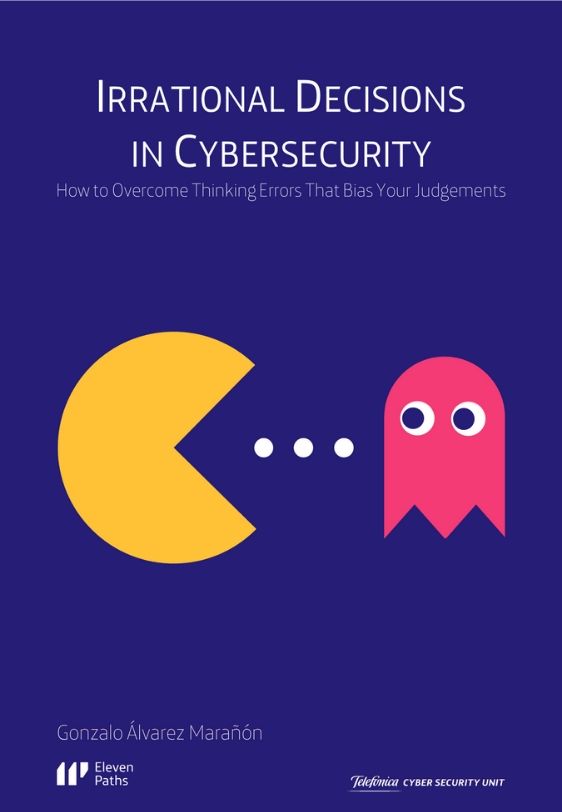
Download for Free Our New Book: ‘Irrational Decisions in Cybersecurity: How to Overcome Thinking Errors That Bias Your Judgements’

ElevenPaths    23 December, 2019

In the transmedia universe of Blade Runner, replicants are artificial human beings manufactured by bioengineering by Tyrell Corporation. They are physically indistinguishable from a human, except for one detail: their lack of empathic response. The Pavlov Institute developed the Voigt-Kampff test to trigger emotional responses in the subject that allowed it to be identified as an android because of its lack of empathy.

How do humans make decisions? When we don’t have access to all the necessary data to make a perfectly informed decision or don’t have enough time to collect such data, we use thinking shortcuts, simple math, stereotypes, prejudgments and hunches. Psychologists call these shortcuts heuristics and biases.

Actually, we make judgement errors that no replicant ever would. Our rationality is bounded. Maybe an irrationality test would have been better to unmask them.

Download the book ‘Irrational Decisions in Cybersecurity’

In order to help ourselves to overcome thinking errors that bias our judgements, we have published a free book: Irrational Decisions in Cybersecurity. And what better time to do it than during our Security Innovation Day 2019? Our security event based this year on the Blade Runner universe and the hunting of replicants.

The book illustrates the psychological concepts previously mentioned within its twelve chapters including examples from the cybersecurity world. Through its challenges, you will identify with the role of CISO and will see how you are not so rational when making decisions. Being aware of your biases and heuristics is the first line of defense against them.

The chapters end with specific recommendations and easily applicable ideas to detect when you are thinking wrongly. Moreover, at the end of the book you will find a comprehensive checklist to guide you when making decisions alone or in a group. By applying the principles explained in its pages, you will improve the quality of your economic and cybersecurity decisions.

Irrational Decisions in Cybersecurity

You can download it for free from the book’s website, in .epub and .mobi formats, for your favorite e-Reader.

Say Goodbye to Biases, Heuristics and Thinking Errors

In particular, this book addresses the following twelve biases, heuristics and thinking errors:

  1. A Story about Two Minds: The Vast Difference between Real and Perceived Risks
  2. Risk Homeostasis: How Adding Security Measures May Make You Unsafe
  3. Loss Aversion: You Are Less Rational Than You Think When You Make Risk Decisions Under Uncertain Conditions
  4. The Framing Effect: You Make Your Choices Depending on How Information Is Presented
  5. The Confirmation Bias: We Seek the Information That Confirm Our Decisions, Refusing Their Opposed Evidences
  6. The Availability Bias: Don’t Confuse the Frequency of an Incident with How Easily You Remember It
  7. Nudges: If You Want to Change Your Employees’ Security Habits, Don’t Call on Their Will, but Modify Their Environment Instead
  8. The Representativeness Heuristic: In Pursuit of the Perfect Phishing That Would Trick Even You
  9. The Planning Fallacy (and other optimistic biases): Why You Are Late Delivering All Your Projects and Finally They Are More Expensive Than Expected (and What You Can Do to Address It)
  10. The Affect Heuristic: Your Feelings Influence Your Perception of Risk and Benefit More Than You Might Think
  11. The Anchor Bias: A Cybercriminal’s Blinking in Brazil May Cause a Phishing Tsunami in Russia
  12. The Sunk Cost Fallacy: If It Doesn’t Work, Don’t Touch It. Let It Sink

The book ends with a comprehensive checklist intended to help you make better decisions:

  • Checklist: 12 Questions to Make Decisions Avoiding Bias Distortions 

Warning! After reading this book, you may not pass an irrationality test because you may start making 100% rational decisions.