Success Story: pioneering project for economic and social development

AI of Things    9 October, 2019

In a previous article we talked about how important it is to undertake a cultural transformation, that is, of individuals, whilst a company or sector undertakes a digital transformation of its processes and tools.

Today we present the success story of the Inter-American Development Bank (IDB), an international financial organization whose objective is to promote sustainable and responsible commercial growth in Latin America and the Caribbean.

​This story begins when this organization detected a problem in its scope of influence. The advanced data analysis techniques offered by Big Data and Artificial Intelligence were not being fully exploited in the countries of Latin America and the Caribbean, especially in terms of growth and competitiveness for the private sector and efficiency for the public sector.

In order to reduce these limitations and develop the skills of sought-after profiles in this field, the IDB entrusted the LUCA Academy team with the design and production of a Spanish MOOC, a pioneer in its format and scope, with a strong focus on improving human capital and managing information in digital environments.

The first edition of the MOOC has been very well received, with more than 17,000 students registered in 17 countries. Due to this success, the second edition of the course has already been launched.

Because every transformation begins with education.

To carry out this project, LUCA was selected due to its leading position in the sector and due to its team of experts in all disciplines of Big Data and Artificial Intelligence, with extensive experience and knowledge of data projects in both the public and private sectors.

To stay up to date with LUCA, visit our Webpagecontact us and follow us on TwitterLinkedIn YouTube.

“Eurobeer”, artificial intelligence and a financial system without banks

Víctor Deutsch    7 October, 2019

Among the challenges of the digital economy is security by default. Innovation, artificial intelligence, IoT, blockchain … a whole series of enabling technologies for new business models but security must be at the center. Telefónica Empresas participated for the first time in the digital economy convention De: Central Days, in the cybersecurity panel, on September 24 and 25 in Mallorca.

(Spanish version here)

Precisely on this island one of the most prominent scientists and intellectuals of his generation had the disruptive idea that human reasoning could be implemented artificially in a machine. And he got hands on. Immediately, he identified the first problem: how to develop a representation model of human knowledge that could be interpreted by the machine?

To model knowledge, he determined that complex concepts necessarily had to be based on the union of a series of simple ideas that he called “roots”, reduced to a sort of “alphabet” of 54. Then, he developed a programming language for a processing system capable of combining these 54 root ideas for obtaining as a result, an inference about different propositions or postulates.

Investors, large companies and startups

This topic, artificial intelligence, was one of the axes of De: Central Days, a forum organized by Reinhold Lang and other colleagues, as a meeting point between investors and large companies with startups with innovative services, to seek synergies and address challenges of digital transformation, among which is security by default.

IoT, blockchain, the future of mobility or augmented reality were other areas in which numerous experts, from about twenty countries, gave their vision of the state of the art, gave an insight into its possible evolution and presented the latest technological solutions and disruptive business models. After attending some of the talks I had the feeling that we are already immersed (and we do not realize) in what has been called the singularity: a turning point in which technology takes its own dynamics, impossible to control, with unpredictable results. Let’s see some examples:

Cryptocurrencies and beer

One of the main problems for the cryptocurrency takeoff as a true alternative to fiat money has always been, in addition to regulation, a “tangible” back of the monetary unit. It is something that central banks solve with gold reserves, more or less secure financial assets or reserve currencies. As it turns out, Craftcoin has discovered the convertibility of its money into a universally accepted asset: beer!

They have invented the CBC (Craft Beer Coin), a virtual currency that allows the purchase of beers attached to the initiative from a smartphone. Craft Coin Company raises money by selling CBC, which is used to finance craft breweries, helping them mature and expand. In return, CBCs can be exchanged for products and even for shares in those breweries. Dividends and voting rights are shared among the community of those who own and use the CBC, which also obtain other benefits such as shorter waiting time in the bar, discounts and other rewards.

AZHOS, led by Marcel Kuhs, comes from an industry as traditional as the chemical, but when it seemed that everything was already being invented in the optimization of the supply chain, this company has managed to integrate the logistics flow with the financial flow in the value chain. And he has done it with a combination of IoT and blockchain.

The technology allows, through online sensors integrated in the customer’s container, the supplier can have real-time information on consumption and provide for the replacement of the product. But what is truly novel is the concept of “smart contract”.

With this tool, the supplier can charge based on actual consumption in the tank or deposit and receive instant payments with blockchain technology, without waiting for replenishment, financing production in real time. The client, in turn, saves the entire process of issuing orders and receiving delivery notes and payments. This substantially reduces paperwork and administration costs because there are interfaces with the main ERP and bank transfer systems. Both parties release capital immobilized in stocks. Ah!… and AZHOS shareholders receive profits and commissions also in real time.

The meeting also talked about the cryptocurrency of Facebook. Gordon Einstein, who defines himself as a “crypto-lawyer”, made a brilliant presentation about the present and future of this virtual currency that only requires a Facebook account as an access mechanism… and the serious conflicts that are foreseen with traditional banking and with National authorities.

And it is that the monetary sovereignty of the countries was never so threatened by a non-bank monetary unit, which completely escapes its control. Governments and central bankers try to apply standards conceived almost a century ago for a different economy, with different rules and do not quite understand the long-term effects of cryptocurrencies.

From an analysis of the detractors and support to Calibra, Einstein deduces that the true objective of its drivers is to capture a market of hundreds of millions of unbanked people in Asia, Africa and South America. This would allow access to microcredits, electronic payments and other financial services. In places with little capacity for action by the authorities, Calibra would impose and expedite all types of business.

“Tokenization” as a financing alternative

Blockchain expert Max Kops spoke about the advantages of “tokenization” as a financing alternative for SMEs and startups. Just as IPOs can only be used by the most consolidated companies, Kops argues that investment rounds, business angels or venture capital programs are inaccessible to many companies. However, the supply of shares through blockchain opens a much faster and cheaper way to raise funds, with the same security for investors.

Kops dares to say that in five years this will be the only form of fundraising to be used in the field of growing SMEs and startups.

Artificial intelligence: rethinking about 1275 in 2019

Michael Wolan, an innovation consultant from Cologne, Germany, outlined the perspectives on the evolution of artificial intelligence, in a line similar to the one we already discussed in this blog.

According to him, it is not that we have reached the goal: we are just beginning and, for the first time, we have the necessary tools to make great progress. Currently, artificial intelligence is still in the domain of specific domain applications, far from strong and generalist artificial intelligence and of being able to solve complex problems. But, from now on, progress will tend to accelerate exponentially.

And they will be a consequence – says Wolan – of the improvement in computing capabilities, data availability and hyperconnectivity, but points out that we continue to use the same representation models and algorithms as years ago. And it is not clear in which direction they will evolve, although he gave some clues with the video of Sophia, the humanoid robot capable of learning and imitating more than fifty facial expressions.

It is paradoxical, in Mallorca in 2019 we were considering the same problems that Ramón Llull had considered to create the thinking machine in 1275, as he explained at the beginning. In a few years, our current models may seem as ridiculous as Llull’s now. And we have not found an algorithm that manages to emulate human thought from it, only very incomplete approaches.

Default security, at the center of the digital economy

In the cybersecurity panel, shared with Ian Murphy of LMNTRIX.COM, from Telefónica Empresas we show a vision of the risks, threats and controls that are necessary in the digital economy. The size of companies in this matter is not important because corporations are exposed as SMEs. The importance of people’s awareness, the industrialization of solutions to lower costs and the consideration of security in the design of the new digital services were some of the topics that were addressed.

If the digital economy advances rapidly, threats do too. That´s why it is important to stay updated and establish certification mechanisms based on best practices, which are even ahead of legal obligations.

Mallorca as a technological hub

One last note: the huge turnout (rooms full of 350 people) and the hall talks suggest that we must pay attention to the emerging technological sector, of European matrix, which is being developed on the island as it already appeared in the media.

It is quite logical. The island has great competitive advantages that entrepreneurs value: excellent communications and transport infrastructure (a large airport with direct connections throughout Europe), availability in Spain of well-trained IT professionals and a language and culture as a springboard to reach Latin America. Some of the largest, global and competitive tourism companies in the world are based in Mallorca. Apart from that, good weather, a modern health system and great quality of life.

In short, with promotion and some facilities (coworking spaces), Mallorca can be a very attractive destination for new companies in Brexit Europe. Maybe you can ever find the solution that Ramón Llull was looking for in the same place.

Telefónica Colombia and Ecuador: Success stories in Digital Transformation

Fernando Menéndez-Ros    4 October, 2019

Thanks to Artificial Intelligence, the digital relationship with customers is becoming closer and more efficient. Colombia and Ecuador have positioned themselves as pioneers in their markets by opting for avant-garde technologies such as Aura that enhance the consumer experience.

Fabian Hernandez, Chairman and CEO of Telefónica Colombia,explained this modernisation process in Andicom 2019: “We are the first Telco in the country to launch an Artificial Intelligence system to facilitate our customers’ digital relationship. With a renewed experience, and taking advantage of cognitive improvements and global synergies, through Aura we are boosting our channels in Colombia to enrich customers’ personal experiences”.

For his part, José Manuel Casas, CEO of Movistar Ecuador, commented in the My Movistar Ecuador app following the launch of Aura: “We continue to innovate in terms of service. Now we also carry it out via Artificial Intelligence, so that we serve our customers in a faster and more nimble way. We seek to answer their questions and concerns quickly. The launch of Aura in Ecuador is another example of the customer being at the heart of our daily work”.

A SAVING OF RESOURCES FOR THE TELCO

Opting for platforms like WhatsApp has enabled Telefónica Movistar Colombia to resolve more than 3.1 million queries from 251,000 customers achieving very positive results for the Company. In fact, the country has also developed cases of use in AIOps (Artificial Intelligence for operations) reducing 27% of all calls to the call centre.  This has made it possible to maintain customer satisfaction and, in turn, save 184 million annually.

Another major advance for Telefónica in Colombia is with regard to robotic process automation (RPA), whose target is to reduce human intervention in the use of computer applications, particularly in repetitive tasks. Thanks to the implementation of this technology, Movistar Colombia has developed more than 60 cases of use and today has more than 350 robots, which impact more than 20 departments in the Company.

Colombia has achieved cost savings of 184 million per year thanks to the use of AIOps and has served more than 251,000 customers through WhatsApp.

Furthermore, Ecuador, has implemented RPAs to optimise processes, reduce delays and costs in operations. The ones with the greatest impact have been those related to line portability and service registrations/de-registrations, projecting savings of 1.6 million in 2019.

Similar to Colombia, Ecuador has also opted for chatbots to improve customer service. In the last year, 105,000 website-based queries were handled entirely by bots. In addition to the website-based requests, 46% of queries were answered through Facebook and 20% through WhatsApp. In total, Telefónica Ecuador has achieved savings of 100,000 dollars thanks to the optimisation of these processes.

NEXT STEPS FOR THE TELCO

Following all these developments, the virtual assistant Aura arrives in Colombia through the My Movistar application, whereby customers can ask questions (both verbally and in writing) about queries relating to products and services they have contracted, understand their bills for postpaid plans, understand their data consumption and find out their available balance for prepaid customers. In addition, more than 120 frequently asked questions are available, so that the customer can manage and find answers to their concerns more easily and immediately. The carrier announced that in a few months it will be available on more channels (web, WhatsApp and the Cognitive Call Centre).

For its part, Aura is also landing in Ecuador via the My Movistar application. It can be asked about topics related to Movistar’s services, for example: “what is my available balance”, “I want to subscribe more megabytes”, “how do I pay my bill” or “how do I activate a prepaid combo”, among others. In addition, it is able to detect whether the customer is asking about an incident or claim that needs the attention of a human agent for the application to be resolved in the best possible way. The virtual assistant is growing all the time with new uses and functionalities to make it ever more relevant to users. It will soon be available on the commercial website and on other social channels such as WhatsApp.


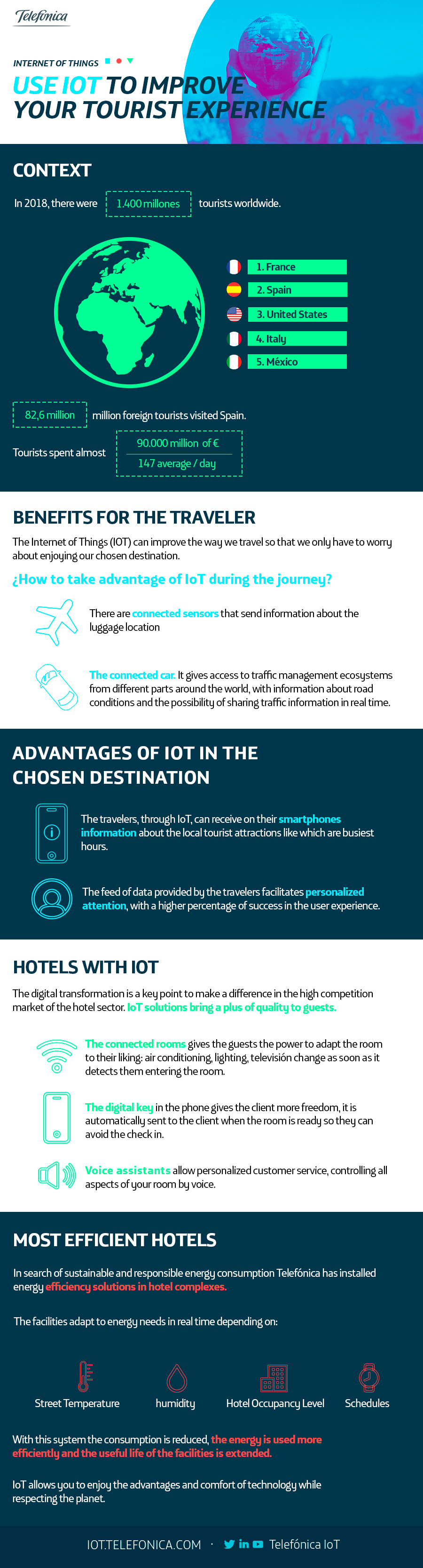
IoT to improve your Tourist Experience

Beatriz Sanz Baños    4 October, 2019

Would you like to enjoy a more personalized and efficient experience during your vacation? The arrival of IoT is already a real revolution in the tourism sector where this technology brings cost savings, service optimization and the creation of an unprecedented user experience.

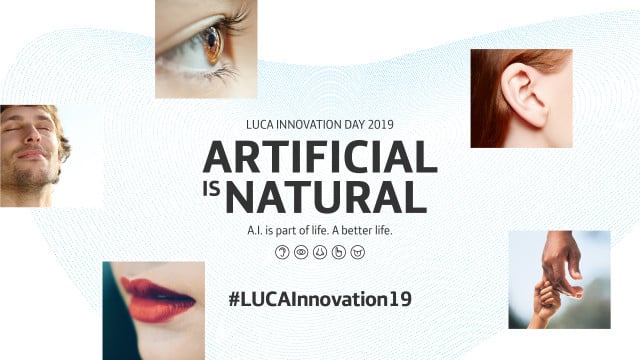
“Artificial is Natural”: The Artificial Intelligence event for companies

AI of Things    2 October, 2019

LUCA Innovation Day 2019 is arriving, the third edition of our annual innovation event where you will have to engage all 5 senses. Watch along on our live stream if you are unable to attend.

It’s a fact: Artificial Intelligence is becoming increasingly attainable and necessary, both in our personal environment and in the corporate world.

On October 16th, we want to show you the applications of AI that we have discovered over the past year: a natural AI, accessible to any organisation, in any sector, for any business objective or need, which will help optimise your value proposal and strengthen the relationship with your clients. It’s within your reach.

LIVE STREAM: We want you to be able to experience all the event has to offer even if you are not able to attend in person. We have set up a live stream which means you can watch along with us from anywhere in the world. Click here to get access to the link!

What do you have to look forward to?

  • During this day, you will see most innovative uses and applications, developed in the last year at LUCA, which solve the needs of your business.
  • You can hear first-hand the experiences of our clients and presentations from our experts, giving insight into upcoming trends and technologies that will transform your company.
  • You will also have the opportunity to touch and experiment with our AI and multisector solutions live with our experts.
  • Futhermore, you will also experience the launch of Movistar Living Apps, our new intelligent channel that transports your business directly into the home of Telefónica’s millions of customers, via new initiatives, easily accessible by a single phrase thanks to Aura and the voice .

Technology maximises the capabilities of our businesses, but we are the people who make the decisions. Will you join us?

LUCA Innovation Day 2019 will take place on the 16th of October at 16:00 in the Central Auditorium of the Telefónica District (Madrid). We are waiting for you! Register here to come in person.

EasyDoH: our new extension for Firefox that makes DNS over HTTPS simpler

Innovation and Laboratory Area in ElevenPaths    1 October, 2019

A year ago, the IETF has raised to RFC the DNS over HTTPS proposal. This new is more important than it may seem. For two reasons: firstly, it’s a new resolving paradigm that shakes network foundations. Secondly, because the support of having RFC combined with the interest shown by browsers (greedy for the power granted by this) has led them to begin its implementation in record time.

DoH (DNS over HTTPS) is really simple. Instead of going to port 53 of a server (for instance, the well-known 8.8.8.8) and requesting for a domain through an UDP or TCP package, DoH standardizes the construction of a GET or POST to a HTTPS domain, so the answer will be the A and AAAA records (the RFC doesn’t specify other records) with the IP. Of course, it has more details, such as the clever solution of turning the cache-control heading into the TTL. Everything carefully encrypted, of course.

Firefox has joined Cloudflare with the aim of becoming the trusted resolver. In fact, Firefox’s DoH is known as TRR (Trusted Recursive Resolver). It promises not to use the little user data that it may need. For instance, Cloudflare is fully committed to deleting that sending of the first three octets used in a DNS query. Firefox is the one that has more decidedly implemented DoH but its interface is still not so intuitive. That is the reason why for this extension.

https://youtu.be/u6OnBJcPy4o

DoH, ‘easy’ for Firefox: we have developed an extension

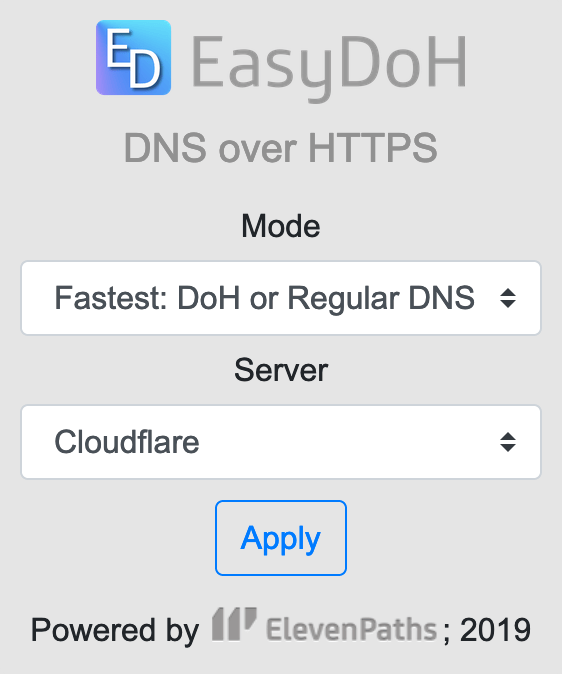
This extension is quite simple. EasyDoH is a Firefox extension that allows you to easily choose between different DNS over HTTPS servers. Currently, Firefox works with Cloudflare as its default DoH server, and allows to modify it by using some confusing configuration parameters. EasyDoH makes this configuration simpler and shows more alternatives to using different DoHs depending on your needs.

Some of the parameters are hidden within about:config menu. Thanks to EasyDoH, such parameters are just one click away. You can choose to use only DoH, the fastest server between DoH or regular DNS, etc.

One last thing: just a script file is needed. Since Firefox extensions do not allow file modification, we need a little script to achieve this and change DoH’s internal configuration. No worries, source code is here.

The extension is available from the official Mozilla repository: https://addons.mozilla.org/es/firefox/addon/easydoh/

ARTYficial Intelligence or just Artificial, can tech be creative?

Olivia Brookhouse    27 September, 2019

When I hear the word art, a few masterpieces spring to mind; Monet’s Water lilies, Picasso’s Guernica and Van Gough’s Starry Night. Whilst many artists names’ do not carry the same grandeur of those above, even a few smudges on a canvas can convey a wealth of culture, history and emotion. Art extends beyond paintings to poetry, plays, novels, music, fashion and film and at the helm of these artistic forms are creators, pioneers, innovators and developers. But are they all human? In this blog, we ask what is takes to be creative and whether this creativity extends to machines.

Painting made by AI technologies using generative adversarial network – “algorithms are able to emulate creativity”

The dictionary defines creativity as the ability to transcend traditional ideas, rules, patterns and relationships to create meaningful new ideas, forms, methods, interpretations. In Daniel Kahneman’s book, Thinking Fast and Slow, he explores the two different ways the brain forms thought between System 1 and System 2. Whilst System 2 is logical and analytical, System 1 is impulsive and automatic, formed by gut feelings and evolutionary adaptive tendencies.

A study of creativity

A study by Jonathan Smallwood proved that the most creative individuals were able to harness both System 1 and System 2 to make creative connections. They were “simultaneously able to live in a dream state while concentrating on the outside world”. Whilst imagination (system 1) was important in generating unique ideas, logical thinking (system 2) was necessary to harness these ideas. Machines have the tools to accurately analyse and make logical connections but whether they are able to simulate traits of system 1, to dream, is questionable.

From composing music to building sculptures, AI systems in art are fed data from 1000’s of examples and then it finds patterns and trends via Machine Learning. Finally the system is capable of replicating and creating similar versions. If we look at creativity simply, as ‘transcending rules and patterns to create interpretations’, is this not what machines are doing? In one of our previous posts we talk about how companies incorporate AI into many creative processes.

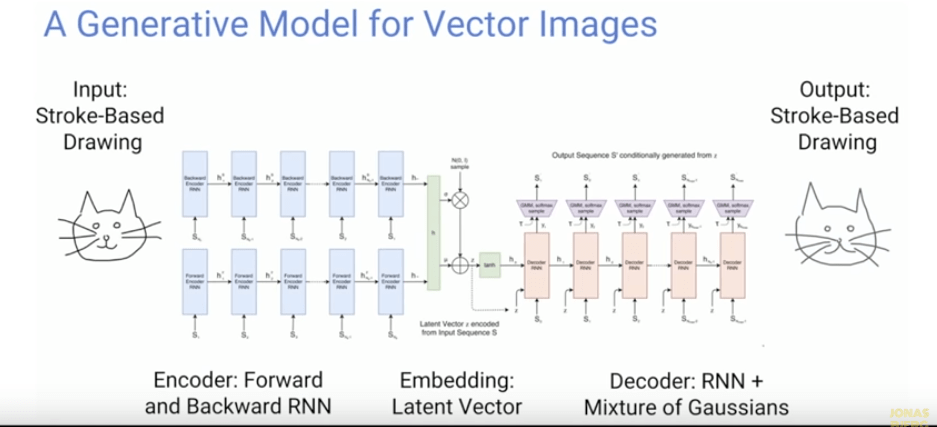
From an input, the system generates gaussians, a range of possibilities of where the next pen stroke should go. As more images are inputted, the system gets smarter. https://www.youtube.com/watch?v=VKdsh2UvNqc

AI, the biggest copycat

Whilst what we admire about artists is their uniquely recognisable styles, we value machines more for their copying skills. Any originality is purely coincidental.

It’s easy for AI to come up with something novel just randomly. But it’s very hard to come up with something that is novel and unexpected and useful.

— John Smith, Manager of Multimedia and Vision at IBM Research

Remember that artists take inspiration from external stimuli, events and relationships, like how AI interacts with inputted data. AI may not be a pioneer, creating somehting remarkable, but does this mean they do not demonstrate creativity?

The argument on whether AI can be the next Picasso is dependent on how you view creativity, as a process or a means to create something engaging. Many will view a beautiful piece of art and be content. But to many, creativity is a process, actively choosing to move away from what those have done before. Machines will be truly creative when they decide to start drawing without instruction but isn’t that a scary thought.

AI in Art, for the time being is a tool to help make art quicker, an intelligent stencil. Whether we can teach AI to be creative for itself, to produce something ‘uniquey beautiful’ is yet to be seen. True creativity comes from being surrounded by senses and experiences which we experience as humans. We would have to supply machines with everything we experience as humans; smells, sounds, feelings, connections, to become a true artist.

To stay up to date with LUCA, visit our Webpage, subscribe to LUCA Data Speaks. Follow us on TwitterLinkedIn or YouTube.

Transform to Perform: If you have talent in your company, don’t let it escape

Carlos Alberto Lorenzo Sandoval    20 September, 2019

Cars can’t fly yet, but do we need them when we are experiencing a flood of information from all directions? I have always wondered what the traffic lights of the future would look like if cars could pass over us, but I never imagined that the technological revolution would happen more in the digital world than in the physical one.

When I was a child, I eagerly waited for the famous flying car to be released on sale, but I was missing something. The changes that were about to come in the technology realm were not to be driven by companies, but by consumer’s needs.

It was the new consumer demands that would set all the technological machinery in motion. Society was not asking for flying cars, it was asking for a more efficient transport system.

And so, as the years went by, and thanks to the Internet and other advances, we began to have more access to information and consequently our consumption habits changed. Today we demand and expect much more from our brands. They should know who we are and tailor their services to best suit us, not only in price, but in quality.

Consequently, companies have had to drastically change their approach to the market and its consumers, not only related to the product or service itself, but even generate new user experiences to aid interaction with the brand. This has been a long process and there is still a long way to go. What is clear is that companies have noticed the benefit of new technologies, such as Artificial Intelligence, to meet those ever-higher expectations of customers.

If that was not difficult enough, then another obstacle has been added; it is not enough to have the will to change, you must know how to do it. Are companies prepared to carry out these changes? What exactly does a company need to do to move towards a new way of working and evolve its business model? Without a doubt, it needs to transform itself culturally and for that, it requires a qualified team. Although this statement may seem obvious, the reality is that it is the main challenge facing companies. Finding people with talent and skills in technologies such as Big Data or Artificial Intelligence, capable of leading the digital transformation of the organization is an increasingly complicated task, especially because of the high demand for these profiles and the shortage of them in the labour market.

Now, if we are aware that the basis of change is people, then equally management must play a crucial role. What is the next step? Invest and create a new department from scratch with only new recruits? It is certainly an option, but not necessarily the best.

Technologies, techniques and processes are changing so rapidly that employees should be valued more for their ability to adapt to the technical requirements asked of them. Otherwise, we may find ourselves in the same predicament when these new tools become obsolete, that we will be left with an outdated team again. So, the key must be to offer timely and quality training to our current teams, whilst of course incorporating new profiles capable of promoting change.

In LUCA, we have created an exclusive area to support companies in this sense, called LUCA Academy; where companies gain access to the knowledge and experience of our data scientists, engineers and data architects, as well as business consultants to train your employees in the use of Big Data and Artificial Intelligence technologies. The goal is to help your organization build AI-driven decision making and achieve the most successful digital transformation.

In the future, I no longer expect the flying car, I expect it to be intelligent. I hope that every brand I interact with takes advantage of the depth of information to target me in a unique and personalized way.

If you want to learn more about how we can help you transforming your company, visit our website

Your city is more accessible with IoT

Beatriz Sanz Baños    19 September, 2019

According to the latest data from the National Statistics Institutethere are 3.84 million people with some type of disability in Spain. A figure to bear in mind since it makes a group that needs to obtain support from all possible spheres of society. However, in recent years progress has been made in terms of accessibility in order to achieve better social integration and avoid discrimination.

Moving around the city can be a challenge for them: from taking a bus, to crossing a street or walk on sidewalks, the difficulties they face prevent them from fully enjoy their lives and their cities. At this point, technology, combined with Internet of Things, can be the perfect ally.

One example is the city of Santander, where it will be easier to move around thanks to the KIMAP Cityinitiative. The idea is to install a smartphone in the wheelchair of the participants, which collects data on the accessibility of the streets as people go around the city. As they progress on their route, the system produces maps in which the streets have three colours: green, yellow and red, depending on the difficulty of access for people with reduced mobility. The initiative is part of the SynchroniCityproject, which seeks to create solutions for smart cities based on Internet of Things.

If we cross the Atlantic, in Chicago they have carried out a project called Array of Things (AoT), with which they are installing a series of ‘nodes’ in street furniture to capture environmental data and urban activity in real time.

All this data is available on a public website with the aim of providing valuable information for the development of more inclusive urban plans. This way, urban architects who plan to create solutions in Chicago will have an easier time identifying areas that are not accessible and promoting inclusive projects to break down barriers for this collective. For example, systems are being developed to notify pedestrians if a regular street is cut off to take an alternative route.

Similarly, we see how public transport is gaining in accessibility. This is the case of Accessible Olli,the self-driving bus developed by IBM. This vehicle is equipped with a virtual assistant capable of communicating with passengers.

For example, when a visually impaired person hops on the bus, Olli will tell you the free places where you can sit via audio or an app on your mobile. For hearing impaired users, they will have augmented reality that will be able to speak sign language and can also activate the ramp automatically when it detects that people on wheelchairs are getting on.

https://www.youtube.com/watch?v=9joEsWiYFEI

For visually impaired people, the WeWALK connected canecan be a revolution. Once connected to the app on the smartphone, the cane detects obstacles with its ultrasonic sensor and sends out vibration warnings. WeWALK is incorporating new features with software updates such as integration with Google Maps and voice assistants.

There are also headphones with Internet of Thingsthat allow users to hear up to 30% better in places with excessive noise such as a street with traffic. In addition, these hearing aids feature IFTTT technology, the standard used by most smart home devices. With them you can control the smart devices in the house to make daily tasks easier. For example, lights can be set to turn on when the user wakes up or turn off when they detects the person left home.

Making a city more accessible not only means moving around freely, but also that people with different abilities are integrated into social life and can improve the community in which they live. Of all the projects and ideas mentioned, we can say that the Internet of Things can help overcome obstacles and change the way we move and interact with our city.

Is your AI system discriminating without knowing it?: The paradox between fairness and privacy

Richard Benjamins    13 September, 2019

This post assumes that readers are aware of the good things that Artificial Intelligence (AI) can bring to our businesses, societies and lives. And also about the most evident challenges that the massive uptake of this technology implies such as bias & unwanted discrimination, lack of algorithmic explainability, automation & the future of work, privacy, liability of self-learning autonomous systems to mention some of them. In this post, I will focus on bias and & unwanted discrimination, and in particular on supervised machine learning algorithms.  

The intrinsic objective of machine learning.

Before entering into the matter, we should not forget that the intrinsic objective of machine learning is to discriminate; it is all about finding those customers that have an intention to leave, finding those X-Rays that manifest cancer, finding those photos that contain faces etc. etc. However, what is not allowed in this process, is to base those patterns (a collection of certain attributes) on attributes forbidden by law. In Europe, those attributes are defined in the General Data Protection Regulation (GDPR) and include racial or ethnic origin; political opinions; religious beliefs; membership of trade unions; physical or mental health; sexual life; criminal offenses. In the US, the following characteristics are protected under the US federal anti-discrimination law: Race, Religion, National origin, Age, Sex, Pregnancy, Familial status, Disability status, Veteran status, Genetic information. 

Different sources of unwanted discrimination by algorithms.

As much research already has pointed out, in Machine Learning there are different sources of unwanted discrimination by algorithms, which may lead to discriminatory decision making. 

  • Discrimination due to bias in the data set because of an unbalanced distribution of so-called protected groups (represented by sensitive variables such as race, ethical origin, religion, etc, as mentioned above). 
  • Discrimination due to the availability of sensitive variables in the data set, or their proxies: apparently harmless variables that exhibit a high correlation with sensitive variables.  
  • Discrimination due to the algorithm manifested by the fact that the proportion of false positives and/or false negatives in the outcome is not equal across protected groups.  

High-profile cases of unwanted discrimination reported in the media.

But let’s start with briefly mentioning some of the high-profile cases of unwanted discrimination that have been reported amply in the media: 

  • COMPAS. The US criminal system uses an AI system, called COMPAS to assess the likelihood of defendants committing future crimes. It turned out that the algorithm used in COMPAS systematically discriminated against black people.  
  • Amazon had to withdraw an AI system that automatically reviewed job applicants’ resumes because it discriminated against women.  
  • Google had to change its Google Photos AI algorithm after it recognized black people as Gorillas.  

Sparked by those high-profile cases, several approaches have seen the light that deal with the identification and mitigation of unwanted discrimination. IBM has developed an open source toolkit, called AI Fairness 360, that provides tools to detect the rate of bias in data sets and to mitigate the bias. Pymetrics, a data science company focused on recruiting, developed open-source software to help to measure and mitigate bias.  Aequitas of the University of Washington is an open-source bias audit toolkit for data scientists, machine learning researchers, and policymakers to audit machine learning models for discrimination and bias.  

Main approaches to detect and mitigate unwanted discrimination.

In general, there are three major approaches to detect and mitigate unwanted discrimination in Machine Learning:  

  • Pre-processing: in this approach, biased variables are transformed into non-biased variables before the training of the algorithm begins.  
  • In-processing: in this approach, apart from optimizing the target variable (the goal of the algorithm), the outcome is also optimized for having no discrimination, or the least discrimination possible.  
  • Post-processing: this approach only acts on the outcome of the model; the output is manipulated in such a way that no undesired discrimination takes place.  

There are several criteria for measuring fairness, including independence, separation, and sufficiency. Telefónica is developing LUCA Ethics a post-processing approach to comply with the separation criterion.  

All those approaches help detecting and mitigating bias and unwanted discrimination by analyzing data sets or the outcome of the algorithm. However, they have one major assumption in common that is important to review. All approaches assume that the sensitive attribute against which should not be discriminated, is included in the data set. In the Amazon case on recruitment, gender forms part of the data set. In the COMPAS case, race is an attribute of the data set. This availability of the sensitive variable enables different kinds of checks on the data set such as its distribution, how balanced it is, etc, and, once the model is trained, this same variable also enables to check whether the model discriminates based on this sensitive variable, which usually corresponds to a protected group.  

Real-world datasets.

But what happens when the data set doesn’t contain any explicit sensitive variables? Not surprisingly, most real-world data sets do not contain any sensitive variables because they are designed in this way. Since it is forbidden by law to discriminate against certain sensitive variables (see above for what is considered sensitive in Europe and the USA), most organizations make an effort to exclude those variables to prevent the algorithm from using it. Collecting and storing such sensitive personal data also increases the privacy risk for organizations.  

If we think about the high-profile cases mentioned above, the sensitive variables (gender and race) actually were in the data set. For gender, we may expect it to be present in many data sets (that is why many if not most examples of bias and unwanted discrimination are illustrated by gender). In the COMPAS case, race is in the data set because it is a very specific (criminal) domain. However, we wouldn’t expect attributes such as religion, sexual life, race or ethnic origin to be part of typical data sets used by organizations. The question arises then of how to know that you are not discriminating illegally if you can’t check it? The simple technical solution would be to have this sensitive personal data available in the data set, and then check the outcome of the algorithm against it. This seems however at odds with many data protection principles (GDPR art. 5, data minimization, purpose limitation) and best practices. Let’s look a moment at possible ways to obtain sensitive personal data:  

  • The user could be asked for sensitive personal data to be included in the data. It might seem unlikely that users would allow this, but in several UK institutions, sensitive personal data variables are asked and stored. Users can always choose not to provide this information, but the option is there. It seems, however, unlikely that users will consent massively to this. 
  • Organizations could use their internal data combined with publicly available data sources to infer the value of sensitive personal data for each of their users. 
  • Organizations could perform a survey with a representative subset of their users and ask them for their sensitive personal data. One could even announce that the survey forms part of an approach to check for unwanted discrimination. Any new machine learning algorithm can then be tested against this subset for unwanted discrimination. 
  • Some “normal” variables are proxies for sensitive variables, such as for example postal code for race in some regions of the USA. If such known (and confirmed) proxies exist and they are in the data set, they can be used for testing the algorithm for unwanted discrimination.  

The paradox between fairness and privacy.

This leads to an interesting paradox between fairness and privacy: in order to ensure that a machine learning algorithm is not illegally discriminating, one needs to store and process highly sensitive personal data. Some might think that the cure is worse than the disease. This paradox was recently highlighted in the context of Facebook advertising for housing when Facebook was accused to discriminate against race and gender.  The automatic process of targeting ads today is very complex, but Facebook could try to infer for each of their users their race and gender (using its own data but also publicly available data sets), and then use this to avoid unwanted or illegal discrimination. But would you like Facebook or any other private company to hold so much sensitive personal data

Given existing privacy regulations and risks, most organizations prefer not to store sensitive data unless it is absolutely necessary like for some medical applications. In that respect, from the four options mentioned above, the “survey” option seems to be the least risky option to equip organizations with a reasonable assurance of not discriminating.  

Practical implications.

So, what does this all mean in practice for organizations? I believe most organizations are only starting to think about these issues. Only a few have something in place and are starting to check their algorithms for discrimination against certain sensitive variables, but only if they are available in the data set. For the cases where organizations do not have sensitive personal data in their data sets (and most organizations make an effort to exclude this data from their data sets – for obvious reasons as we saw), the current state of the art does not allow systematic checks. It is true that organizations are starting sensibilization campaigns to make their engineers aware of the possible risks of AI, and some are aiming to have diverse and inclusive teams to avoid as much as possible that bias creeps in the machine learning process.  

Conclusion.

As a conclusion, if sensitive data is included in data sets, technically organizations can know whether or not they are discriminating in an unfair way. But when there is no sensitive data in the data set, they cannot know. This might not seem optimal, but it is the current state of play, which until now, we all seem to have accepted.  I am, however, convinced that new research will also come up with solutions to tackle this problem, and thereby solving one of the most cited undesired, unintended consequences of Artificial Intelligence.  

To keep up to date with LUCA visit our website, subscribe to LUCA Data Speaks or follow us on TwitterLinkedIn or YouTube .

Leave a Comment on Is your AI system discriminating without knowing it?: The paradox between fairness and privacy