Telefónica merges home communications through Aura Ecosystem

Cristina de la Cruz    24 July, 2019

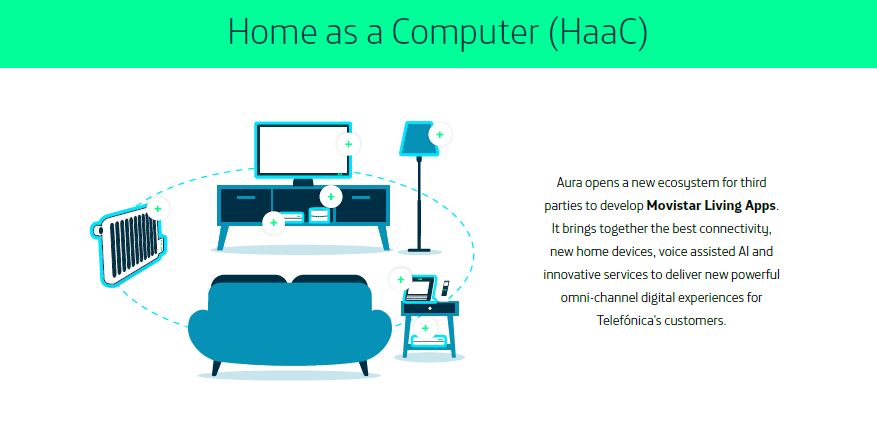
Telefónica has been introducing technology into its customers’ homes for years, and now it is taking a step further by implementing Artificial Intelligence at home, through Movistar Home and Movistar Living Apps. An entire ecosystem of devices and services that work through Aura, Telefónica’s Artificial Intelligence.

Movistar Living Apps are new experiences developed internally or by third parties that will enrich the way users make use of technology in their homes. They can be accessed through the television, the Movistar Home device, or the remote control.

Thanks to Movistar Living Apps, Telefónica is opening up a path of digital transformation through what they have named the “Aura Ecosystem”, the new technological platform for the home in which external partners can develop their Movistar Living Apps to offer new services related to home automation, travel, shopping, etc.

We turn homes into an intelligent and open to new experiences computer, creating unique moments with just one voice command.

Chema Alonso, Telefonica’s CDO

Some of the following partners have already joined this new experience, which can be used through Movistar Home and television, for example:

  • Air Europa: Aura will help users check in for a flight, select their seat, add luggage, and it sends the boarding pass to their mobile phone.
  • Atlético de Madrid: Aura will provide club members, who are Movistar customers also, with the option to transfer their season tickets so that there are no empty seats in the stadium.
  • El Corte Inglés: Aura will offer products related to Movistar+ content. It will also offer customers the option of completing their purchase through their mobile phone.

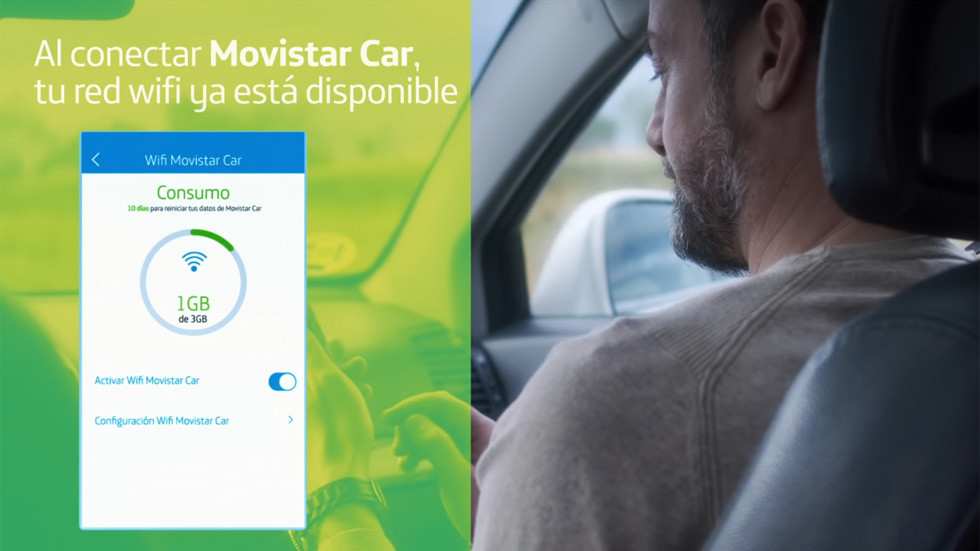
In addition to these experiences, internal functionalities have also been developed such as Smart Wi-Fi, which lets you see which devices are connected at home or the list of devices on the Wi-Fi network, Movistar Cloud, where all the videos and photos stored in the cloud can be viewed on the television, and Movistar Car which shows the route a car is taking in real time, as well as sending periodic notifications to the customer about the condition of their vehicle. 
This is just one example of how Telefónica is becoming increasingly significant to its customers and how it fulfils its responsibility to bring the best of technology and new cognitive skills to their lives, proving to be a telco which knows how to best anticipate the future.

The 2 types of learning in Machine Learning: supervised and unsupervised

AI of Things    23 July, 2019

We have already seen in previous posts that Machine Learning techniques basically consist of automation, through specific algorithms, the identification of patterns or trends which “hide” in the data. Thus, it is very important not only to choose the most suitable algorithm (and its subsequent parameterisation for each particular problem), but also to have a large volume of data of a sufficient quality.

The selection of the algorithm is not easy. If we look it up on the internet, we can find ourselves in an avalanche of very detailed items, which at times, more than helping us, actually confuse us. Therefore, we are going to try and give some basic guidelines to get started. There are two fundamental questions which we must ask ourselves. The first is:

What is it that we want to do?

To respond to this question, it may come in handy to reread two posrs that we posted earlier in our LUCA blog, “The 9 tasks on which to base Machine Learning”, and “The 5 questions which you can answer with Data Science”. The crux of the matter is to clearly define the objective. To solve our problem, then, we will consider what kind of task we will have to undertake. This may be, for example, a classification problem, such as spam detection or spam; or a clustering problem, such as recommending a book to a customer based on their previous purchases (Amazon’s recommendation system). We can also try to figure out, for example, how much a customer will use a particular service. In this case, we would be faced with a regression problem (estimating a value).

If we consider the classic customer retention problem, we see that we can address it from different approaches. We want to do customer segmentation, yes, but which strategy is best? Is it better to treat it as a classification problem, clustering or even regression? The key clue is going to be to ask us the second question.

What information I have to achieve my objective?

If I ask myself, “My clients, do they group together in any way, naturally?”, I have not defined any target for the grouping. However, if I ask the question in this other way: Can we identify groups of customers with a high probability of requesting the service to be stopped as soon as their contract ends, we have a perfectly defined goal: whether the customer will deregister, and we want to take action based on the response we get. In the first case, we are faced with an example of unsupervised learning, while the second is supervised learning. 

 In the early stages of the Data Science process, it is very important to decide whether the “attack strategy” will be monitored or unsupervised, and in the latter case define precisely what the target variable will be. As we decide, we will work with one family of algorithms or another.

Supervised Learning

In supervised learning, algorithms work with “labelled data”, trying to find a function that, given the input data variables, assigns them the appropriate output tag. The algorithm is trained “historical” data and thus “learns” to assign the appropriate output tag to a new value, that is, it predicts the output value.

For example, a spam detector analyses the history of messages, seeing what function it can represent, depending on the input parameters that are defined (the sender, whether the recipient is individual or part of a list, if the subject contains certain terms etc), the assignment of the “spam” or “not spam” tag. Once this function is defined, when you enter a new unlabelled message, the algorithm is able to assign it the correct tag.

Supervised learning is often used in classification issues, such as digit identification, diagnostics, or identity fraud detection.  It is also used in regression problems, such as weather predictions, life expectancy, growth etc. These two main types of supervised learning, classification and regression, are distinguished by the target variable type. In classification cases, it is of categorical type, while in cases of regression, the target variable is numeric.

Although in previous posts we spoke in more detail about different algorithms, we have already moved forward with some of the most common:

1. Decision trees

2. Classification of Naïve Bayes

3. Regression by least squares

4. Logistic Regression

5. Support Vector Machines (SVM)

6. “Ensemble” Methods (Classifier Sets)

Unsupervised Learning

Unsupervised learning occurs when “labelled” data is not available for training. We only know the input data, but there is no output data that corresponds to a certain input. Therefore, we can only describe the structure of the data, to try to find some kind of organization that simplifies the analysis. Therefore, they have an exploratory character.

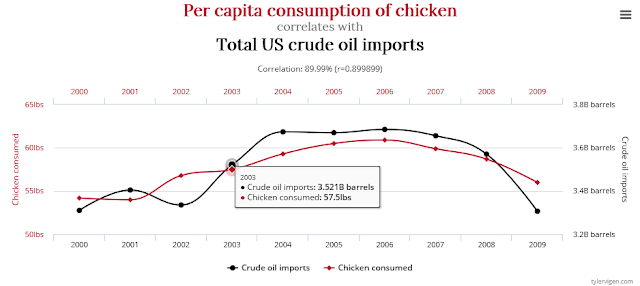
For example, clustering tasks look for groupings based on similarities, but there is no guarantee that these will have any meaning or utility. Sometimes, when exploring data without a defined goal, you can find curious but impractical spurious correlations. For example, in the graph below, published on Tyler Vigen Spurious Correlations’ website, we can see a strong correlation between per capita chicken consumption in the United States and its oil imports.

Figure 1: Example of a spurred correlation

Unsupervised learning is often used in clustering, co-occurrence groupings, and profiling issues. However, problems that involve finding similarity, link prediction, or data reduction can be monitored or not.

The most common types of algorithms in unsupervised learning are:

1.Clustering algorithms

2.Analysis of major components

3.Decomposition into singular values (singular value decomposition)

4. Independent Component Analysis

Which algorithm to choose?

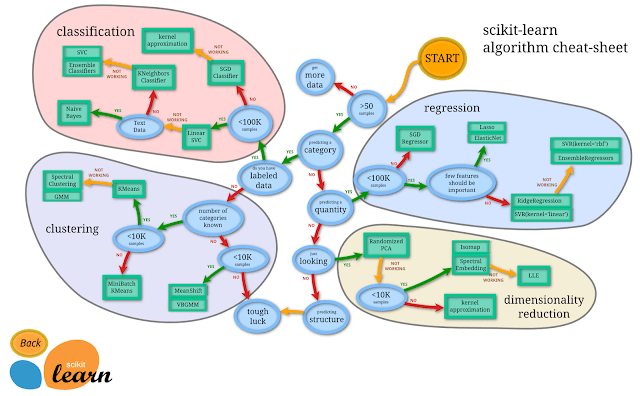
Once we are clear whether we are dealing with a supervised or unsupervised learning case, we can use one of the famous “cheat-sheet” algorithms (what we would call “chop”), to help us choose which one we want to start working with. We leave as an example one of the most well-known, the scikit-learn. But there are many more, such as the Microsoft Azure Machine Learning Algorithm cheat sheet.

Figure 2: “Chop” algorithm selection from Scikit-learn

So, what is reinforcement learning?

Not all ML algorithms can be classified as supervised or unsupervised learning algorithms. There is a “no man’s land” which is where reinforcement learning techniques fit. This type of learning is based on improving the response of the model using a feedback process. They are based on studies on how to encourage learning in humans and rats based on rewards and punishments. The algorithm learns by observing the world around it. Your input information is the feedback you get from the outside world in response to your actions. Therefore, the system learns from trial and error.

It is not a type of supervised learning, because it is not strictly based on a set of tagged data, but on monitoring the response to actions taken. It is also not unsupervised learning, since when we model our “apprentice” we know in advance what the expected reward is.

Don’t miss out on a single post. Subscribe to LUCA Data Speaks.

You can also follow us on TwitterYouTube and LinkedIn

How Big Data & Artificial Intelligence are having a positive impact in the sport of Rugby Union

Stefan Leadbeater    19 July, 2019

The use of big data and data analytics is not something which has only just become apparent in sport, in fact it has been around for a long time. We can see various examples of its use, in sports such as Formula 1 where teams have used high speed analytics for a number of years, to try and gain a competitive advantage over competitors. Also, within football, the world’s biggest sport, Data Analytics has been used in order to monitor the performance of the players through mechanisms tracking a player’s movements and statistics during a game.

The industry of data intelligence is an exploding industry as the value of the data is so high. Technologies mentioned above allowing monitoring and tracking of individual players like the number of touches on the ball or metres travelled. This type of information is then being used to aid management in important decision making such as squad selection or to establish where improvements need to be made. These technologies have existed for a long time but have lacked context meaning that their full potential could not be exploited.

One particular sport in which this ‘boom’ is ever more present is in rugby, which is growing massively as a participation sport, with the 2015 Rugby World Cup attracting 480,000 fans generating over £250 million.

In matches, both international and national, the rugby coaches, managers and support staff can be seen sitting high up in the stands with a wide variety of computers and technology monitoring all aspects of the match in great detail. All of this technology is needed because nowadays, all the leading rugby union clubs use this data to monitor fitness, to help prevent injuries and to track players’ movement through GPS.

Regarding GPS tracking, players wear a small device which is sewn into the back of their jerseys allowing data to be collected on their heart rate and position on the field. This information is analysed by the support staff, who are reviewing the physiological demands placed on the players during the game in different situations and levels of fatigue of each playerm so as to aid in planning and executing effecting rehabilitation and injury prevention measures.

The demands placed on players are different due to the nature of the position played within the team. The ‘forwards scrimmaging and performing many intensive tackles, whereas certain positions in the ‘backs’ such as the winger will include longer periods without the ball and more intense periods of sprinting. All of this information can be analysed allowing specific training plans to be put together for specific players allowing them to optimise their potential and maximise their work rate out on the field.

With these devices also being used during training, the coaching staff can also see the levels of effort which are being put in during training sessions which in turn means that through monitoring the players’ thresholds, the support staff can manage the training sessions so as to keep the players fresh for the games. This is possible as real-time data is being monitored by specialists from the touch line on each of the training sessions, giving coaching staff live and accurate information, upon which they base their team selections.

Sir Ian McGeechan has stated that up to 80% of the selection process is now driven by data with only about 20% left to the ‘gut feeling’ of the coaching staff which he states is also invaluable in the selection process.

Application with concussions:

As well as using data to analyse aspects of the game and to improve the performance of the team and the individual players, teams are utilising it against the growing problem of concussions in rugby, a very serious problem if not managed correctly.

In 2018, concussions were the most reported upon match injury in the professional English game for the 6th season in a row, and the ever growing amount of evidence showing long-term damage of sports-related brain injuries has led World Rugby, the game’s global governing body, to search for more efficient and effective ways of identifying and treating concussions in the modern game, both during and post-match.

The result of their work was the creation of the Head Injury Assessment (HIA) which consists of a series of checks to determine if a player has experienced a concussion and whether further treatment is required. There are 3 stages to this process:

  1. Match officials or doctors spot a suspected head impact on the pitch.
  2. If the medical professionals recognise symptoms of a concussion, then the player is immediately removed from the game.
  3. If the signs are unclear, a 10-minute substitution is made for tests to be done to determine if the player is fit to return to the game.

Every player on a team undergoes a further test after the game has finished to check their neurological systems and to check their memory against a baseline previously taken so as to show if previous signs of a concussion were missed by officials. If signs do show up at this stage, a test is then undertaken after two night’s sleep using technology developed by CSx which collects neurocognitive information which can be reviewed by professionals to determine if a concussion has occurred. This data is then transferred using an API to the data analytics platform, Domo, where the various datasets can be joined up and further analysed.

This system was tested during the 2015 Rugby World Cup in England and World Rugby are planning to use it again this year in the 2019 Rugby World Cup in Japan.

Applications in recruitment:

As proved by in 2016 by ASI Data Science, a British AI firm looking to revolutionise the world of sports transfers, they designed software to help analyse players and aid decision making on which players are bargains and therefore, the best pick to purchase for a team.

They signed a deal with the British rugby union side London Irish to test out these revolutionary technologies.

Whereas traditionally scouting involves looking through hours of videos, manually noting down abilities and weaknesses, however with this software, clubs can enter the name of a well-known player in the position for which they are scouting and it will find, through assessing match statistics, players with similar styles and abilities.

It looks through around 100 different parameters taken from Opta, the sports data company covering every professional player around the world. Bias is removed by the clustering together of different types of players by the software making it easier for scouts and analysts to find players.

In a sport where salary caps often limit the budgets of even the biggest clubs, this tool could prove invaluable to all types of sports clubs.

Finally, I would like to talk about the RFU, (Rugby Football Union) whose job it is to firstly create successful winning English national teams, but one area in which AI is being used is within its second obligation, of increasing participation in the sport at a grassroots level.

For the last 5 years, the RFU has had a working relationship with IBM who have helped them to transform their operations through technology, doing such things as creating player and teak databases and providing personalised interactions and important moments of players’ careers. However, they also help at a fan engagement level with the development and implementation of a Customer Relationship Management (CRM) system as supporters also need managing in such a global sport. They believe that all this will help to significantly maintain the growth of the sport and help it to increase the number of active players and supporters pushing for more and more games and events.

Conclusion:

Without a doubt, the use of Big Data & AI in the world of rugby has been, and will continue to be invaluable both for the coaching staff, but also for the players and their well-being. I believe that the future is bright in this field and we are going to see more and more examples of Big Data & AI applications in different aspects of both rugby and all other sports around the world.

Who says your pet can not become an influencer?

Beatriz Sanz Baños    18 July, 2019

Currently, 40% of Spanish households own a pet, according to the Madrid Association of Pet Veterinarians. That’s about 20 million dogs, cats, birds or hamsters that brighten the lives of many people every day.

Over time, society is more aware of animal care and there are many people who leave their pets at home with concern. If you are one of them, you can relax now, because IoT already allows you to care about your pet in ways you cannot even imagine. Besides, you will end up joining the new healthy trend that contemplates, not only the health of the people, but also your pets’ health.

The first thing that came to the market were the location gadgets. Ergonomic collars that incorporate GPS technology and allow locating the pet in a radius of several kilometers. From there, new systems have been developed with sensors, connected to the Internet, and even with cameras, capable of monitoring specific data in their health or mood.

Devices like Dondosend location data to a mobile app, for great tranquility of those who have the naughtiest pets. With this necklace you can keep an eye on them and avoid more than one upset.Ntt Docomois a similar one, but it also offers a record of the health status of the animal: it measures, among other things, its temperature, its weight, the digestion process, the burning of calories and the physical activity carried out.

The offer could stop here, but there is still more. Technology has enabled us to obtain information beyond the physical state of our pets and we observe the emotional state and socialization of our pets. These types of solutions are the most used today. An example is Fitbark, a connected collar that monitors how our pets rest: it collects information about sleep patterns with sensors and determines if they rest well enough. Another feature is the comparison of the animal’s behavior with others of the same race, to assure the owner that their behavior and their constants are always good.

We can still go one step further with Kyon Pet Tracker, the device that monitors the mood of pets through an algorithm and sends notifications to the user if he is thirsty, wants to play or needs a walk. In addition, it activates by repeated barking to warn the user. 

At an anecdotal level, some extravagant solutions are also being developed, for which the market is not yet ready. One example of this is The posting tail device, which detects the mood by the tail´s movement. When it moves because of happiness, it takes a picture and automatically uploads it to his profile on social media, thus collecting the best moments and sharing them with other users.

For the next few years, the market is trying to find new solutions with LPWA connectivity that contributes to extend the usage of IoT technology in the world of pets.

#CyberSecurityReport19H1: 45,000 apps removed from Google Play, 2% of them detected by antiviruses

Innovation and Laboratory Area in ElevenPaths    16 July, 2019

Currently, there are a number of reports addressing trends and summaries on security. However, at ElevenPaths we want to make a difference. Our Innovation and Labs team has just launched another release of our own cybersecurity report, summarizing the most significant information from the first semester 2019. The report’s philosophy is providing a global, targeted and useful vision on the most relevant data and facts on cybersecurity. It is addressed to cybersecurity professionals and enthusiasts, in a simple and visually-appealing format. Let’s go over some of the data from this edition.

Nowadays there is a flood of information on cybersecurity. Nevertheless, it does not mean that this flood of information is correctly understood and analyzed, thus such information is not properly exploited to improve processes and be less vulnerable. Lack of information is as harmful as its excess. To be updated and inform people is not enough, but it is also necessary to analyze and be able to prioritize, learn what is important and why. What are the most relevant facts currently happening? What is the current outlook? How security problems, vulnerabilities and attacks are evolving? It is necessary to summarize without losing depth.

Given all the above, this report aims to summarize latest information on cybersecurity (ranging from security on mobile phones to cyber risk, from the most relevant news to the most technical ones and the most common vulnerabilities), while covering most aspects of the field, in order to help the readers to understand the risks of the current outlook.

The information here presented is mostly based on the collection and synthesis of internal data that have been contrasted with public information from sources considered to be of quality. In the following lines you will find several important points extracted from the report.

#CyberSecurityReport19H1: Some data

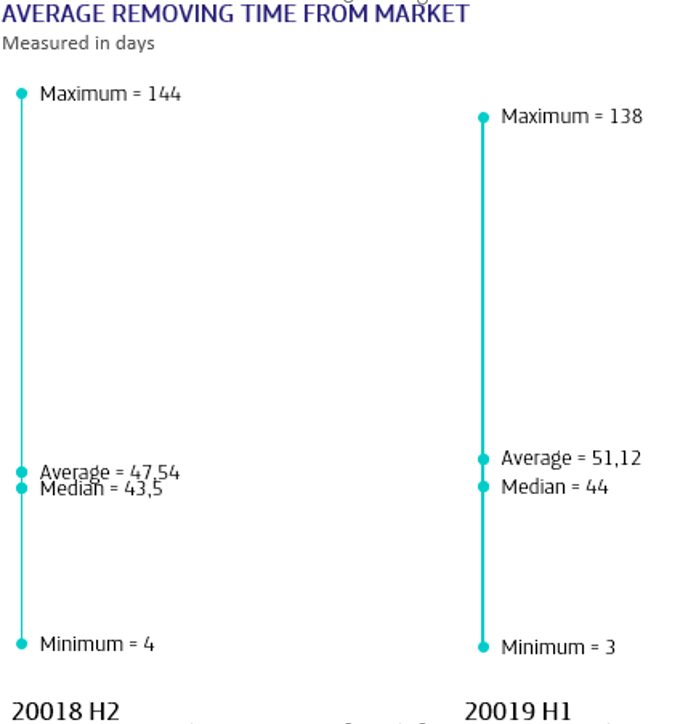
Around 45,000 apps were removed from Google Play during this period, and of them, around 2% of the applications were detected by antiviruses. On average, they stayed on the app store 51 days.

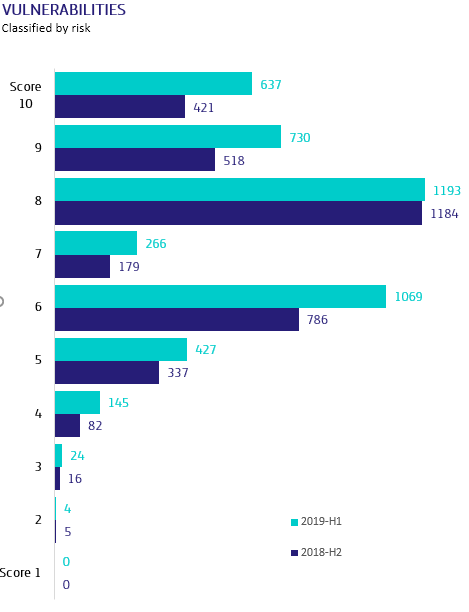
4,495 vulnerabilities have been analyzed over the first semester 2019. As the previous semester, 62% of them have a severity score of 7 or higher. Oracle, Adobe and Microsoft remain the vendors with the highest number of CVEs assigned.

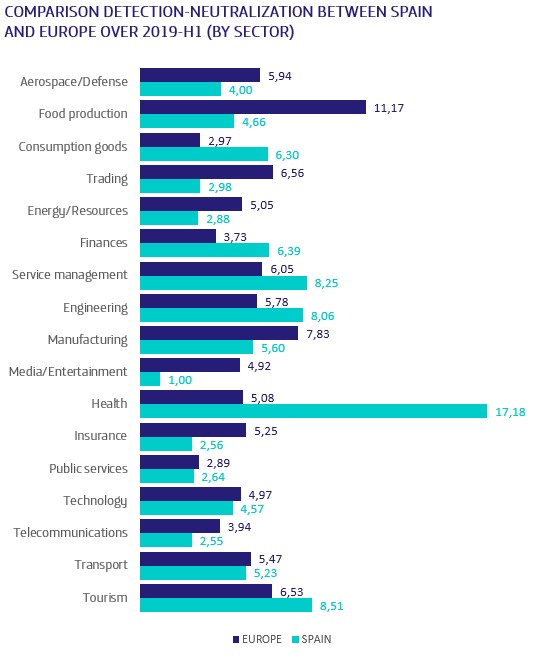
Thanks to BitSight, we have some data about cyberrisk. A European company needs an average of almost 5 days to fix a malware threat. Two more days compared to the previous semester. The fastest are the legal sector (they need just over 2 days), while the slowest are again food production companies (but now they need 11 days). In Spain, the health sector needs up to 17 days to neutralize a malware threat.

Other conclusions

• Over the first semester 2019, a total of 155 vulnerabilities for iOS were published, although only 5 of them serious enough to enable code execution. Consequently, iOS has gathered 1656 vulnerabilities since 2007.
• Over the same period, a total of 60 vulnerabilities for Android were published, although only 4 of them serious enough to enable code execution. Consequently, Android has gathered 2014 vulnerabilities since 2009.
• 6% of iPhones execute an iOS earlier than 11. Regarding Android, less than half of the current devices execute version 8 or later.
• Spear phishing and malicious office documents (mainly through macros) remain the most common infection methods used among the most sophisticated groups of attackers.
• Gamarue and Conficker remain the most common malware threats in Europe, even with higher figures compared to the previous semester.

Full report here:

The expansion and future of Aura, Telefónica’s AI

Fernando Menéndez-Ros    Cristina de la Cruz    15 July, 2019

A few years ago, Telefónica began a digital transformation process with the aim of seeking simplification, adaptation and the comprehensive digitalisation of the Company through the design and implementation of a cognitive engine that came into being through Aura, its Artificial Intelligence (AI). Aura was designed with the mission to create a relationship with its customers based on trust, giving them the option to converse through natural language with personalised responses and in real time.

“Aura as a global product generates a positive impact on business indicators, automation efficiencies, new ways of monetisation, improved customer loyalty and satisfaction.”

José Ramón Gómez Utrilla, Head of Aura Product Strategy.
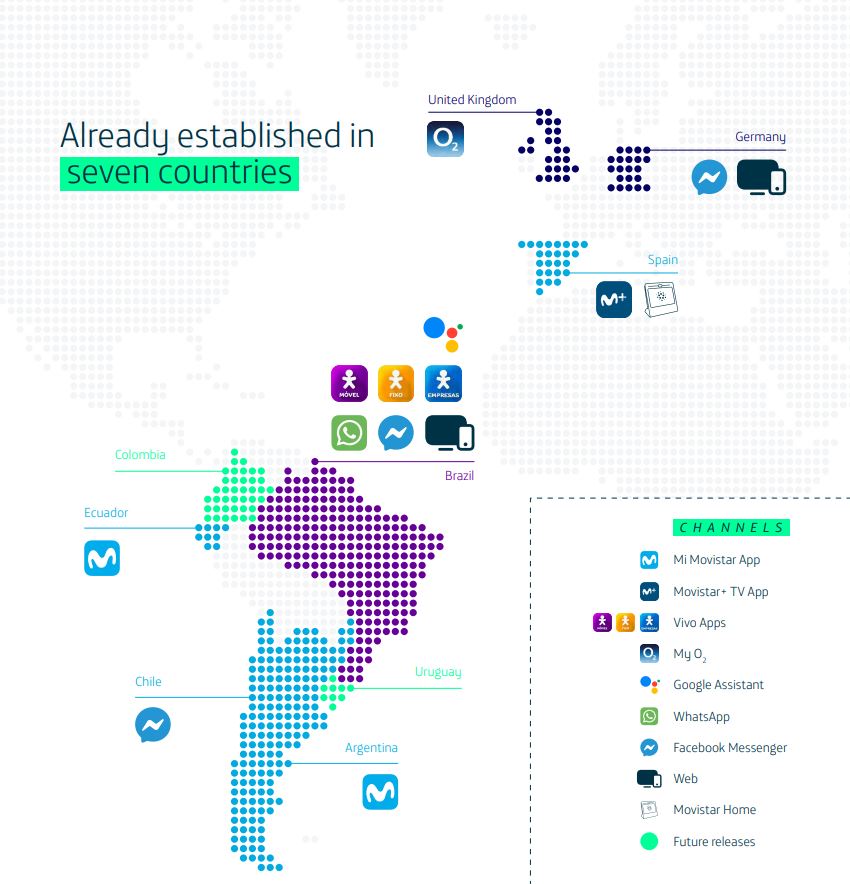
Presence of Aura around the world

Aura around the world

Aura is present in seven countries – Brazil, Spain, United Kingdom, Germany, Argentina, Chile and Ecuador – and will soon be available in Colombia and Uruguay, opening up a strong presence in Latin America. In addition, about two million people use this service each month with more than six million conversations and about 30 million interactions during its first year in existence. Moreover, it has more than 1,000 use cases (between personalised cases and knowledge bases)and is integrated in multiple channels, both our own channels and mobile apps (Mi Movistar; Movistar +, My O2, Meu Vivo Móvel), commercial websites and the new Movistar Home device; as well as in social channels, such as Facebook Messenger, Google Assistant and WhatsApp.

What can it do for customers?

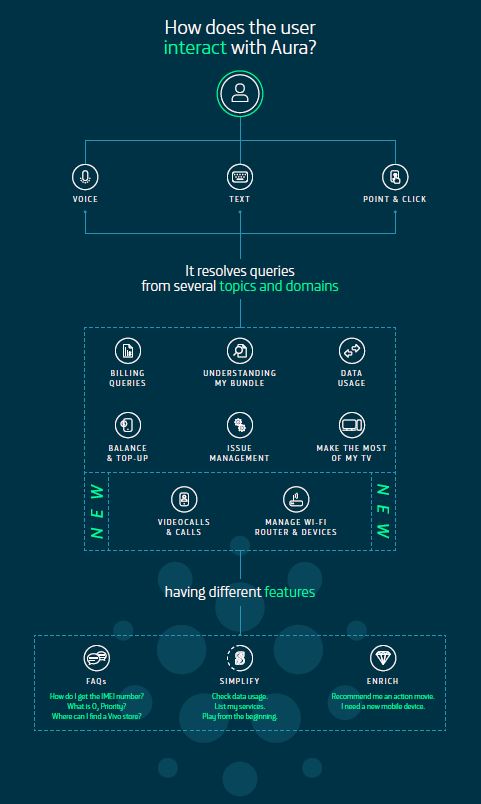
The use cases that AI can offer range from resolving issues related to contracted products and services, asking for the details of the latest bills or the remaining data for the customer to consume, to managing connectivity in the home or making video calls.

The present and future of the project

This year Aura will reach a total of 9 geographies and will be present in more channels and with more functionalities so that users can make the most of Telefónica’s Artificial Intelligence. For example, in Spain it will be available through the Movistar + decoder so you can interact with Aura through the Movistar television remote and be able to search for series, films and other content “a phrase away”. It will also soon be integrated with the television application Movistar Play in Argentina.

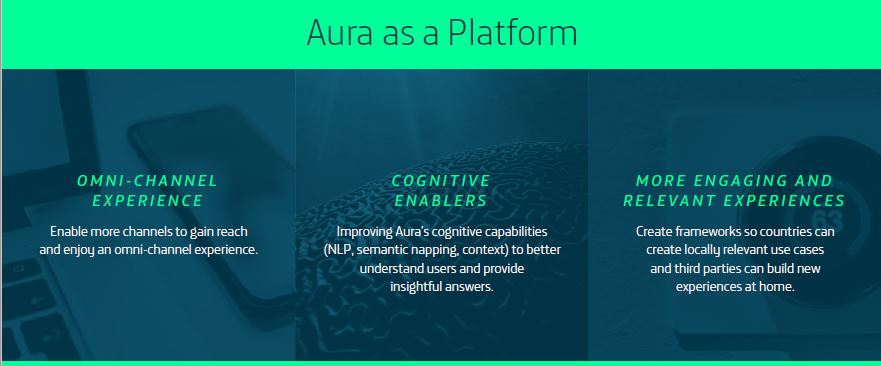
Thanks to the “Local CDOs” initiative, local teams have been created with a Global/local Governance, so that they can create locally relevant use cases for Aura in each country. This will help scale the project in a sustainable and efficient way. It is also important to highlight the “Aura as a Platform” project whose three core features are explained in this infographic.

Aura as a platform

From now on, in the words of Irene Gómez, global director of Telefónica Aura, “Aura’s next steps will be focused on relevance, or context and ideas to make Aura smarter, empowerment and personal data privacy, control and management tools so that the user has control of their own data, and creating an open ecosystem with third parties to create a new home experience.

Movistar Living Apps

If you would like to know more about Aura, visit volumes 1 and 2, which tell you its history from its beginning to the present day.

Artificial Intelligence for warfare or for maintaining peace

Richard Benjamins    12 July, 2019

On July 3, 2019, I attended an event organized by the Spanish Center for National Defense Studies (CESEDEN) and the Polytechnic University of Madrid (UPM) on the impact of AI on defense and national security. Not coming from the military area, I was asked to speak about my view on what AI will look like in 20 years from now. But the interesting part was not my presentation, but the message conveyed by several generals, in particular by Major General José Manuel Roldán Tudela and Major General Juan Antonio Moliner González.

Situations where AI may be helpful in wars are often related to safety of soldiers, fighting at the frontline, situations that require high endurance and persistence, lethal or very dangerous environments, to avoid physical or mental exhaustion, and when extreme fast reactions are required. 

AI can also improve different tactical levels in warfare related to for example, the decision-making cycle, improving the understanding of the situation, capacity to maneuver,  protection of soldiers, performance of soldiers, capacity of perseverance.

But there are several rules when applying AI to such situations, relating to supervision, teams, and security.

  • Supervision
    • The (AI) systems needs an advanced user interface for fast interaction
    • All activities should be registered for later inspection
    • The system can be activated and deactivated under human control
  • Teams
    • Humans and AI systems work together in teams
    • AI systems should be able to explain themselves
  • Security
    • Hostile manipulation should be avoided
    • No intrusion should be possible
    • Cybersecurity

AI is improving defense and national security on land, sea and in air. Some examples include:

  • Land
    • Remove landmines
    • Recognition of important routes
    • Battles in urban zones
    • Air support
  • Sea
    • Mine detection and removal
    • Anti-submarine warfare
    • Maritime Search and Rescue
  • Air
    • Precision attacks
    • Search and rescue in combat
    • Suppression of Enemy Air Defenses

There are of course also ethical aspects with the use of AI for Defense. For instance, the final responsibility of all actions needs to stay with humans. Humans should be “in the loop” (decide all), “on the loop” (be able to correct), and only in very specific cases “out of the loop.” An important lesson seems to be that when ethical principles are relaxed, armed conflicts increase.  Specific aspects that were mentioned include:

  • The principle to reduce unnecessary risks to own soldiers – machines seems to make less errors than people
  • Discriminate between soldiers and civilians – AI is likely to better discriminate
  • Overall, there is aversion against lethal autonomous weapon systems (LAWS)

Raising a specific question about LAWS, the answer was that humans always need to stay in control of life or death decisions. But it was also recognized that there is a serious risk for an AI arms race. Even though many countries may be completely against the use of LAWS, if one country starts to develop and threat with LAWS, other countries might feel obliged to follow. This is probably behind the withdrawal of France and Germany from the “Killer Robots” ban. Humanity has experience with the nuclear arms race, and so far, has been wise enough to use it only as a threat. However, nuclear arms have a very high entrance barrier, probably much higher than LAWS.

Let’s hope that humanity is also wise enough with LAWS and that no one has to brace for impact.

Don’t miss out on a single post. Subscribe to LUCA Data Speaks.

You can also follow us on TwitterYouTube and LinkedIn

Leave a Comment on Artificial Intelligence for warfare or for maintaining peace

A government is known by the Apple data it requests

Sergio de los Santos    11 July, 2019

Sometimes, governments need to be underpinned by huge corporations to carry out their work. When a threat depends on knowing the identity or gaining access to a potential attacker or a victim in danger’s data, digital information stored by these companies may be critical to perform an investigation and consequently avoid a disaster. Apple has published a full transparency report on government requests where they explain which and the extent to which such requests are granted. Ranging from App Store takedown requests to account access requests: Which government requests what? In order to make it clear, we have created a number of graphs to identify through this post what concerns governments most.

Device-based Requests

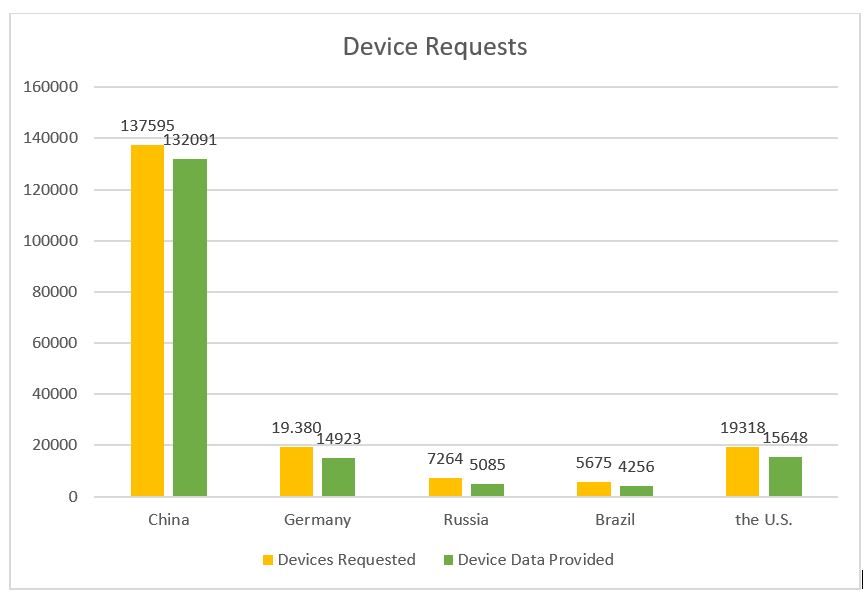
The following graph represents those requests based on devices. For instance, when law enforcement agencies are working on behalf of customers regarding lost or stolen devices. They also receive requests related to fraud investigations. Device-based requests generally seek details of Apple customers associated with devices or device connections to Apple services (for example, a serial number or IMEI number).

Device Requests by country

Without a doubt, China is the country that most requests on details of customers associated with devices or device connections to Apple services submitted. We can imagine as well that figures have soared due to piracy and fraud in the country.

Financial Identifier-based Requests

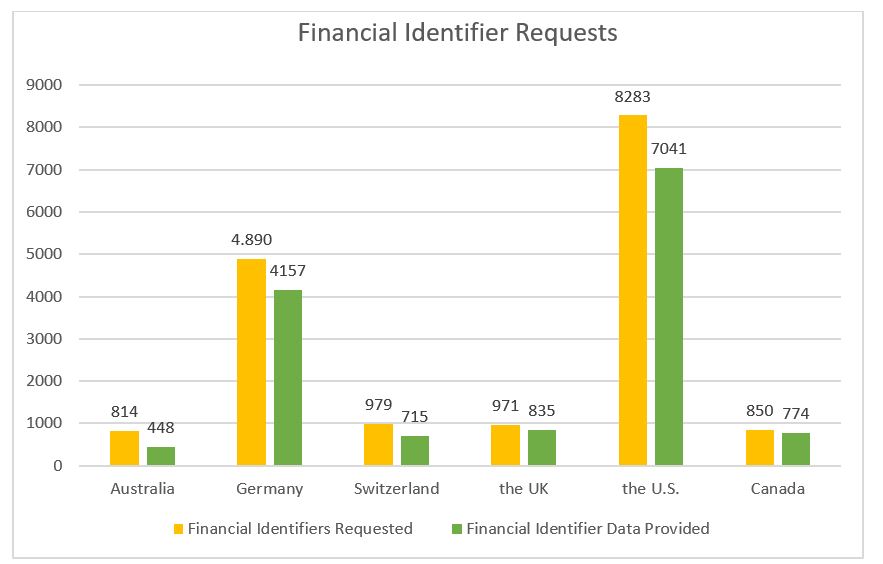
Examples of such requests are where law enforcement agencies are working on behalf of customers who have requested assistance regarding suspected fraudulent credit or gift card activity used to purchase Apple products or services.

Financial Identifier Requests by country

The U.S. and Germany are the countries that most financial identifier requests submitted. It may be explained by the increasing number of frauds in the U.S. related to credit cards (although it may not seem the case, in the U.S. credit card signatures are still usual to validate a payment). In this case requests are granted to a lesser extent, compared with the previous case.

Account-based Requests

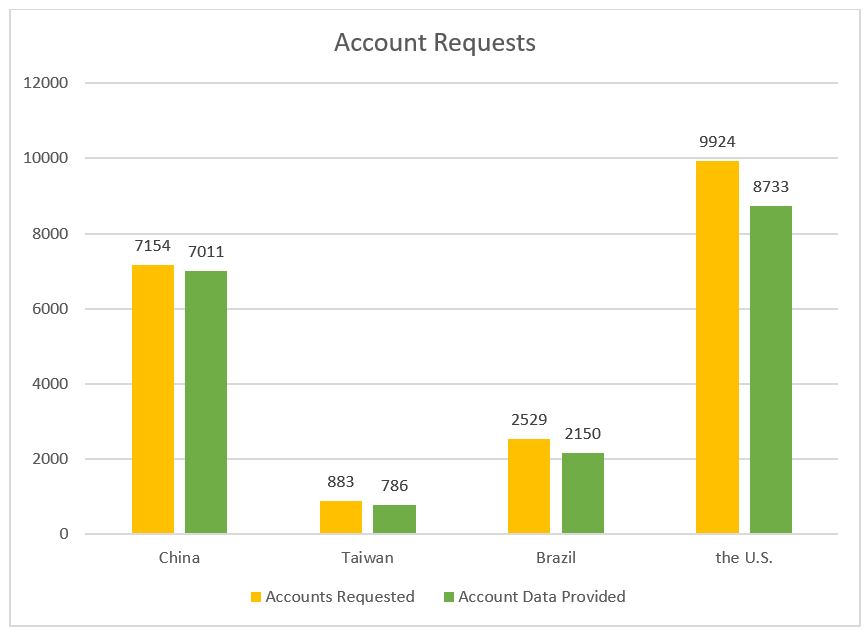
Examples of such requests are where law enforcement agencies are working on cases where they suspect an account may have been used unlawfully or in violation of Apple’s terms of service. They usually seek details of customers’ iTunes or iCloud accounts, such as a name and address; and in certain instances, customers’ iCloud content (iOS device backups, stored photos, contacts…).

Account Requests by country

This is perhaps the most intrusive measure, since Apple provides private content. Again, China and the U.S. are the countries that most accounts requests submitted. Interestingly, China’s requests were granted in 98% of cases, while U.S.’s ones “only” in 88% of cases. Apple has the power to reject a request if they consider there is a problem of form or content. It must be taken into account that Apple, in addition to providing data, can also providing metadata not directly linked with data. This case is not considered a “granted” request, although it includes providing information as well.

Account Preservation-based Requests

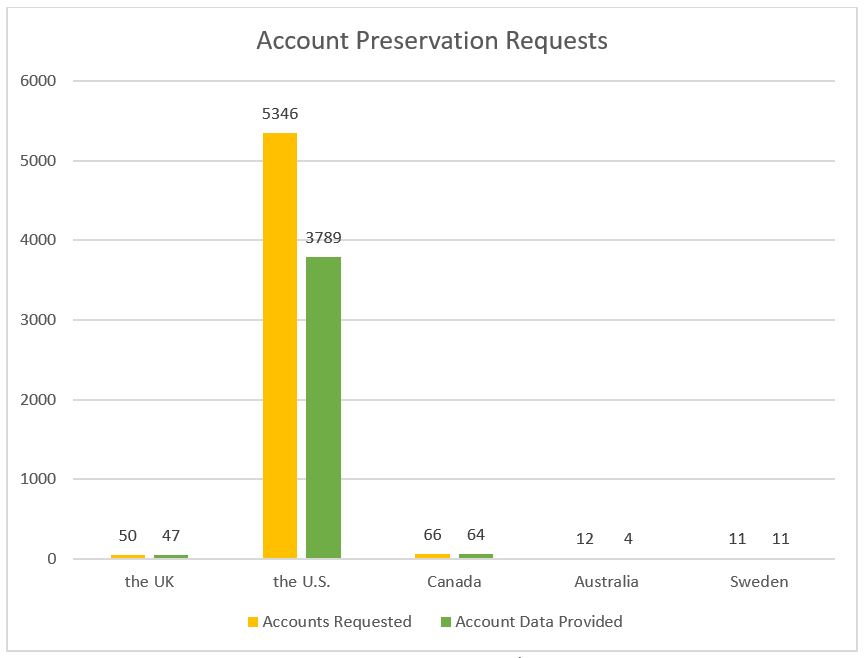
Under the U.S. Electronic Communications Privacy Act (ECPA), government agencies may request Apple to freeze accounts for 90-180 days. This is the previous step before requesting access to accounts (while they obtain legal permission to request data), and this way they prevent the individual under investigation from deleting the account.

Account Preservation Requests by country

The U.S. is the country that most account preservation requests submitted. It is remarkable that on this occasion China has disappeared from the graph, although it is considered a previous step before requesting access to accounts, where the country is quite active. Is it possible that China does not find many problems to obtain legal permission?

Account Restriction/Deletion Requests

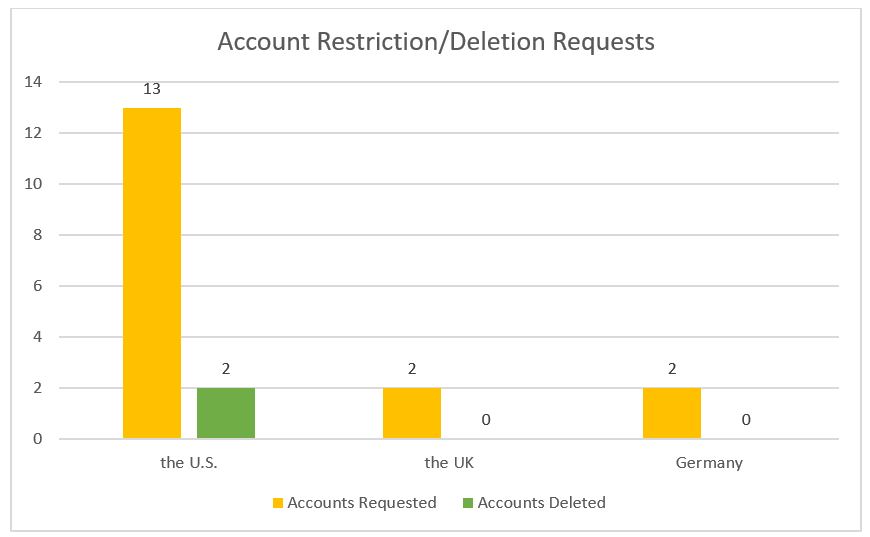
Examples of such requests are where government agencies request to delete a customer’s Apple ID, or to restrict access. They are quite unusual. The U.S. submitted 6 requests and 2 of them were granted. The remaining countries just submitted one or two, but none was granted.

Account Restriction/Deletion Requests by country

Emergency Requests

Under the U.S. Electronic Communications Privacy Act (ECPA) as well, Apple may be requested to disclose account information to a government entity in emergency situations if Apple considers that an emergency involving imminent danger of death or serious physical injury to any person requires such disclosure without delay.

Emergency Requests by country

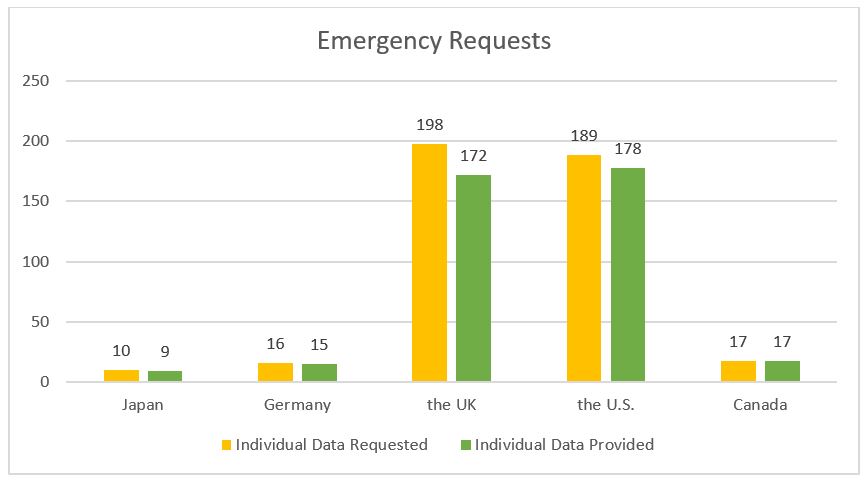
Interestingly, here the winner is the United Kingdom with 198 requests, even though they were not always granted; and it was closely followed by the U.S. The remaining countries submitted around 10 requests, and most of them were rejected. Is the United Kingdom mainly worried about emergencies and consequently it only requests data in such a case?

App Store Takedown Requests

They are usually related to apps that are supposed to be unlawful.

App Store Takedown Requests by country

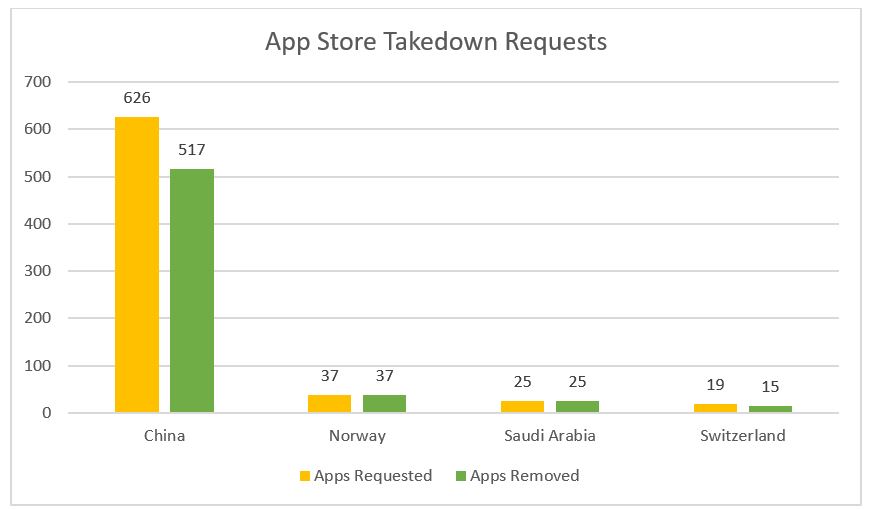
China is far and away the country that most app store takedown requests submitted. It is curiously followed by Norway, Saudi Arabia and Switzerland. On this occasion, the U.S. ꟷquite active on data access requests in generalꟷ has completely disappeared from the graph.

This report also discusses private party requests upon legal request. Up to 181 requests; 53 of them granted by Apple on information access.

Conclusions

They are complex. We can see it from two different points of view: we can conclude that some governments request data access “all too often”, but we could argue as well that perhaps justice systems of such countries work in a more agile and effective manner, or that fraud is mostly located in them. You can interpret it as you wish. Only the following data-based conclusions seem to be clear:

  • China’s interest in deleting applications that it considers unlawful.
  • The United Kingdom’s involvement (the U.S. as well, but the UK only appears in this category) in emergency situations.
  • The U.S.’s preventive actions, since it requests to freeze accounts much more often than the remaining countries.
  • Germany’s high involvement (again, along with the U.S.) in financial frauds related to Apple products.
  • China, the U.S., Taiwan and Brazil are the countries that most personal data requested.

Please note that: over this post we have represented those graphs published by Apple itself. It is important to point out that all requests are submitted by batches. For instance, Apple counts the number of app store takedown requests, and in turn each request may include an undetermined number of apps. The same for account requests and the number of accounts included in the request. When Apple talks about the percentage of granted requests, it talks about requests, not about specific accounts. For example, Apple receives 10 requests, all of them adding 100 accounts. Later, it states that it has granted 90% of those requests, but we do not know how many individual accounts have been provided. However, the graphs show the total amount against that percentage. Even though it is not an exact exercise, it may give us an approximate idea of the real amount of data provided.

Your children’s toys are now connected

Beatriz Sanz Baños    11 July, 2019

Smartwatches, drones, lights controlled from our mobile or connected scooters are already a reality in our everyday life. Connectivity and data storage have been gradually taking over the consumer products market and it was only a matter of time until it reached the children’s entertainment industry.

Toy brands know well the concerns of parents to protect their children and to keep them located. They also know that children are their future consumers and that, in fact, they are already demanding consumers. Trying to face these two issues, manufacturers decided to launch smart and connected products for children. This way, they provide peace of mind for parents and fun for children, opening a new category in the traditional market of toys.

Design, software complexity and usability of these toys are essential to attract the attention of children, who are starting to embrace technology at younger ages, and making safer toysis essential for the parents’ peace of mind, who perceive children are more vulnerable in this digital environment.

Remember when interactive toys arrived? Tamagotchi or Furby were the first toys a child could maintain a virtual interaction with. It was the latest technology in toys in the 90s, but today seems very far away. IoT has brought to the market complex toys that not only interact with the user, but connect with other devices and communicate with them.

For digital natives, connected toys are very attractive, even more if they can be operated remotely from a Smartphone. 61% of children between 10 and 15 years old have a smartphone. Considering that nowadays children start using smartphones at 13, connected toys could help to develop their digital skills as early as 2 or 3 years old and to teach them until they have their own telephone. In addition, these new forms of interactive and participatory games favor digital literacy and allow children to develop competences and technological skills in the most natural way: learning through play.

IoT interactive toysare smart devices with technology to interact via Wi-Fi with other devices at home and also with equipment from the same manufacturer.

Toys such as tablets, programmable robots or interactive dolls have complex functions such as facial or voice recognition and are able to interact with children by answering their questions or imitating their movements. They can also record games and then store all that data in the cloud. This is where the issue of privacy becomes very important, so it’s important to choose products that offer privacy guarantees.

Teksta Dog Robot 4Gis an example of this kind of toy, a robotic pet that interacts with kids and can be controlled with a mobile app. Kids can program it and choose how their pet behaves. This robot dog learns progressively and answers to both the app and the child’s voice, to the point of jumping and turning if asked. It has an LED screen that allows it to express six different emotions and it comes with a bone, also connected, that lights up when he needs to eat. This teaches the child how to manage different variables through monitoring.

We can also find the Minion MIP turbo Dave. This toy i sable to talk to the child and be guided by gestures and an app connected via Bluetooth. The most interesting thing is that the app contains blocks of educational programming. Through a simple coding system the child can program it to perform different tasks and design circuits so that he can walk along them.

Children have an innate tendency to creativity, so the most interesting feature of these toys is precisely that they offer a creative and enriching dimension. With all these games kids are not a mere consumer, but become creators. This is not a constant exposure to screens, but it has an educational goal where they learn to build, design or program.

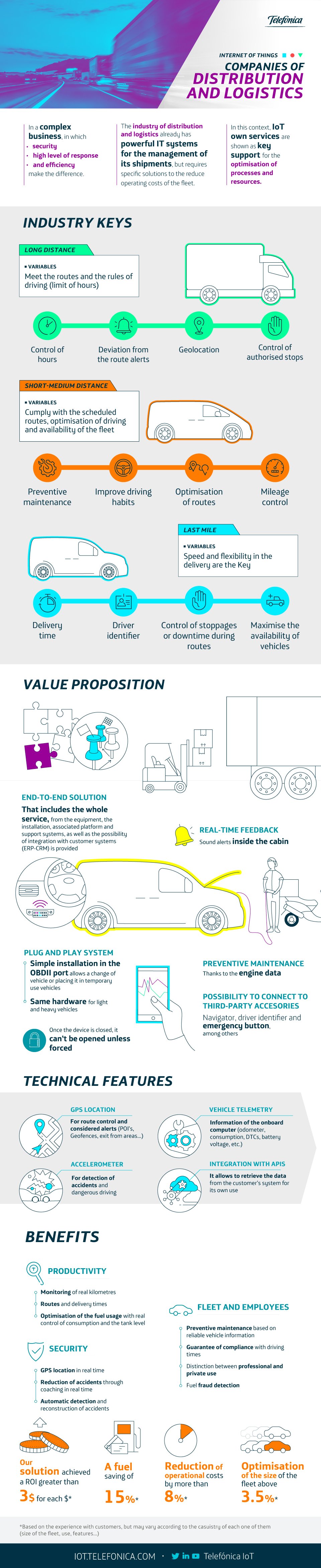
Distribution and Logistics Companies

Beatriz Sanz Baños    4 July, 2019

IoT technology services are already applied in the distribution and logistics industry to optimize different processes. This has a positive effect on the productivity, security and the preventive maintenance of the fleets.