
Big Data and IoT in tennis, serving up new insights

Olivia Brookhouse    3 March, 2020

One of the closest games in Tennis history was the 2008 Wimbledon final between Rafael Nadal and Roger Federer; a 5 hour and 5 set fight, resulting in the longest final in Wimbledon history. Nadal came out on top, but in such a tight match, between players of similar skill levels, the difference between winning and losing is in the minute details.

First in our series of #IoTinSport, Big Data and IoT in Tennis can now be used to uncover hidden insights, not only to analyse individual performance but to predict how opponents will play to build a tailored strategy for future matches. Technology is quickly becoming an integral component to ensure success for tennis players.

Big Data means better chances

From the amount of shots hit, to the degree of spin achieved on each stroke, Big Data encompasses it all, holding metrics on every single action which can be broken down, analysed and used to improve performance. Real time applications like SAP Tennis Analytics allow coaches to see how and why the player is performing as they are to ensure quick decision making and strategy planning.

As with anything, the more data collected, the more accurate the analysis will be. Identifying areas of weakness and improvement will give the best chance of beating the opponent.

The intelligent use of data during preparation can have a significant impact on a match.


Craig O’Shannessy, the official strategy analyst for the ATP

Big data analytics, the process of collecting and analysing large amounts of data to extract information, finds hidden patterns within the play. For example, based on how high and at what angle the ball is thrown into the air before it is served, the machine learning software will be enable to learn where the ball is most likely to land and therefore how likely the player is to win the shot.

Extracting patterns of play are extremely useful for coaches as it takes the data beyond simple descriptions, providing predictive analysis to ensure strategy optimization, tailored specifically to each opponent.

Big Data is not only being used to provide performance analytics; it can also enhance other aspects of Tennis such as improving fan engagement strategies and building greater sponsorship opportunities. “We can precisely equate fan visibility to media value to allow our sponsors to calculate the return on investment”, Lewis Sherr, Chief Revenue Officer at the US Tennis Association.

IoT, connecting the game

So, we’ve talked about Big Data, but how does IoT play a crucial role in digitalizing Tennis. IoT connected sensors in smart stadiums capture information inorder to enhance facility and resource performance, whilst hawk-eye cameras and smart rackets record metrics of the players performance.

At the Rafa Nadal Academy by Movistar, the connected facilities provide optimal conditions to train the best.

https://youtu.be/fTVyJWiM16o

Babolat play is one of the start-ups transforming the field of sports equipment. They have designed IoT mini sensors and trackers into the traditional tennis racket design which can provide real time insights on swing speed, angle, ball trajectory and other aspects of performance of each hit.

Connecting the game makes analysing performance much more efficient, freeing up coaches’ time to focus on creative strategy.

To stay up to date with LUCA, visit our Webpage, subscribe to LUCA Data Speaks and follow us on TwitterLinkedIn YouTube.

Fake News : how should we be fighting it?

Olivia Brookhouse    28 February, 2020

55% of people in Spain use social media to get their daily news fix instead of traditional newspapers meaning these platforms have become very influential in the last few years in reporting and spreading major stories. However, with the rise of Fake News and Deep Fakes, we must question whether what we are reading is actually true.

We are at war — an information war

Claire Wardle, executive chair of First Draft

The difference between Fake News and Deep Fakes

Fakenews refers to a pulications or propoganda which aim to misinform or spread hoaxes via traditional news media or online social media, which has become the easiest platform to share fake news. Deep fakes refer to fake videos which have been edited using sophisticated digital video manipulation.

The technology used to manipulate these videos is called GANs technology. Ian Goodfellow invented a machine learning technique called a General adversarial network which can generate new data from the data provided. For example, from 100 pictures of a cat, the network can produce a new realistic version that is completely unique. The technology can also generate new audio clips and text. However, the threat of the technology did not become clear until 2017 when a Reddit user used the technology to superimpose celebrities’ faces on actors in pornography.

Celebrities and Politicians are often those targeted by deep fakes, manipulating what they have said, where they are or what they are doing which often results in something controversial and untrue.

Who has been targeted?

Facebook has actively removed 3.3 billion fake accounts which it believes to be accounts run by bots, publishing damaging content. Facebook has been an extremely influential platform in recent elections and therefore a hub for fake news and deep fakes. Even Zuckerberg himself became a victim of a deep fake where he seemed to say that he had “control over billions of people’s stolen data”.

Twitter, like Facebook said it removed nearly 6,000 fake accounts created by the Saudi government.

Donald Trump, the master of the phrase “fake news” was targeted by a Belgium political party who made a deep fake video of Mr. Trump trying to persuade countries to withdraw from the Paris Agreement. The party responsible had created the video as a joke to attract people to their petition calling for more radical climate change policies. However, the video caused hysteria and showed how powerful the technology could be, especially in the political arena.

Buzzfeed has also been criticized for the amount of fake news circulating on its site. A network of social media accounts connected to Russia used the Buzzfeed community to publish a forged MI6 agent interview, conspiracy theories about David Cameron’s stance on Brexit and another about the sale of the NHS. All the stories aimed to “create divisions between western countries”.

How can we stop fake news?

Every time we passively accept information without double-checking, or share a post, image or video before we’ve verified it, we’re adding to the noise and confusion

Wardle, a former research fellow at the Harvard Kennedy School.

As consumers of online content we must be conscious of what we share, particularly if you have many followers.

  • Ensure you are not sharing content without verifying the source. This may mean triple checking information and using more reliable sources to spot fake news.
  • Watch controversial videos closely to see if the mouth and sound move together naturally to spot deep fakes.
  • Paste photos into the google image search engine to see if a picture has been modified from an original. The free service TinEye tracks where images appear online
  • Check the metadata behind images and videos to show date, time and sometimes location

To stay up to date with LUCA, visit our Webpage, subscribe to LUCA Data Speaks and follow us on TwitterLinkedIn YouTube.

ElevenPaths at RSA Conference 2020

ElevenPaths    21 February, 2020

Once again, we return to the RSA Conference, the reference event in the cybersecurity sector. From February 24 to 27 we will be presenting our proposal under the claim Humanizing Security. Three days full of activities, meetings, presentation of demos and projects of some start ups supported by Wayra and companies invested by Telefónica.

The activities will take place at our booth, South #1459 at the Moscone Center in San Francisco. Discover what you will find there:

Our tools’ demos

The Innovation and Laboratory Area, together with the IoT Cybersecurity Area, are working to develop new security tools that adapt to new technological trends and allow technology to be used safely. The demos that we will present during the RSA Conference are the following:

  • IDoT: IDoT provides IoT devices with a unique identity, particularly those that perform critical operations and must be monitored in detail. This robust identity allows guaranteeing the sending of that information generated by the device in a secure way, using end-to-end encryption with an own certificate issued on the fly by Telefónica.
  • TheTHE: Due to the experience of our Threat Hunting teams, the Innovation and Lab team has developed a free OpenSource framework hosted at Github to facilitate the first stages of research.
  • IoT Anomaly Detection: this demonstration allows to monitor in real time attacks aimed at IoT devices, especially brute force attacks. The information of the attack arrives automatically to the IoT Threat Detection platform, allowing to detect the attack and to raise an alert with details of the attack.
  • Aldara: one of the main tools of VERO, an intelligence service that has allowed us to analyze the behavior and progress of Coronavirus in social networks. We will present conclusions, figures and main communities created around the virus in the digital world.

Security Start ups and Wayra

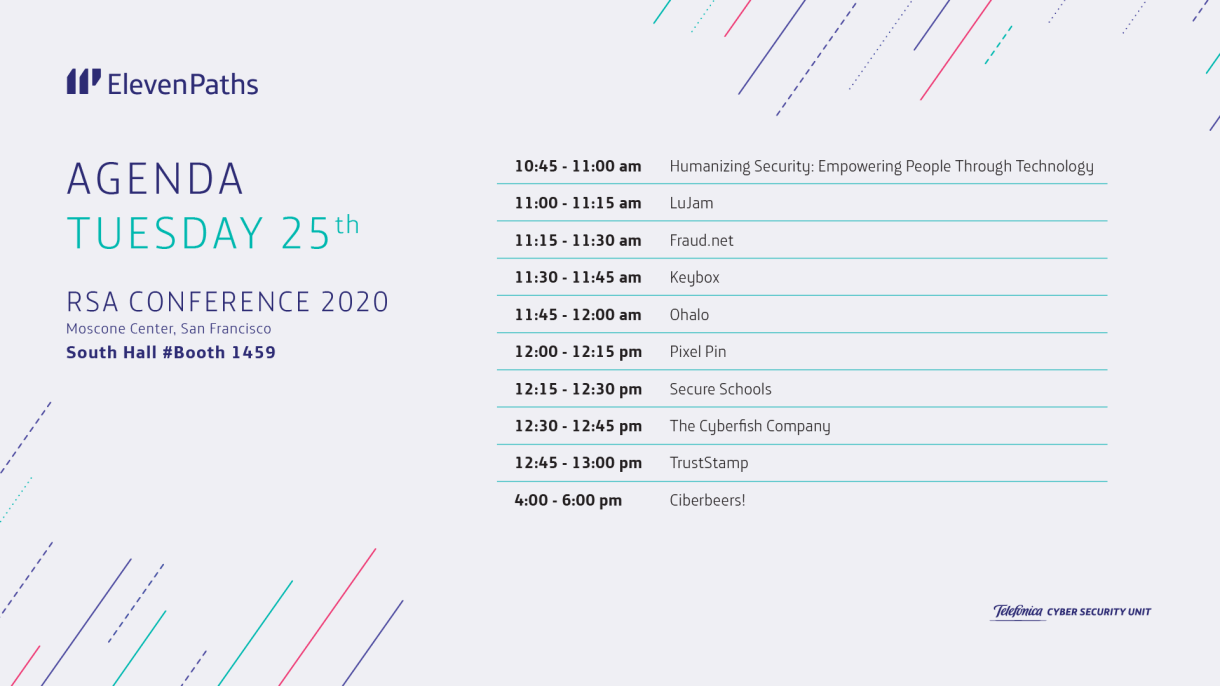
On Tuesday we will enjoy the visit to our stand of several security start ups who will present their proposals with Wayra. Discover their innovative solutions from 11:00 to 13:00 on Tuesday 25 February:

  • LuJam: LuJam Cyber was founded in 2014 when Tim Moran realised that small and mid-sized businesses need similar levels of cyber security to that enjoyed by major enterprises, but delivered in a way that was easy for a business owner or manager to use, without having to be an IT specialist. Four years and extensive trials later LuJam launched its Cyber Protection Service. The inexpensive subscription service offers a jargon free customer experience that gives visibility of all the devices connected to a network, while protecting it 24/7 against the latest cyber threats.
  • CloudKnox: CloudKnox is a two-year-old company based in Sunnyvale California founded by veterans from VMWare. It addresses a significant risk in a twenty-five-year-old technology, role based access control.To date it has raised $12m in seed and series A funding from ClearSky Security, Dell Ventures and Foundation Capital. It has been successful in winning several awards already including Gold for the InfoSecurity Startup of the Year 2019. In the short time the product has been shipping CloudKnox have secured customers including Blackrock and eBay.​ 11:00 – 11:15 AM
  • Fraud.net: Fraud.net operates a real-time fraud detection and analytics platform, helping digital payment companies to quickly identify transactional anomalies and pinpoint fraud using big data and live-streaming visualizations. This first-of-its-kind platform allows enterprises to monitor their end-to-end fraud program’s performance, identify process improvement opportunities, and gain new insights into developing fraud trends in minutes instead of months.​ 11:15 – 11:30 AM
  • Keybox: Keybox is a distributed data vault allowing the highest level of data security through fragmentation and distributed storage. Using distributed ledger technology Keybox stores “information secure” fragments of encrypted data in multiple nodes, and smart contracts to recombine data when required. Keybox allows anyone with high value data to store that data in a way that is both highly secure and readily available. It thereby addresses expensive data hacks and data leaks that we see more frequently in centralised data storage.​ 11:30 – 11:45 AM
  • Ohalo: Ohalo is a data privacy focused enterprise software firm.  We produce tools that automate data privacy compliance processes, such as data mapping and answering data subject requests, for better, more efficient data governance.  Our Data X-Ray tool employs machine learning to let users scan unstructured, structured and semi-structured datasources for personal data, which they can then efficiently search across at scale. 11:45 – 12:00 AM
  • Pixel Pin: PixelPin was founded in 2012 by Brian Taylor and Geoff Anderson. The two co-founders saw a market opportunity for improved authentication methods. The product was iterated using client feedback over the first few years and went live with its first clients in 2016.  In 2018 PixelPin picked up their first Venture Capital funding from SBI (formally SoftBank Investments) in Japan, with an investment of £1 million. This brought the lifetime funding to £4.5 million. The company has offices in London, Cheltenham and Tokyo​. 12:00 – 12:15 PM
  • Secure Schools: We are experts in information security, and education is in our DNA. Our technology is awesome but wouldn’t have been possible without a thorough understanding of school culture and the challenges they face. Paul Alberry (an information security expert) and Jill Foster (an expert in education; former headteacher and multi-academy trust CEO) formed the co-founding team, having worked together in schools for eight years on technical projects.​ 12:15 – 12:30 PM
  • The Cyberfish Company: The CyberFish Company delivers solutions that manage organisational exposure to digital risk resulting from human behaviour. Our Attitudes Assessment is a pioneering first, psychometric assessment, measuring 32 personality traits. Our research has shown to have a direct, indirect influence on security risk and organisational resiliency. It is used with clients for recruitment, development, and education initiatives. Wargaming simulation playbooks and bespoke role-play helps organisations test their leadership and incident response dynamics in crisis. Improving the overall resiliency of organizations​ . 12:30 – 12:45 PM
  • TrustStamp: Trust Stamp is a dynamic four-year-old cyber security startup with dual headquarters and corporate registrations in the United States and United Kingdom. We are 30+ ambitious and creative scientists, technologists, economists, law-enforcement professionals and entrepreneurs. We are committed to building long-term shareholder value by inventing, patenting and delivering ethical, AI-powered solutions addressing trust and identity while empowering transactional and personal security, data privacy and integrity​. 12:45 – 13:00 PM
 Agenda ElevenPaths tuesday 25 RSA Conference 2020
Agenda ElevenPaths tuesday 25 RSA Conference 2020

Presentations by our experts

On Wednesday it will be the turn of our experts. Through different lectures led by ElevenPaths security team we will present our own contents, we leave you with the order and topics of the lectures, as well as the speakers:

  • Humanizing Security: There when you need us, Emma O’Nien and Paulo López. 11:00 – 11:15 AM
  • IoT & OT, Vicente Segura. 11:15 – 11:30 AM
  • Coronavirus: Health and beyond, Helene Aguirre. 11:30 – 11:45 AM
  • Open Cloud Factory, Ester Tejedor and Darragh Kelly. 1:00 – 1:15 PM
  • Intelligence & Innovation, Claudio Caracciolo. 1:15 – 1:30 PM
  • Innovative Technologies, Claudio Caracciolo. 1:30 – 1:45 PM
  • Cloud Security, David Martín Lindstrom. 3:00 – 3:15 PM
  • SOC of the future architecture, Alexandre Gaspar. 3:15 – 3:30 PM
  • MDR & MSSP, Alberto Cuesta. 3:30 – 3:45 PM
Agenda ElevenPaths wednesday 26 RSA Conference 2020

Invited Companies

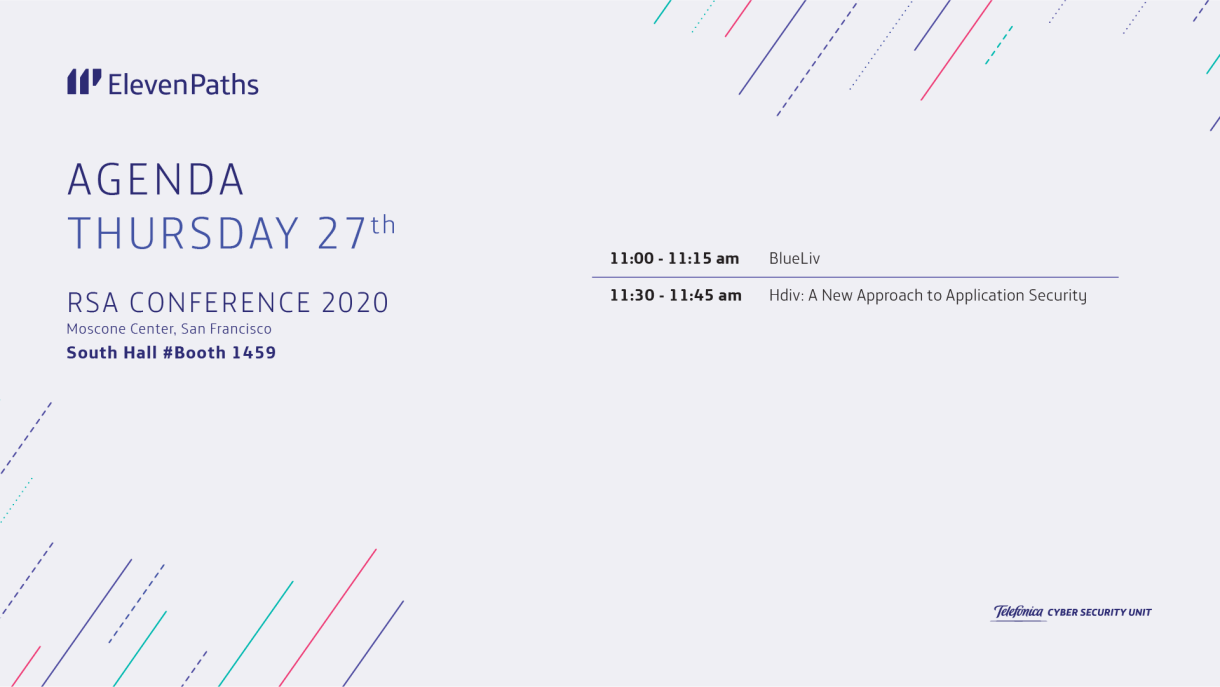
On Thursday, several companies will come to our booth to share experiences and create synergies:

  • BlueLiv: Blueliv is Europe’s leading cyberthreat intelligence provider, headquartered in Barcelona, Spain. We look beyond your perimeter, scouring the open, deep and dark web to deliver fresh, automated and actionable threat intelligence to protect the enterprise and manage your digital risk.​ 11:00 – 11:15 AM
  • Hdiv: Hdiv Security is a leading provider of security software for real-time, self-protected applications, being the first company worldwide to offer protection against security bugs and design flaws from SDLC. Since 2008, we have pioneered self-protection software and today, Hdiv integrates with leading commercial software providers such as Spring and Grails.​ 11:30 – 11:45 AM
  Agenda ElevenPaths thursday 27 RSA Conference 2020
Agenda ElevenPaths thursday 27 RSA Conference 2020

If you’re going to be in San Francisco, we’ll be waiting for you at the RSA Conference. Remember that you can use our Expo Code (XE0UTELEF) to register and access to the conference.

Artificial Intelligence to fight pandemics

Paloma Recuero de los Santos    19 February, 2020

Did you know how Artificial Intelligence can help us fight pandemics like the 2019-nCoV coronavirus? In today’s post we tell you how it can become a great tool for national and international health authorities.

The coronavirus 2019-nCoV

Canadian start-up BlueDot alerted its clients to the outbreak of the epidemic in the Chinese city of Wuhan a week before its detection by US health authorities and the World Health Organization.

Coronavirus, still unclassified, has infected 7700 people in just one month, and is responsible for the death of 170. All this in spite of the fact that the world’s largest collection of strategic resources are in place to stop the spread.

Mobility and transport restrictions have affected 60 million people in an attempt to curb the spread of the epidemic. Despite this, WHO has been forced to declare an international emergency. According to the International Health Regulations, the declaration of an emergency must be made when an event “constitutes a risk to the public health of other States through the international spread of a disease”. This “may require a coordinated international response”.

What is a virus?

Viruses are much smaller microorganisms than bacteria. We can only see them through an electron microscope. To multiply, they need a host. That’s why they emerged on our planet at the same time as living things.

It’s estimated that there are about 2 million different species of viruses on Earth. They are, therefore, the most numerous and diverse living beings that exist.

On the other hand, our planet is populated by 7.7 billion people, in continuous population growth. We live in a globalized world and, as a consequence, the flow of people, animals and goods even between continents, is permanent. And with them, viruses travel.

For example, the seasonal flu virus jumps from one continent to another, taking advantage of the movements of migratory birds. Others, like HIV, which affected monkeys, leave the natural niches in which they were confined, and begin to spread among humans.

How to fight the viruses?

To fight them, it is essential to develop antiviral and antibody-based therapies capable of stopping the infection in affected people. It is also very important to use preventive vaccines among health workers or those at risk of infection, in order to prevent its progression.

Therefore, early detection of new diseases is key in the fight against global pandemics. It is at this point that artificial intelligence can help us fight viruses.

Artificial intelligence against viruses

BlueDot was founded in 2014 to provide health workers with early warnings to more effectively identify and treat people who may suffer from epidemic infectious diseases, thus helping to slow their spread.

To do this, they rely on natural language processing techniques that analyze 100,000 articles in 65 languages to track information on more than 100 infectious diseases everyday. Their machine learning algorithms scan news, official reports, blogs and forums related to diseases that can affect people, animals and plants. They also analyze weather or mobility information, which allows them to predict the next “jump” of the disease. For example, the algorithm correctly predicted that coronavirus would jump from Wuhan to Bangkok, Seoul, Taipei and Tokyo in the days following its initial appearance.

BlueDot’s epidemiologists analyze this information and issue reports that alert their clients (companies, governments, NGOs). They will then forward them to health centers and public health officials in a dozen countries. In this way, they help them to react more quickly and efficiently to these emergencies.

Early detection is key in the fight against pandemics and, as we can see, Artificial Intelligence can be a great ally.

To stay up to date with LUCA, visit our Webpage, subscribe to LUCA Data Speaks and follow us on TwitterLinkedIn YouTube.

APTualizator (II): Deconstructing Necurs Rootkit and Tools for Detecting and Removing It

ElevenPaths    18 February, 2020

This report has been drafted by Roberto Santos and Javier Rascón from the CSIRT-SCC (Security Cyberoperations Center) Research Team, in collaboration with ElevenPaths. 

At the end of June 2019, a big Spanish company was attacked and thousands of their computers were impacted. Such was the size of the attack that we were motivated to begin this investigation. In July 2019, we wrote an article on this issue: APTualizador (I)

At that time we were struck because in a first quick analysis we observed that the sample downloaded the legitimate Windows security update KB3033929, although it did so from an unofficial server. In other words: it installed the legitimate file (signed by Microsoft) from an unofficial server. 

This second report will be focused on the technical aspects of the rootkit found. 

As a result of the investigation we identified this rootkit as a development of Necurs. This botnet (appeared in 2012) is one of the most persistent and largest in the world and it is estimated that it is made up of 6 million zombie computers −target computers around the world and controlled by attackers remotely. 

This report will consider in depth and from a technical perspective how malware manages to hide in the computer, analyzing the tools used and the code that controls this behavior. On the other hand, the communication protocol used is also analyzed. This has been modified since the first versions and IOCTL commands are no longer used. Instead, it is now based on reading / writing on Windows registry, turning the registry into a local covert channel. 

Our investigation ends with the release of two tools, NeCure and NeCsists, that allow detecting malware and disinfecting the machine. These tools have been developed after finding the means to exploit the techniques used by the attackers themselves, thanks to the study and analysis using reverse engineering techniques. 

Through this report, we have helped update the state of the art on the evolution of one of the most sophisticated rootkits so far. 

Conclusions and findings: 

  • An updated list including all functional commands that the rootkit may receive has been drawn. So far, only a very small number of them were known but if there were full lists, they were not updated. 
  • We have been able to develop tools that allow detection and disinfection. In addition, we make publicly available both this analysis and its source code. 
  • We show how Necurs has evolved into a business model of the type Malware as a Service that serves as an input vector for another malware and offers this service to other actors. Only this explains the existence of the keys that set a deadline and a maximum number of malware executions. 
  • Thanks to the comparison between blacklists (list of processes against which the rootkit protects itself) from previous and current versions, an active investigation work performed by attackers on the state of the art of antimalware solutions is drawn. 

Full report available here:

The Telco Security Alliance Bolsters Threat Detection Capabilities Through Shared Intelligence

ElevenPaths    18 February, 2020

Dallas, Singapore and Madrid, February 18th, 2020  The Telco Security Alliance today announced new collaborative efforts designed to further enhance the ability to detect and eliminate threats from customer environments.  

Members of the alliance — AT&T, Singtel and Telefónica – are working together, continuously sharing the latest threat intelligence and indicators of compromise (IoCs) related to cybersecurity threats and global attack campaigns so they can help organizations remain resilient as the threat landscape evolves. We believe this to be the first-of-its-kind collaboration among telecommunication providers’ security organizations. 

Telco Security Alliance threat intelligence is derived from multiple sources including anonymized data from alliance member security operations centers and security investigations. By pooling valuable information on new malware campaigns and indicators of compromise from ongoing attacks, our customers gain a more global and complete view of cybersecurity developments that may impact operations. 

Joint threat intelligence sharing will allow our security analysts to take more proactive means to combat malicious activities. We will accomplish this by writing and pushing signatures for newly discovered malware and phishing campaigns across customer products and environments down to individual endpoints. The different feeds serving the threat intelligence instruments will utilize the AT&T Alien Labs® Open Threat Exchange® (OTX™) platform. 

The Telco Security Alliance formed by AT&T, Etisalat, Singtel, SoftBank and Telefónica, is the first global security alliance between telecom operators. The alliance aims to improve each member’s ability to respond rapidly to cybersecurity threats. The Telco Security Alliance aims to help enterprises and government agencies address the growing threat of cyber-attacks and the evolving threat landscape. 

AT&T, Singtel and Telefónica are the first Telco Security Alliance members to participate in the threat intelligence sharing initiative but expansion to other members is planned. 

Telco Security Alliance member quotes: 

“Access to global actionable threat intelligence has become increasingly crucial as cyber threats traverse sovereign boundaries,” said Chng Tien San, Global Head of Alliances at Trustwave, a Singtel company. “Trustwave helps enterprises perform continuous threat detection and response, and we look forward to our continued collaboration with the Telco Security Alliance as we collectively help businesses embrace digital transformation securely.”  

“Our customers demand us to deliver contextualized threat intelligence, delivering as many details as possible to reveal undetected attacks. By leveraging the Alliance members’ most relevant IoCs into one single platform, it will allow us to improve our detection and response, and the emerging playbooks will let our analysts focus on the analysis and investigations of the advanced threat defeating techniques,” said Sebastián García de Saint-Léger, Telco Sector managing Director at ElevenPaths.   

“This relationship supports the global fight against cybercrime,” said Jaime Blasco, AVP of Product Development for AT&T Cybersecurity. “This initiative already proved valuable to AT&T’s visibility into current threats, and as we continue to work together, our focus is on utilizing this relationship to deliver better threat intelligence to our customers.” 

The Radio, getting smarter everyday thanks to Artificial Intelligence

Elena Selgas Carvajal    13 February, 2020

Nowadays the presence of online radios and podcasts has transformed the sector of the radio as it has  adapted to new consumer habits. In this post we will explore what Artificial Intelligence can bring to the future of the radio and if new technologies will overshadow the traditional platform.

The radio emerged at the end of the 19th century, revolutionizing the world of communications, as a wireless alternative to the telegraph. The original idea was to use the device for military purposes that would allow information to be transmitted even from out at sea. A few years later its role would evolve into a channel that could deliver information, entertainment and music to the masses.

In 1906 the first radio broadcast was made in Massachusetts, where listeners enjoyed the broadcast of “Oh Holy Night” and passages from the Bible. From then on, the radio has experienced a remarkable evolution.

Consumer habits

In the last 10 years every mode of communication has had to redefine its content and advertising strategies due to the presence of the internet in its fields. In particular, this has meant a big change for the radio. It has also been an opportunity, not only for the audience but  for amateurs and professionals alike to create their own radio stations in an easy and economical way.

With the arrival of the online radios, platforms such as Spotify, Apple Music and Prime Music, and podcasts, the consumption of the conventional radio has decreased, especially amongst the youth populations. Despite this, the radio continues to be a mass media, which, while maintaining its traditional channel, has managed to take advantage of new opportunities to expand its reach, without losing its identity.

 The choice to listen to online platforms over the radio is often because of how easy it is to select content at any moment but requires internet connection. On the radio, content is available at the press of a button, but it is decided by the broadcaster of the radio station and therefore lacks customization. Therefore, both have their advantages and disadvantages. The choice between the radio and these platforms is very much dependant on the individual listeners tastes at that specific moment. One isn’t completely substitutable for the other due to their different characteristics and requirements.

AI chooses the content of the radio

Some professionals in the industry think that AI can do a very good job in choosing the content that listeners want to hear. However, others argue that the role of the human producer is essential in this selection of content and of course as a DJ.

Brian Kamisky, president of Revenue Operations and Insights for iHeartMedia, argues that creating content for the radio comes down to creating an experience that builds a connection with listeners and keeps them entertained, informed and eager to come back for more. AI should be used in a responsible way whilst maintaining and enhancing the human elements.

“We shouldn’t be looking for ways to replace humans.”

Brian Kamisky

iHeartMedia uses algorithms to choose which music is played and which combinations of content are scheduled, but leaves  the final decision on what is broadcasted to the humans. There are many AI and Machine Learning solutions that assist in the creation of musical compositions, but the quality of these products is subjective and the selection of what the audience wants to hear will still require human approval.

“The technology will be there to help us classify the large amounts of content being produced and make us more efficient in that process.”

Brian Kamisky

A smart radio thanks to AI

Several companies have tried to innovate by creating radios that rely on Artificial Intelligence. Here we have two examples that use this technology in different aspects.

Firstly, Worldcast systems, a company that designs and develops innovative radio and television broadcasting equipment worldwide, presents the first Artificial Intelligence for FM radio, SmartFM. Through AI, an algorithm is implemented that can adapt the broadcasting power in real time according to different variables of the signal entering the transmitter.

With this new technology they intend to:

  • Improve the listening experience for listeners
  • Reduce energy costs by 10-40%
  • Reduce CO2 emissions

Likewise, the communication company Uniform Communications, presents Solo, an intelligent digital radio that interacts with people. By scanning faces it is able to determine their mood and find a song that reflects exactly how each person feels.

Solo works through Spotify, taking advantage of a platform that already categorizes its songs  by mood, and incorporating its own analysis of facial characteristics of the person in front of the device. The designers of Uniform predict that the technology, which is already capable of recognising  the characteristics for many moods, will improve as the algorithms progress.

The future of traditional radio

Will all these technological innovations be able to replace the traditional radio? Despite all the innovations, traditional radio seems irreplaceable. Issac Moreno, president of the Hybrid Radio Forum, explained at BITAM 2018: “It is analogical, I know, but it is the queen of broadcasting, not only in Spain but in Europe. Some reasons are its ubiquity, simplicity of use, privacy, security, control of the whole distribution chain and its free of charge.”

Many experts agree that, although Artificial Intelligence and new technologies can bring many improvements and innovations to radio, human presence is, and will always be, fundamental in this media when it comes to connecting and achieving empathy with the listener.

To stay up to date with LUCA, visit our Webpage, subscribe to LUCA Data Speaks and follow us on TwitterLinkedIn YouTube.

Artificial Intelligence, making its mark in Hollywood

Olivia Brookhouse    11 February, 2020

700 films are produced in Hollywood each year, generating 35 billion dollars in revenue, but how can producers predict what will be successful out of hundreds of movie ideas that are pitched? Artificial Intelligence, once the subject of sci-fi films as a futuristic force is now getting behind the lens, using Machine Learning techniques to provide more intelligent decision-making within the film industry.

Artificial Intelligence has already established a strong relationship with online streaming services such as Netflix and Amazon to power personalized and intuitive experiences. Its recommendation systems keeps subscribers hooked from series to series. Now, AI is slowly breaking into Hollywood and changing the game.  

The start-ups transforming the film industry

Cinelytic is one of the key players promising Artificial Intelligence as the next best producer in Hollywood. Using Machine Learning, it can provide hidden patterns within the historical data, highlighting how various parameters will weigh in on the movie’s success and profitability.

Similar companies have also appeared, claiming to provide untapped insights to produce a blockbuster. Vault, an Israeli startup, founded in 2015, promises to predict which demographics will watch their films by tracking how its trailers are received online. Also founded in 2015, ScriptBook, has produced an algorithm that claims to predict profitability just by analysing its script.

Warner bros, the second biggest grossing film studio in Hollywood, with a 13.4% share of the total revenue has announced it will be working with Cinelytic to guide decision-making at the “greenlight stage”. They have assured that AI will not be culling creativity, instead it will deliver insights to inform decisions in the research stage; human creativity is still very much required to produce a blockbuster.

“AI is good at crunching numbers, breaking down huge data sets and showing patterns that would not be visible to humans. But for creative decision-making, you still need experience and gut instinct”

Tobias Queisser, Founder of Cinelytic.

How does the technology produce insights?  

Hollywood is full of surprises, of films that did better than expected and those that did not fulfill expectations. Artificial Intelligence should be used as a supplementary tool that can help predict those “suprises” to minimise losses. The Joker, a psychological thriller directed by Todd Philips was subject to a lot of controversy prior to its release. However, in its opening weekend alone, it grossed $234 million worldwide, when predictions said it would only make half.

The predictive analysis that these companies can provide is particularly important in the film industry where the majority of films that are made are not released and of those that are released, only half cover their costs. AI is able to anticipate whether it will be an immediate flop with the desired audience or if the proposal is achievable within the budget.

Cinelytic combines AI and cloud-based technologies to enable companies to make well-informed decisions throughout the content value chain. The comprehensive data, predictive analytics and project management tools are accesible through an interactive online platform. AI-powered predictive forecasting tool informs decisions on greenlighting, casting, financing, budgeting and release decisions. The online platform allows companies to play around with metrics to ensure the highest forecast of profitability.

For example, if they wanted to make romantic comedy starring Jennifer Aniston and Bradley cooper but one of them was unavailable, producers can play around with different actors to find a winning combination. This is something that producers can already judge, but that AI can do quicker.

Is AI always right?

The problem with using Artificial Intelligence in Hollywood for casting is that, like many AI applications, producers must consider data bias. If there’s a higher proportion of successful films with white male casts, this will be reflected in the data. Producers must use AI as an advisor, to ensure the film industry moves with the times, not with the past. Experts also worry that if you fed the machine a completely unique and experimental idea, the algorithm would discourage you from taking the risk due to the lack of data to support the claim.

The possibility of AI becoming the best producer in Hollywood is something we will have to see over the coming years. As a creative however, AI produces some questionable work. The deep neaural network is fed thousands of scripts in order to learn how to write a winning result, equipped with stage directions, often producing amusing results:

To stay up to date with LUCA, visit our Webpage, subscribe to LUCA Data Speaks and follow us on TwitterLinkedIn YouTube.

TheTHE: The Threat Hunting Environment, our tool for researchers

Innovation and Laboratory Area in ElevenPaths    10 February, 2020

A given IOC comes to your hands, for instance a hash, URL, IP or suspicious domain. You need to find out some basic information. Is it malware? Is it in any repository? Since when? Whois? Source country? Is it in pastebin?

You start to open tabs, to enter passwords in the different services and launch queries. Hopefully you have an API shared with a co-worker and, after checking several systems, you open a TXT to recopy the data to the intelligence platform. Your co-worker, who you share those APIs and passwords with but who is on your computer elsewhere in the world, does the same because the same IOC has also reached their hands. This is over with TheTHE.

A video is worth a thousand words

The Threat Hunting Environment

We recently presented this tool at the Black Hat 2019 in London, where it was well received among the target audience: researchers, SOCs, teams, security companies, CERTs, etc. TheTHE is an environment intended to help analysts and hunters over the early stages of their work to make it easier, faster and more unified. One of the major drawbacks when hunting or investigating IoCs is dealing with the initial collection of such amount of information coming from so many sources, public and private.

All this information is usually scattered and sometimes even volatile. Perhaps at a certain point there is no information on a particular IOC (Indicator of Compromise), but that situation may change within a few hours and become crucial for the investigation. Based on our experience on Threat Hunting, we have created a free and open source framework to make the early stages of the investigation simpler:

  • IoCs are yours: never shared out of your platform.
  • Free as in beer, free as in freedom: dockerized and totally yours.
  • Server-client architecture: investigation may be shared with your team.
  • Results are cached so no repeated API calls are used.
  • Feeds better your Threat intelligence Platform: TheTHE enables performing easier and faster previous research.
  • Easy plugins: whatever is needed, it may be easily embedded within the interface.
  • Ideal for SOCs, CERTS or any team.
  • APIkeys are stored in a database and may be shared by a team from a single point.
  • Automation of tasks and searches.
  • Rapid API processing of multiple tools.
  • Unification of information in a single interface: so that screenshots, spreadsheets, text files, etc. are not scattered.
  • Enrichment of collected data.
  • Periodic monitoring of a given IOC in case new information or related movements appear.
  • IOCs do never leave your environment!

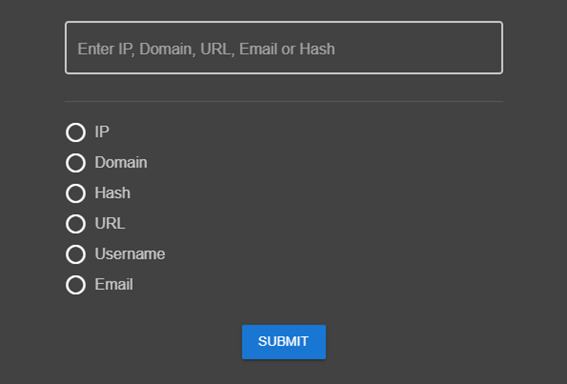
TheTHE has a web interface where the analyst starts its work by entering IOCs that will be sent to a backend, where the system will automatically look up for such resource (via plugins) on the various configured platforms in order to obtain unified information from different sources and access related reports or data existing on them.

This image has an empty alt attribute; its file name is Esquema.png

Details of this tool

TheTHE is an open source and modular framework developed in Python 3 that allows to locally consolidate and analyze information on a MongoDB database, without sharing such information with other platforms until it is appropriately organized, linked and synthesized, which allows the information to be analyzed later in any other platform (like a Threat Intelligence Platform) in the most enriched way possible. It is a unique tool within its category that helps analysts and hunters to to carry out their research tasks in a more agile and practical way.

TheTHE is a framework that runs locally in your own system or local server. It currently has passive modules for information collection as well as active modules, which in turn allow to:

  • Obtain information automatically from multiple public and private sources (by configuring users’ own accounts and configurable APIs) such as Hunter.io, Maltiverse, Shodan, Sherlock, etc.
  • Execute tests and consolidate information from other tools such as Cansina, etc.

How does it work?

TheTHE is based on projects. A project is a container of related IoCs, for example. It creates a project for a set of users or for a specific research.

This image has an empty alt attribute; its file name is thethe1.jpg

In each project, there are six main menus based on the initial IoC you are working with. According to the IoC entered, TheTHE will try to classify it into the appropriate menu:

  • Network: basically, IP addresses.
  • Domain: domains only, any TLD.
  • URL: if your domain has a path, then is an URL.
  • Hash: any hash, MD5, SHA1 and SHA256.
  • Emails
  • Usernames: any string that is not in any other category will be treated as a username.

If you want to force something as a specific kind of IOC, choose it here.

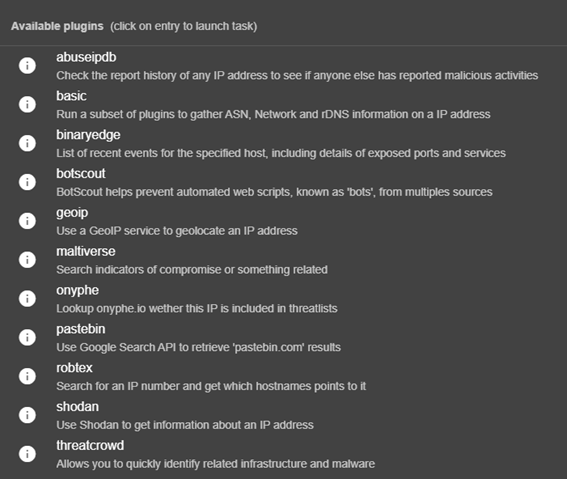
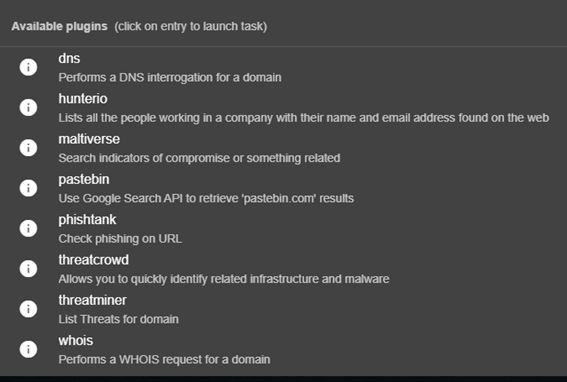
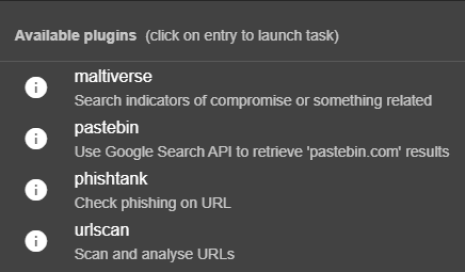
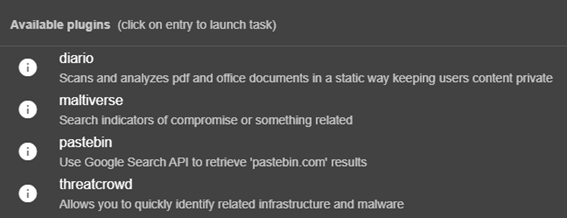
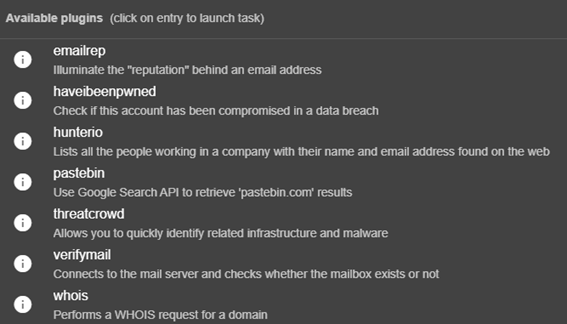
Within each menu, the minimum information required to process the information will be loaded. Within it, you can choose the appropriate plugins for each category that may be applied to each IoC.

For Network:

For Domains:

For URL:

For Hash:

For Emails:

For Usernames:

When a plugin is being used, the task will be queued, and results will be displayed when the necessary information is retrieved. All tasks will be queued asynchronously so work can continue while the results are calculated. In case of using third-party services on the network that need to consume APIs with APIkeys, these will be stored on the main server and all users will be able to use them remotely. The results will be cached indefinitely so as not to use requests if they have already been made by another team member. The results may be refreshed on request.

This image has an empty alt attribute; its file name is thethe3.jpg

Depending on the plugin output, a new tag will be created once the IoC is selected. Tags may be used to better categorize your work (with colors and names you can choose). Tags will be available for the same project once created.

Future work

  • Monitoring specific IOCs programmatically under platforms in case new data may appear in the future.
  • Monitoring changes in the infrastructures under investigation in case of failure or if new threats appear within.
  • Keeping a local record of the investigations performed.
  • Accessing information in a consolidated way on a local DB from a web interface.
  • Storing securely the various APIKeys and the pre-configuration of queries from dozens of public and private platforms.
  • Many more plugins!

AI Augmented Reality, powering the online shopping experience

Olivia Brookhouse    6 February, 2020

The online retail experience has transformed over the last 10 years, from simple webpages to personalized interactive experiences. ASOS, an exclusively online retailer has been one of the leading organizations to apply Artificial Intelligence to power intuitive recommendation systems. Now they are going one step further, introducing AI Augmented Reality to create a truly personalised experience, not just to your tastes but to mirror your body type too.

On the 14th of January, ASOS released its trial of “See My Fit” an AI powered augmented reality tool developed with Zeekit, a start-up dedicated to innovating the shopping experience. “See My Fit” offers a simulated view of products on models by digitally fitting garments onto their bodies. This provides a more accurate view on how the dresses will look of different shapes and sizes.

With this trial of See My Fit, we’re using the latest AR technology to put the power in our customers’ hands, so they can choose to view a dress on the model that they most identify with in a way that wouldn’t be possible using traditional model-shooting techniques,”

Tim Carey, senior content manager at ASOS Studios,

See My Fit

See My Fit can digitally map the garment onto each model, creating extremely realistic photographs. There are 16 different models of different heights, ranging from sizes 4-18. This allows customers to assess whether an item of clothing will suit them before purchasing, bringing the shopping experience truly into the home.

Source: asos.com

Augmented reality in E-commerce

Augmented reality is bridging the gap between the physical and digital world to empower online consumers. AI and AR are distinct technologies but can be used together to enrich the experience. “AR creates an enhanced version of reality by using technology to overlay digital information on an image”. In order to produce realistic experiences with accurate shape, lighting and materials, companies previously spent hours staging photoshoots. But now, Artificial Intelligence and Machine learning models can reduce content creation time and help make AR more realistic.

“We think AR, combined with AI, can be a killer combination of experiences unlike anything we’ve seen before,”

Abhay Parasnis, EVP and CTO at Adobe.

It is estimated that 40% of customers would be more willing to make the final purchase/spend more on a product if AR was part of the online experience. This puts companies such as ASOS at a strategic advantage with a more personalised offer.

To stay up to date with LUCA, visit our Webpage, subscribe to LUCA Data Speaks and follow us on TwitterLinkedIn YouTube.