MWC 2017 Day 1: Unlocking Big Data value with LUCA Comms

AI of Things    27 February, 2017
This week, we’re showing a range of truly exciting demos on our stand at Mobile World Congress in Barcelona. In Hall 3, as part of Telefónica’s stand – we’re bringing data-driven solutions to the masses, providing an interactive journey on our Microsoft Surface Hub.
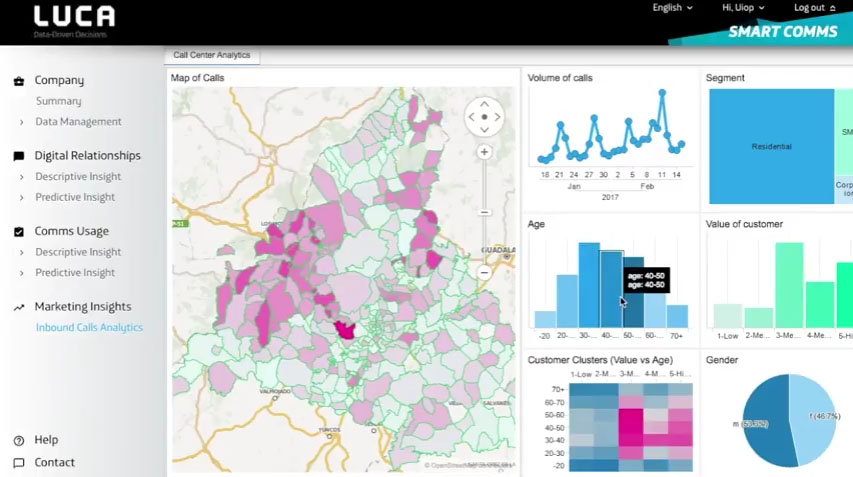
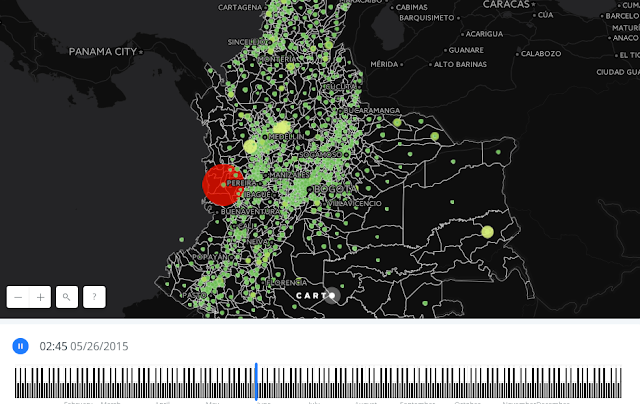
Each day on our blog, we’ll be sharing a short video demo of one of our solutions and today we’re kicking off with LUCA Comms.  This is a global communications visualization tool which leverages Machine Learning algorithms to enable multinational companies to predict and understand comms behaviour at a global level – providing key insights to CIOs and CFOs.  Check out our teaser video below:

If you’d like to see more, then come along to Hall 3 on Stand 3K21 and let us take you on a Big Data journey with one of our LUCA gurus. Alternatively, you can email us here.

ElevenPaths uncover several malicious apps on Google Play

Florence Broderick    27 February, 2017
ElevenPaths published recently an investigation revealing how malicious apps are opperating in Google PLay, by subscribing users under special tariff numbers. They analysed which type of app is mostly used to get potential victims’ attention, which tactics were used to disseminate the app, the infrastructure code and the management panels used in the campaigns


Some years ago, it was very easy to upload a “dialer” (or some type of malicious app) on Google Play, but now it’s getting harder and harder as the detection mechanisms have improved considerably. This fact pushed many groups to focus in other deposits of non official applications, although this doesn’t mean that the official deposits are protected from this threat. Not long ago, a Spanish group managed to upload a non official app from the famous TV Show in Spain “Gran Hermano”.

Its accomplishment to be in Google Play is based in an old trick. First of all, the uploaded a clear version that was approved by the security control in Google Play. Some days after, they updated the app adding new functionalities, including the subscription for paid services. This trick was extremely simple but the results ended up being very effective, as the app was available for downloads for around two months , (from mid September until mid November 2015).

This app used interesting and modern techniques, to manage fraudulent subscriptions and monetise the infection of victims. This group of “programmers” also tried something similar by using another dissemination sources besides Google Play. One of the services used in this application exposed a control panel with informations from “users”. In September 2016, they pushed it again in Google Play, still using the TV show theme.

This group really succeeded by uploading apps in Google Play, using an attractive theme as the Spanish TV show “Gran Hermano”. Spain and Poland are two countries traditionally picked as a targets for such type of applications. However, we haven’t seen in the latest years no group that could upload an app in official deposits in a relatively simply way. This types of apps, where functionalities are close to this thin line between what is a legit and what would be a fraudulent activity, they really test these automatic detection systems. This enables such apps to become available on Google Play, even if they are removed within some time.

Open Data and API’s in Video Games: League of Legends puts them to practice

AI of Things    24 February, 2017
 
When we at LUCA became aware of the release of the upcoming Movistar eSports we wanted to give a nod to fans of games like LOL and CSGO. With the help of David Heras, who collaborated with us by taking part in a scholarship and also has practical experience with LOL (as well as playing it, he is aware of the APIs it offers). Combining our experience, we have come up with a small representation of three European teams who will be taking part in the Intel Extreme Masters this weekend.


The following video shows David explaining what our small experiment consists of and how we created it. You can see that it is a curious and interesting example of Open Data that is available through using APIs, this is something that we really love and cannot get tired of debating. This can be seen and discussed through our LUCA Talk #1.  


To make a correct assessment, it would have obviously been more effective to use more historic and metric data, however we wanted to focus on showing the potential of Open Data via APIs. In fact, there are more sites that use APIs to present statistics in a very attractive way. Champion.gg is a website that collects user statistics from the champions of the game to show global statistics. Through this, we can find out where the game is played more or less. These statistics can be compared with league-analytics.com, who are specialized in collecting graphs and statistics from important game competitions.


Effectively, multiplying the value of your data is one of the best advantages of exposing data through API, whether that is for internal consumption to streamline and systematize the flow and processing of data within a company, or to create a business ecosystem based on the results. Ideally, this flow of data starts from the source of the data and then splits two ways. On one hand, this helps intra- and inter-system actions for the company (managing clients, products and processes. On the other hand, it can power visualisation tools (description, patterns, alerts, predictions, etc.) which can help the business make decisions. A good example of a business ecosystem using the data of a company accessible through APIs is BBVA’s API Market. We can’t forget that some of the challenges we mentioned for the use of data for the social good are also valid in these cases: privacy, security, and legislation.

We hope that this approach to video games has been inspiring and entertaining, keep on gaming!

 
Written by David Heras an intern at LUCA alongside Javier Carro, LUCA Data Scientist.

LUCA reshapes tourism insights at SDWC 2017

Ana Zamora    24 February, 2017
Last Friday, the first edition of the World Conference on Smart Destinations took place in Murcia. More than 100 experts from over twenty countries discussed trends such as digital tourism, innovation challenges, digital accessibility, tourism intelligence and the sustainable management of tourism resources.
The event, organized by the UNWTO together with the Ministry of Energy, Industry and Tourism and the Region of Murcia, brought together public administrations, leading businesses, travel agents, technology players and universities from around the world to analyze the 21st century tourism model.

Our CEO, Elena Gil, was one of the speakers, together with main players of the tourism sector including companies and public bodies such as Amadeus and the Global Sustainable Tourism Council.
Elena highlighted the immense importance of using data, specifically mobile data, to analyze, optimize and predict the different processes in the tourism sector. She shared how today’s traveller is increasingly digital and demanding, stating how companies and local councils need to fulfil their expectations.

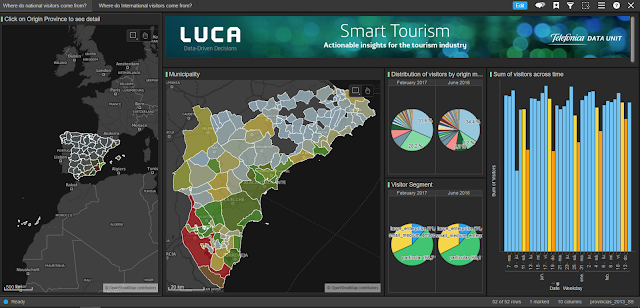
LUCA Tourism dashboard
Figure 1: A screenshot from our LUCA Tourism dashboard.

Afterwards, she explained LUCA Tourism, one of our mobile data insights solutions. With this product, we are able to analyze tourist behaviour, gaining key insights on their demographic profiles allowing us to really understand what they want and expect from their trip. Elena explained some of our case studies and also illustrated the two main types of insights we can provide: the movement of people, by showing us a points of interest activity analysis in Barcelona, and the profiling of tourists, through a demo about the demography of tourists in Murcia.


If you’d like to find out more, you can watch Elena’s full presentation here, in Spanish:

Our top 5 Big Data blogs

AI of Things    23 February, 2017
Want to keep up with the latest innovation Big Data? Who are the Artificial Intelligence gurus out there on Twitter? It’s normal to feel the struggle to keep up with latest evolutions in these spaces but we think that specialist bloggers provide a great way to do so.  This week, we’ve taken a look online to understand which have the best content to keep your finger on the Big Data and AI pulse.


One of the most widely read blogs we came across was CIO, a website which is not so author-focused but rather shares tech news and trends. CIO is to the tech sector what Adweek is to publicists – which should give you an idea of the quality of the content. By using the Big Data tag, you’ll find some top quality content to keep you up to date. 

CIO webpage
Figure 3: CIO has a great amount of content to read everyday about tech.


2. Forrester’s Blog

Leading analysts, Forrester, have a dedicated Big Data section on their tech and business blog which is well worth taking a look at. They have a great range of more business-focused articles written by Forrester employees about Big Data news and trends in different markets. It might not have the heavy technical content you’re looking for, but it’s a great way to get a feel for the value of data in the rapidly evolving world of business.

Forrester`s Blogs
Figure 1: Forrester’s Blogs will help you to focus on a more business sight of Big Data.


3. KDnuggets

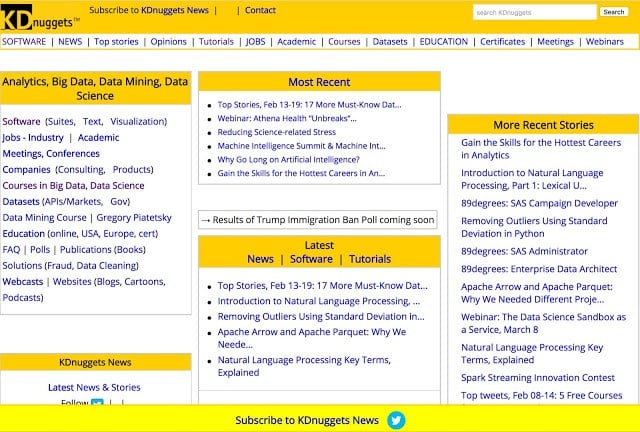
Also known as Knowledge Discovery nuggets, this blog was created in 1993 by Gregory Piatestky-Shapiro, a well-known expert in Business Analytics, Data Mining and Data Science who used to work for GTE Laboratories (now Verizon). Piatestky organized the first workshop of Knowledge Discovery in Data (KDD-89) for researchers. KDnuggets started off as a newsletter to keep in touch with researchers who attended the event. When Piatestky left GTE Labs he created the current website where you can find news, tutorials, the online Stanford Data Mining course and even job posts. It might have a very 90’s aesthetic but it’s full of awesome content to keep us entertained.

KDnuggets webpage
Figure 2: Although it’s design is not the newest, KDnuggets is one of the most popular Big Data sites ran by Gregory Piatestky.

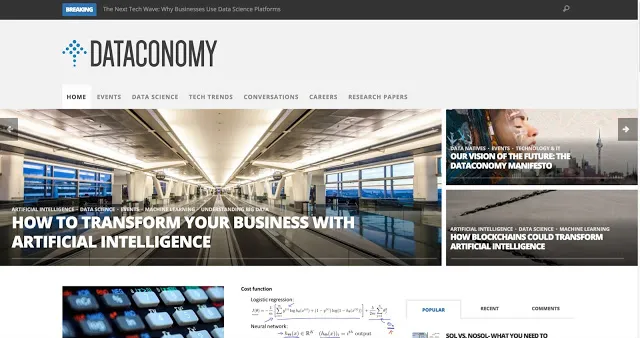
Similarly CIO, Dataconomy is one of the leading media outlets specialized in data. There is less information available but it is more focuses on specific tech areas such as IOT and Virtual Reality – discussing the data created by each phenomenon. It also has a more academic section dedicated to published research papers. Run by a small, young, talented team, it gives great insights on how Big Data can be applied in our day to day lives.

Dataconomy webpage
Figure 4: Dataconomy will give you a refreshing view on data technology.
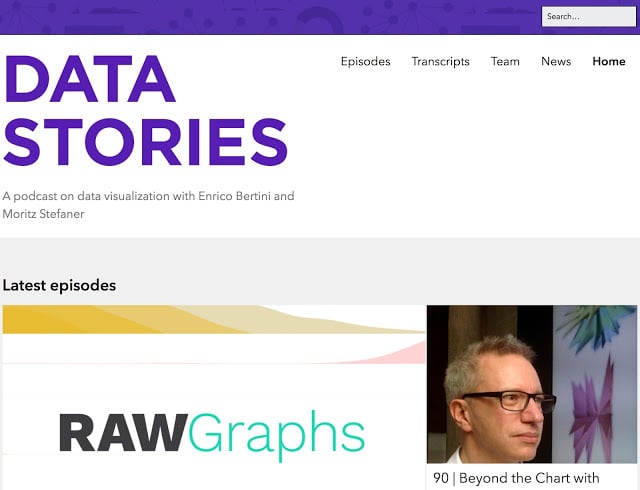
If you prefer listening to reading on your commute into work, perhaps Data Stories is a great choice for you. Enrico Bertini and Moritz Stefaner run Data Stories, a podcast which covers different topics around Big Data with the company of a specialist guest. They often focus on data visualization, but they also cover the increasingly important topics of Big Data ethics, interpretation and data journalism. We love their original approach to content and we certainly learn a lot from them.
Data Stories site
Figure 5: Data Stories is available at their website and iTunes.
Feel equipped to become a guru on Big Data? With these five blogs and our “Data Speaks“, we can guarantee you’re ready to become a guru on all things data. Make sure you subscribe here for our monthly digest. 

ElevenPaths and Consultores de Firma Avanzada together to protect Digital Banking, Insurance and Utility sectors

Florence Broderick    22 February, 2017

The scientific advances in facial and voice recognition, or biometric recognition for signatures are already a reality. In this context, we announce our most recent technological partnership with Consultores de Firma Avanzada. From their part, we have Firming, the biometric platform for secure contract signing created by Consultores de Firma Avanzada, and from our part, SealSign, created to be an electronic and biometric signature solution.

This partnership is the answer for the existing demand in the world of Digital Banking, and also for Insurance and Utilities Companies that were looking for an independent and mobile solution, so their customers could sign their contracts in a protected and faster way through Smartphones, Tablets and other devices.


Firming uses different technologies, such as NEC – NeoFace- facial recognition, one of the most famous in the market. It was considered worldwide number one technology in its sector by NIST – National Institute of Standards and Technology in 2014. Firming also uses a technology called NUANCE, for voice recognition. NUANCE is the global leader in biometric voice solutions for the intelligence and forensic government sector.

Juan Rodrigo Vigil, CEO and Founder of Consultores de Firma Avanzada, says “the technological integration for electronic and biometric signing couldn’t be other then SealSign, ElevenPaths’ greatest solution for the market of electronic and biometric signing.”

Rames Sarwat, ElevenPaths’ Vice Presidente for Strategic Alliances, mentions “The joint of SealSign and Firming technologies boosts the guarantee of legality and certification, offering a wider and safer platform. This association is the proof we are facing a very unique product.

For more information, check the Partners Section in our webpage.
To see the Press Release done by ElevenPaths and Consultores de Firma Avanzada, click here.

4 reasons why you should visit the LUCA stand at MWC2017

AI of Things    21 February, 2017
Next week, we’ll be taking part in Mobile World Congress in Barcelona, the world’s largest gathering for the telecommunications industry. With Big Data and Artificial Intelligence playing such a key part in Telefónica’s strategy – LUCA will of course feature, showcasing our most cutting-edge technology. 
So, what can you expect from our section on the Telefónica stand? What kind of data-driven demos will our gurus be showing off? Well, we don’t want to give it away – but we can give you a few pointers. 

1. Cutting-edge visualization

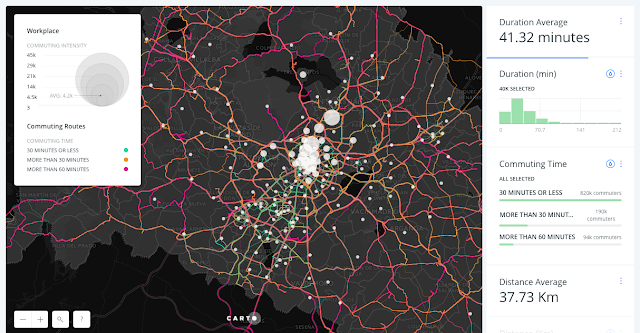
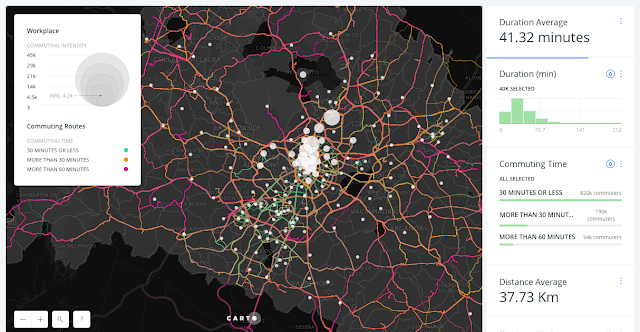
Here at LUCA we believe that to get the best insights from our data, high-quality and compelling visualization is fundamental. That’s why we’ve used a range of visualization tools including CARTO and Spotfire to bring our data stories to life. You can even see a sneak preview below:
LUCA commuting tool
Figure 1: Our commuting tool, visualized by CARTO.

2. Interactive technology

This year, we’ll be showing our demos on a Microsoft Surface Hub – an incredible large touch screen device which allows us to take you on an interactive journey through our data.  Our experts can show you how they work and just how useful this type of tool could potentially be for your organization. 
Microsoft Surface Hub
Figure 2: Microsoft Surface Hub in action.

3. Big Data for Social Good

You may have noticed that here at LUCA, we’re passionate about harnessing the power of technology and Big Data for Social Good. For that reason, we’ll be unveiling a groundbreaking new partnership to enable us to unlock the immense value of mobile data insights to have a social impact in the face of natural disasters. Make sure you come a find out who we’re partnering with.
Big Data for social good
Figure 3: Big Data for Social Good.

4. Multi-sector insight

MWC might focus on the telecommunications sector, but here at LUCA we believe in bringing the value of mobile data to a much wider range of sectors in different geographies. So, whether you’re interested in transport or retail, energy or media – we’ll have something to keep you entertained. We want to convince you just how important Big Data is in your business strategy, and we’ll do that with solid examples to show how we guarantee ROI. 

We’ll be in Hall 3 on Stand 3K21, so come along and find out what LUCA is all about and how we can help your organization on its Big Data journey. 

Latch Plugins Contest 2016: Videos and Documentation

Florence Broderick    21 February, 2017

You can find here the compilation of plugins submitted to the Latch Plugins Contest 2016. Congratulations to all participants for the work done and the results!


Plugin Name: Latch OpenWRT.
Author: Juan Camero.
Description: Plugin for the OpenWRT open firmware for neutral routers that allows to manage the internet connection of wireless devices in an intuitive way through a smartphone with Latch.
Github Linkb: https://github.com/JCameroMartin/LatchOpenWRT
Documentation Link: https://github.com/JCameroMartin/LatchOpenWRT
Video Link:

Plugin Name: Umbraco Latch
Author: Cristhian Amaya
Description: Plugin or package in Umbraco’s jargon (CMS open source) that allows to protect several operations of the administration area or backoffice.
Github Link: https://github.com/camaya/umbraco-latch
Documentation Link: https://github.com/camaya/umbraco-latch
Video Link:

Plugin Name: Latchdroid
Author: Pepe Nieto
Description: Lock of Android devices with Latch acting as a curfew, so that minors stop using these devices.
Github Link: https://www.github.com/ppnieto/latchdroid
Documentation Link: https://github.com/ppnieto/latchdroid/blob/master/Latchdroid-UserManual.pdf
Video Link:

Plugin Name: Heaven´s Door RA.
Author: Matías Troncoso.
Description: Plugin that allows the activation/deactivation of remote access to a device through the Internet. Performing a Port Forwarding on the router that allows access to the Internet.
Github Link: https://github.com/matiast-gh/heavens-door-ra
Documentation Link: https://github.com/matiast-gh/heavens-door-ra/tree/master/docs
Video Link:

Plugin Name: Latch MyCar.
Author: Diego Gamboa.
Description: It adds a security layer to vehicles that are powered by mobile devices or wireless keys.
Github Link: https://github.com/skyg4mb/LatchMyCar
Documentation Link: https://micloud.movistar.es/share/8de115813d5a02b302b2017055a66b33b1239716b47432b0#1
Video Link:

Plugin Name: Mosquito MQTT
Author: Álvaro Caso
Description: A Mosquitto plugin that allows us to easily add a second factor authorization to the IoT ecosystem, performing the integration in the platform (MQTT Broker), releasing resources and maximizing compatibility and scalability.
Github Link: https://github.com/oribit/latch-plugin
Documentation Link: https://github.com/oribit/latch-plugin/tree/master/manual
Video Linko:

We would like to take this opportunity to remind you the winners of the contest:

First prize: 5.000 USD.
Winner: Alvaro Caso.
Plugin: Mosquito MQTT.

Second prize: 2.000 USD.
Winner: Juan Camero.
Plugin: Latch OpenWRT.

Thank you all for participating!

Open Algorithms, what are they? Yves-Alexandre de Montjoye explains

Ana Zamora    20 February, 2017

Yves – Alexandre de Montjoye is a lecturer at Imperial College London’s new Data Science Institute. As a postdoctoral researcher at Harvard IQSS, his main field of research focuses on metadata privacy.

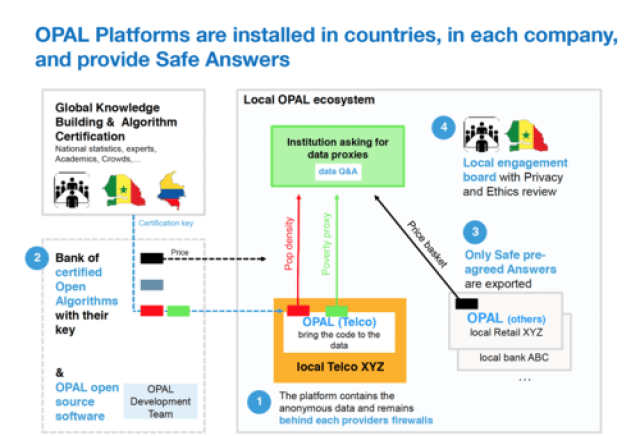
This week, we spoke to Yves about the OPAL project, which is an open technology platform where open algorithms run directly on the servers of partner companies, behind their firewalls, to extract key development indicators for a wide range of potential users, including national statistical offices, ministries, civil society organizations and media organizations – just to name a few.

So Yves, tell us more about the OPAL initiative.

OPAL is a platform which enables companies to use private data for social good. As I see it, OPAL is a new way of looking at data in a way that you can preserve people’s privacy. It takes us back to the basics. The question is: why did the anonymization of data start? Because we needed a way to use data on a large scale to do statistics and, at the same time, it wasn’t going to affect you because we didn’t know which part of the data was yours. This is why everything started. OPAL is a question and answer system and the idea behind it is to replace the privacy guarantee that anonymization used to provide for small datasets in the past, by solid proofs and IT security. 


“OPAL is turning a privacy question into a security question.”

The philosophy behind this is about allowing people to use data, but without actually giving the data away. We allow organizations to ask questions about the data and then give them an aggregated answer, but without giving the actual dataset. People from social organizations and NGO’s can formulate questions in the form of an Open Algorithm, then we review the algorithm and validate it, and then we run this question in our data. 

“The fundamental difference of OPAL is that the platform allows you to use the data without giving you a copy of it.”

In 2006,  AOL had a data breach and, basically released search data. After some time, it turned out it was really easy to identify people in this dataset. Then you think we can’t have this data out there, but everyone already had a copy of it. That was 11 years ago and you can still download this dataset on BitTorrent.
In 1995, when data anonymization really started we barely had the internet, but now we’re in the era of Big Data. A lot has changed in over the past few years so it is essential that we stop and rethink the way we approach data privacy, with proper computer science and security to ensure we use data in a way where we preserve people’s privacy. 

Data privacy
Figure 2: “It is essential that we stop and rethink the way we approach data privacy”.

What are the next steps for OPAL to move forward?
We have a lot of work ahead of us, figuring out the details and building the platform in a scalable way. We are building a development team here at Imperial College Data Science Institute to do this. In its initial phase of deployment, the project will focus on a small set of countries in Latin America, Africa and Asia. First we are going to deploy it in Senegal, with the help of Orange Sonatel, and in Colombia, with Telefónica

Once we have tested the platform and run it there, we can add new partners. This is the benefit of software solutions, it is easy to deploy in new countries. Once an algorithm has been validated, it can be run around the world!
How would you picture privacy in 10 years?
In general, you can really see people are starting to care a great deal about privacy. We have seen a lot of backlash around privacy. There are a lot of good uses of Big Data such as the one generated by mobile phones, but we need to build solutions that allow this data to be used in a way that really protects people’s privacy. This is why we’re building OPAL.

ElevenPaths and Enigmasec associated to help small and medium organizations in face of the invasion of systems

Florence Broderick    20 February, 2017

The last week, we announced a partnership with Enigmasec, a company specialized in incident responses for cybersecurity, with the goal of improving its capabilities in cyber attacks that breaks into the traditional mechanisms of defenses.

Nowadays, there’s no accessible tool that can compile the information from a security incident, helping to reduce its response time. In this context rises Enigmabox, a tool created by Enigmasec to detect security incidents and collect data for analysis. Igor Lukic, Enigmasec’s CEO, tell us that “Enigmabox works like an airplane’s black box, so in case our customer has some security issue, all its information will be stored in the same place. It also works as a warning system to provide responses to security incidents”.


We love to exchange experiences oriented to incident responses and combine synergies in commercial agreements, to develop the future of cybersecurity solutions with other players in this theme. ElevenPaths’ Vice President for Strategic Alliances, Rames Sarwat, comments the deal “this alliance supports our goal, adding precious information to a precise reaction when facing a system intrusion”.

Enigmabox uses Latch as an authentication solution, increasing the confidentiality in managing systems’ accesses. ElevenPaths and Enigmasec will include these services in their portfolios, increasing our solutions in cybersecurity.

Along that, last Friday 16th of February, we were with Enigmasec in Tenerife island for the IV Hackron Edition, a congress focused on hacking and cyber security with our hacker and CSA, Pablo San Emeterio. In the talk IM RELOADED, Pablo discussed about the security vulnerabilities for instant messages and Chema Alonso, Chairman of ElevenPaths and Chief Data Office for Telefonica, mentioned the keynote of the congress through videoconference.  

For more information, check the Partners Section in our webpage.
To see the Press Release done by ElevenPaths and Enigmasec, click here.