LUCA Talk 2: Big Data as a Force for Good

Ana Zamora    17 February, 2017
In the world of data, we tend to focus on how Big Data technology can optimize our organizations, maximize revenues and make our organizational processes more efficient. However, there is another side to data: one that allows us to use these massive volumes of information to bring back real value to our society. That is why here at LUCA we always love to consider both sides, and explore all the social power that our data can provide.

Our next LUCA talk covers the Big Data for Social Good phenomena, in the second of our series of webinars which started in January. LUCA Talk #2 will be held next Thursday (February 26th) at 17:00 CET and it will be delivered by our VP for Big Data for Social Good, Dr Richard Benjamins. Richard will be discussing the immense potential of data in driving progress towards the Sustainable Development Goals – sharing real-life examples of how private sector organizations can analyze and apply data to have a social benefit.

After covering some case studies, both from LUCA and from around the world, Richard will discuss the big challenges companies have to face when it comes to accelerating their Big Data for Social Good initiatives.

Haven’t signed up yet? Don’t miss the chance and do it now here.
ElevenPaths and Cyber Threat Alliance (CTA) collaborates in sharing information intelligence about cyber threats

Florence Broderick    17 February, 2017

In 2015, ElevenPaths, together with another market leader companies, such as Check Point, Cisco, Fortinet, Intel Security, Palo Alto and Symantec, brought together their strength to join a community that aims to exchange information about intelligence in cyber threats. This community is called CyberThreat Alliance (CTA).

In January 2017, the CyberThreat Alliance was converted into a non-profit organisation and, after that, announced Michael Daniel, ex-coordinator of cybersecurity in the White House, as President of the institution. In this context, ElevenPaths and CyberThreat Alliance renewed and accelerated the commitment in exchanging information about intelligence in cybersecurity, in order to provide better support and security to our customers.


Combining this collective intelligence, the CTA aspires to improve the detection of recent threats and its defences, to boost the protection to customers and partners in the alliance.

The CTA had developed an automatic system for shared information, allowing in real time the sharing in all Indicators of Compromise (IoCs), adding not only the indicators in an individual way, but also correlated and in context of each threat. The system allows the members of the alliance to access immediately the enriched indicators, working ahead of the industry, providing an early detection and being published before another sources.

Everyday, thousands of indicators are exchanged in CTA, and their relation are focusing on creating context, enriching the intelligence information and providing a better and faster detection of unknowing threats.

In ElevenPaths, we are constantly creating the best security solutions for our customer, supporting all collaborative initiatives from the security industry. In this way, we can be ahead in an effective way in the war against the cybercriminals.

Do you want to know more? Check here the official document released by CTA during the RSA Conference in San Francisco.

ElevenPaths joins Saint Patrick Technology to offer security solutions based on the latest Big Data technologies

Florence Broderick    16 February, 2017
We announce today our most recent partnership with Saint Patrick Technology, the leading company in the development of solutions based on the latest technologies, such as AR, VR, NFC, RFI and Big Data.

With this collaboration, we aim to share knowledge, synergies and technical resources to develop products and services for digital security. ElevenPaths’ Vice Presidente for Strategic Alliances, Rames Sarwat, says “thanks to this partnership, ElevenPaths and Saint Patrick Technology will work together for the development and distribution of products and services for both companies. We want to reach the Spanish market and also, the markets in Ireland and UK.“.

“The products developed by Saint Patrick Technology fits perfectly with the ElevenPaths’ Identity and Access Solutions says Roberto Rodríguez Gómez, Partner Director in Saint Patrick Technology. Along these lines, Saint Patrick Technology joins the Partners Program of ElevenPaths as SSP (Solution & Services Partners).

This new deal supports ElevenPaths and Saint Patrick Technology’s objective to develop and implement mobile apps specialised in technologies as  AR, VR, NFC, RFI and Big Data. Both ElevenPaths and Saint Patrick Technology will include these services in their portfolios, increasing the options for technological and consultancy solutions and also last generation developments.

For more information, check the Partners Section in our webpage.
Do you want to know more about the ElevenPaths Partner Program? Contact us!

To see the Press Release done by ElevenPaths and Saint Patrick Technology, click here.

GeoGestión, the Internet of Mobile Workforces

Beatriz Sanz Baños    15 February, 2017

GeoGestión is a solution that streamlines processes that were previously costly for businesses in terms of both money and resources. To illustrate this with some examples this system addresses the paperwork required after a sales force visit, the work sheet filled out by a technical service when visiting a customer – where the technician must report on the tasks carried out and file the signature of the client after the repair has been completed, or package delivery for courier services. Therefore GeoGestión is a sidekick for businesses that require digitising their mobile workforce bureaucracy.

GeoGestión is based on two types of user devices: dedicated devices – similar to traditional beepers – that compile information autonomously and smartphones that collect data from both the employee’s input as well as the data that the smartphone sensors collect autonomously. Both types of devices, of course, have a SIM card installed. The app can require employee interaction for certain tasks and work on its own in the background at all time as other IoT systems are designed to do.

GeoGestión allows an administrator to know where their employees are at a given moment, triggering alarms in the event the employees move beyond predesignated geofences – combining geofencing and asset tracking in one single solution. The platform has built in reports that compile collected data (from the two types of devices) offering insight and leverage to companies in order to improve business processes. The platform allows to carry out employee wide actions regardless of the type of employee (sales force, security agents, etc.), indicating the route to follow, where to go at one given time, and even start text based chats with them. In the meanwhile completed work sheets are collected after the visit, repair or delivery.

We have identified four types of businesses that can clearly benefit from GeoGestión:

  • Companies with mobile sales forces
  • Security firms
  • Logistics, Courier and Delivery companies
  • Technical assistance companies

From the employee perspective, it is not complicated to start using GeoGestión. This lack of a steep learning curve helps users cut paperwork time from day one. Data is automatically relayed to the employee’s office making it easy to report back. This information channel works both ways allowing last minute updates to reach the employee immediately in case of an emergency (for security employees or technicians) that know where to go as soon as possible and how to get there. The system records both programmed and unscheduled events, granting access to the forms the employee needs to fill out, this impacting positively on productivity.

GeoGestión is a key partner for the four types of companies mentioned before. They can embrace digital transformation with a clear plan to recovering the invested cost. Some advantages are common to every use case and some are business specific.

From a practical point of view, security services improve their efficiency in answer distress signals 20% thanks to the built in real time features. The panic button feature improves the ease of mind for both the end client and the security employees that feels that help is always close by. Paperwork improvements and bureaucracy streamlining can achieve a 70% cut in both people and time required. Users that need to meet an SLA with clients have achieved a 20% improvement. Finally, we would like to also mention the improvements in salesforces. Mobile sales workers’ routes are optimized 30% allowing for a redesign in routes and assigned clients that helps both overworked and partially-idle sales workers to improve their personal productivity an extra 20%.

The data provided by our 25,000 active licenses offer us excellent Return of Investment (ROI) perspectives for our customers estimated in ranging from 5 to 1 to 7 to 1. The ROI cycle is shortened even more thanks to the tool’s market position and its competitive pricing.

How these 4 sports are using Data Science

Richard Benjamins    15 February, 2017
Thousands of companies around the world may have started their journey to become data-driven, harnessing the full potential of Big Data, however, the world of professional sports is only just starting to explore this world of applying Data Science to gain a competitive advantage. 


Until now, sports coaches have been able to boast about their experience or their gut feelings when making decisions and have therefore been somewhat resistant to the world of Big Data – something which we all saw so perfectly illustrated in Moneyball where Brad Pitt shows the tension between human experience and data-driven.

However, things are changing – and slowly but surely we’re starting to see a lot more research around the role of data in sport as well as an increasing number of jobs working directly with professional sports teams to enhance their performance. But which sports are leading the way? We took a look:

1. Formula 1


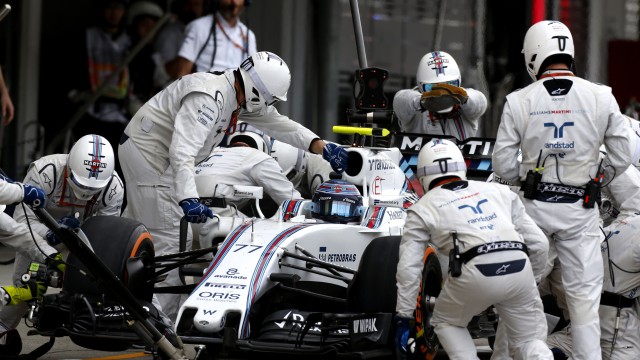
As our CDO, Chema Alonso, mentioned the other day in a talk with the Movistar cycling team, Formula 1 teams are pioneers when it comes to data-driven decisions. With every race generating huge amounts of data, on the track, vehicles, conditions and drivers – Williams saw a unique opportunity. 


They optimized team pits-stops by taking bio-metric measurements from the technical team allowing them to understand when each team member functions optimally. Eventually, they ended up reducing their pitstop time to 1.92 seconds – the fastest ever recorded.


Formula 1
Figure 1: Formula 1 team

2. Football

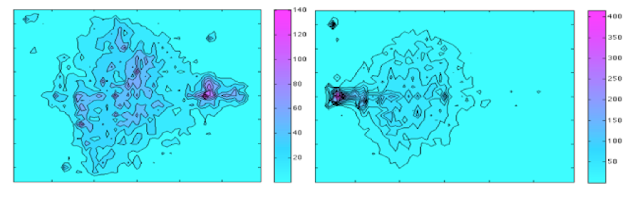
Some years ago, we obtained some data from the Spanish football league for the 2012-2013 season, allowing our Data Scientists to carry out an in-depth analysis. The data was generated by cameras that take up to 10 photos per second, and are post-processed so that individual players can be identified. In the figures below you can see heatmaps of Barcelona vs Atletico Madrid. The area represents the field, and the goal of the team is located in the pointed parts with the darkest colours. The darker the color, the longer the players are at a certain location.  It becomes immediately clear that Barcelona were more of an attacking team throughout that season, unlike Atletico who tended to have a more defensive approach.

Football stadiums
Figure 2: Barcelona’s pitch activity (left) vs Atletico Madrid’s pitch activity (right).

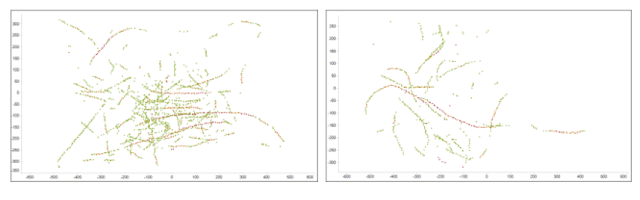
It was also possible to follow individual players, and in the images below we can see the paths of two players throughout a match. The green points show that the player ran at approximately 5 m/s (the equivalent of running 100m in 20 seconds) and red points at approximately 7 m/s.  It is clear that the first players runs much more than the second, but what does that mean? That the first player is better than the second? That they have different roles? Looking at only this data, if you were the trainer, which player would you prefer to buy?

The "work rate" figure
Figure 3: The “work rate” of Xavi Hernandez (left) vs Leo Messi (right).

Well, the first player is midfielder Xavi Hernandez, and the second player is Leo Messi, who doesn’t need any further introduction.  

3. Cycling

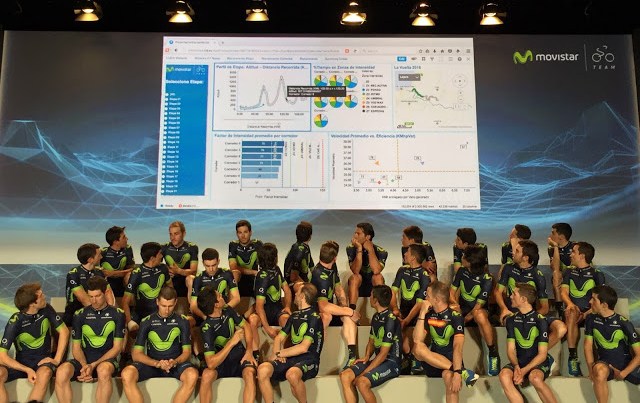
More recently, we had the opportunity to analyze data from the 2016 “Vuelta a España“, looking at Movistar Team’s performance. We had access to the data of 8 cyclists from the team throughout the 21 stages from start to finish. Every second, 7 types of data of each cyclist are captured resulting in more than 2 million data feeds. The variables captured, include location, altitude, force, speed, heart rate and pedal rate.

    Movistar Team

    With this data, apart from analyzing individual cyclists, it becomes possible to analyze how the team works together, and to understand and compare different stages. Looking at the data, it becomes very evident how professional cycling is a team sport with differentiated roles for the different team members: today it is impossible to win one of the main competitions “flying solo”. What we have learned is that it is important to:

    • Understand when team members peak in terms of performance so that training can be planned for peaks to coincide with competitions.
    • Determine the context variables (altitude, weather), the training variables and the personal cyclist variables which impact most in the cyclist’s performance and subjective experience. 
    • Combine the roles that cyclists play in the different stages with performance and fatigue variables to plan the recovery of the cyclists and the next stages during the competition.

    4. Cricket

    Cricket, which is the most popular sport in India, and the second most popular sport in the world is also embracing the growing value of Big Data. IBM launched their #ScorewithData campaign during the Cricket World Cup which included a Social Sentiment Index which predicted correctly who would win certain phases of the tournament.

    The England Cricket team have also been pioneers and their ex-team coach, Peter Moores, even said “we use advanced data analytics as the sole basis for some of our decisions – even affecting who we select for the team.” Nathan Leamon, who was hired by the new head coach for his expertise in maths and statistics, also used to create spreadsheets using Hawk-Eye technology to run match simulations which ended up being accurate to within 5% – breaking the field up into different segments for players to target when batting.

    Cricket match
    Figure 5: Big Data in the world of cricket.
    As you can see, Big Data and Data Science aren’t just limited to the world of big business – they are in fact affecting every single part of our lives.  In the context of sport, the most successful will embrace data on and off the field if they want to fill up their trophy cabinets any time soon.

    Leave a Comment on How these 4 sports are using Data Science

    Latch Plugins Contest 2016: we finally have winners!

    Florence Broderick    15 February, 2017

    We can now announce the winners of our “Latch Plugins Contest 2016“, showing the creativity, ideas and imagination of the participants in the submitted proposals. This edition of the contest results in its consolidation and the consolidation of the community of developers who feed and develop Latch.
    In our community, you can find the documentation, videos and plugins of all participants who have shown great interest, effort and quality in the works submitted. Here is a brief description of the winning plugins and hacks:
    First prize – 5.000 USD

    Winner: Álvaro Caso
    Plugin: Mosquito MQTT

    Description:
    This plugin easily adds a second factor authorization to the IoT ecosystem, performing the integration on the MQTT Broker platform (lightweight M2M message protocol), rather than on the devices.

    This way of functioning frees resources and improves compatibility and scalability.

    What we liked:
    The approach to the proposed solution looks interesting and original. The integration with a protocol like MQTT increases the usability of Latch and allows a great diffusion in commercial solutions, such as IoT Stack of Telefónica.

    Video:

    Second prize – 2.000 USD
    Winner: Juan Camero
    Plugin: Latch OpenWRT

    Description:
    Plugin for the OpenWRT open firmware used on neutral routers. It manages the internet connection of wireless devices through a Smartphone with the Latch app in a simple and intuitive way. It adds an extra layer of security for the Internet access by router, avoiding access to the network if an attacker surpasses the first security measures, such as the key of the access point or a MAC filter, with Mac Spoofing techniques, etc.
    What we liked:
    The approach applied is good and with great possibilities of development. The scope of OpenWRT is wide because of its community of users and its compatibility with neutral routers of the market. The integration with the webGUI (Luci) is excellent and with a simple installation.

    Video:

    Third prize – 1.000 USD
    Not awarded

    We want to thank all the participants for the contribution and the outpouring of eagerness, as well as for being part of our community and the exchange of ideas. Congratulations to the winners!
    Share your knowledge, experience and curiosities with our experts. Talk to them in our community. They are waiting for you! And remember to visit the website with the Latch plugins and strengthen your systems.

    For more information:
    elevenpaths.com
    latch.elevenpaths.com

    These 4 people are using Big Data to find their Valentine

    AI of Things    14 February, 2017
    More often than not, we talk about the application of Big Data in the realms of business – focusing on how such technology can enable us to optimize our organizations or drive revenues.  However, we should not forget just how much this phenomenon will affect our day-to-day lives as citizens of a digital world.
    Today, as it’s the 14th February, we’ve asked ourselves the question: just how could data help us to find our Valentine? We’ve done some research online to see just how far people and entrepreneurs are going to bring techniques such as Artificial Intelligence and Machine Learning to find “the one”. We’ve highlighted a few cases to see how data gurus out there are finding data-driven ways to the hearts of others:

    1. Amy Webb: the online dating”hacker”

    Amy Webb, founder of the Future Today Institute, was struggling to find the right match when it came to online dating – with the profiles she was interested in never replying to her messages. With extensive experience working in Big Data, she decided to build a model to categorize potential suitors – taking into account top-tier and second-tier traits. See how successful she was in the video below:

    2. Kang Zhao: the man using Machine Learning to find love

    This data analytics professor from the University of Iowa created a match-making system which uses a technique called “collaborative filtering” which looks at users’ behaviour as they search for partners dating sites, as well as taking into account the responses they receive. The algorithm he created then suggests potential matches in the same way platforms such as Amazon and Netflix recommend things to buy or watch based on the behaviour of other users who bought those products or enjoyed the same movies. He explains his research in the video below:

    3. Justin Long: Automating Tinder with AI

    Vancouver-based software developer Justin Long decided that his friends were wasting way too much time swiping away on Tinder and decided to apply his knowledge from the world of AI and deep learning to find his match. After initially building Tinderbox, he eventually founded his own startup to bring his aphrodisiac bots to the masses under the name of Bernie AI. Imagine explaining that one on the first offline date:  
    Justin Long
    Figure 2: Justin Long explains the tech behind Bernie AI.

    4. Dr Hannah Fry: Maths + Stats = Big Dating

    Dr Hannah Fry has even written a book about just how important data is in finding love.  She explains how using mathematical modelling can explain everything from the possibility of finding a partner to the number of sexual partners we have in a lifetime – in her book “The Mathematics of Love.” Her TED talk below is well worth a watch: 

    So, as you can see – finding your Valentine may not be as simple as stumbling upon that special someone in your local bar anymore. Technology isn’t just disrupting the way we work, shop or communicate and but also the way we interact and find love – potentially saving us a lot of time and heartbreak. But the question is, will this data-driven approach take the magic out of dating? Let us know what you think in our comments section.
    Happy Valentine’s Day! 

    Artificial Intelligence vs Cognitive Computing: What’s the difference?

    Richard Benjamins    13 February, 2017
    The media hype around Artificial Intelligence (AI) and Cognitive Computing is unquestionable at the moment. They seem to appear everywhere on the Internet in the press, blogs, conferences and events and many companies and startups are now moving towards offering AI or Cognitive solutions.
     
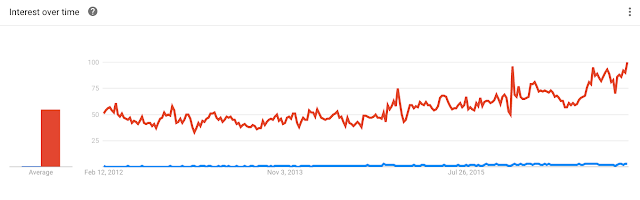
    Google shows 44m hits on AI and 9m on Cognitive Computing and the figure below from Google Trends clearly shows that the search term “Artificial Intelligence” is more popular than “Cognitive Computing”, however, I’m sure we’ll start to see that gap close in 2017. 

    In our white paper “Surviving in the AI hype“, we explained some of the fundamental concepts behind AI, as well as touching on Cognitive Science and Computing but in this post we want to focus in more detail on the relationship between AI and Cognitive Computing specifically.

     
    Google Trends for AI
    Figure 2: Google Trends for Artificial Intelligence (red) and Cognitive Computing (blue).
     
    To start off, what do Intelligence and Cognition mean if we search for a definition online?
     
    • Intelligence: “the ability to learn or understand or to deal with new or trying situations :  reason; also :  the skilled use of reason (2) :  the ability to apply knowledge to manipulate one’s environment or to think abstractly as measured by objective criteria (as tests).”
    • Cognition: “the mental action or process of acquiring knowledge and understanding through thought, experience, and the senses.”

    The term Cognitive Computing has been popularized by IBM, through its Watson program, and we think IBM deserves a lot of credit for that. But what are exactly the differences between Artificial Intelligence and Cognitive Computing? And how are they related? Or are they synonyms? The best way we have seen this explained is by the late Herb Simon, one of the early gurus of AI:

    “AI can have two purposes. One is to use the power of computers to augment human thinking, just as we use motors to augment human or horse power. Robotics and expert systems are major branches of that. The other is to use a computer’s artificial intelligence to understand how humans think. In a humanoid way. If you test your programs not merely by what they can accomplish, but how they accomplish it, then you’re really doing cognitive science; you’re using AI to understand the human mind.”

    Stated in other words: AI is about making computers solve complex problems, that if people solved them would require intelligence – it is the result that counts. Cognitive Science is about making computers solve complex problems similar to how humans solve problems – it is the process that counts. So Cognitive Computing aims to mimic human reasoning behavior.  

    Deep Blue
    is a great example to look at. In 1997, for the first time in history this IBM computer program beat the world chess champion, Gary Kasparov. The main reason why Deep Blue was able to win was pure brute force. It was capable of evaluating 200 million chess positions per second, and to look up to 20 moves ahead, something no human is able to do.  

    So, is Deep Blue AI? Yes, because it solves a complex task, even better than the best human. Is Deep Blue Cognitive Computing? No, because the reasoning process has little to do with how humans play chess.  

    So, what does it mean to “mimic human problem solving” or to “mimic the human brain”? Well, actually there are different levels of “mimicking”.  And here again we see the distinction between symbolic and non-symbolic or connectionist AI (as you can see here in our white paper). Originally, symbolic AI tried to mimic logical human problem-solving, while connectionist AI tried to mimic the brain’s hardware, as Deep Learning does today.  

    So, some symbolic AI may be cognitive computing, if it mimics human problem solving e.g. through rule-based systems. But not all (e.g. Deep Blue).  

    Where does that leave us? Today the terms AI and Cognitive Computing are used as synonyms. We believe that whether a company calls its product AI or Cognitive Computing, it is a marketing decision. Everybody is offering AI solutions right now, and it becomes increasingly difficult to be perceived as differential. Cognitive Computing is an attractive alternative, as it alludes to the same underlying mystery (human intelligence), but the space is much less crowded.  

    Leave a Comment on Artificial Intelligence vs Cognitive Computing: What’s the difference?

    LUCA boosts brand engagement with “Sponsored Data” product

    AI of Things    10 February, 2017
     
     
    Sponsored data is the mobile data equivalent of the toll-free telephone service where a third party or carrier pays for the customer’s access to the internet or a set of specific mobile services. The benefit to the end user is obvious, but what 2016 showed is that beyond this it also provides tremendous advantages on sales and marketing budgets and CapEx investments for enterprises and government and CapEx advantages for enterprises and governments. 
     
    These manifest in the form of time and money saving facilities that mobile data technologies allow. They include cost effective mobile marketing measures; incremental revenue from engaging new customer sets through free access to m-commerce as well as highly targeted mobile advertising; increased customer engagement – we’ll talk more about this later in the post; enhanced brand perception and finally positive impact of digital inclusion.


    While half the world’s population has no access to the internet, over 85% live in the range of a data cellular network and, according to a study by Comscore, there are now more mobile devices on the planet than people – 8.6 billion devices vs. 7.3 billion people. With an estimated 5.8 billion mobile users worldwide, that means almost 80% of the planet’s population are mobile, and they have an average of 1.5 devices each. It’s a buyer’s market so to speak if you’re in the business of Sponsored Data.

     
    This is especially true in emerging markets such as Brazil, where a mobile phone is often the only connected device they own and where the vast majority (75%) of customers are on prepaid plans – a position that leads to at best extremely cautious and low consumption of mobile data or restrictions to when that customer is connected to Wifi.

     
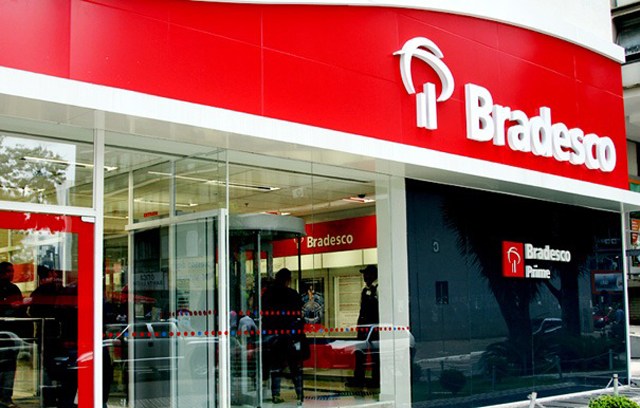
    One example of what we’re seeing above is perfectly demonstrated by Bradesco, one of Brazil’s top retail banks. It launched “Acesso Grátis Bradesco Celular” in 2014 enabling clients to access their bank accounts from their smartphones without using up their mobile data caps. As a result the bank was able to shift more of its clients’ interactions to internet-based self-service thereby dramatically reducing the cost per transaction. All the more astounding given the long established habits of prepaid customers.


    Bradesco Brazil
    Figure 2: We worked with Bradesco in Brazil to bring the power of Sponsored Data to their strategy.
     
    And it wasn’t just a moment in time type of investment return. Indeed one year after launching its Sponsored Data offer, Bradesco mobile banking users have more than doubled, with transactions over mobile growing four-fold.

     
    Brazil’s Bradesco was not alone in this success. Companies of all sizes across the world have last year employed this method to reap one of the many benefits of the service. Hewlett Packard for instance started selling its own tablets in Sweden, UK and Denmark with its two years of free mobile data program, aimed at generating incremental revenue. It was not long before the company found itself being able to expand the service to laptops and across many new countries including 8 new markets in Europe as well as US, Hong Kong and Singapore.

     
    Another star of 2016 was Brazilian sports e-retailer, Netshoes who saw a 60% increase of sales conversion rate. By providing access to their site for free they not only incentivized, they also made it easy for customers to buy their products on mobile.

     
    Sponsored Data
    Figure 3: Sponsored Data has immense benefits for the e-commerce sector, as in the case of Netshoes.
     

    Similarly, much smaller players like Indonesia’s Berniaga, an online classifieds portal partnered with a local carrier to offer three-hour free internet passes. Not only did it help raise Berniaga’s profile but also drove up traffic to its website of which 88 % comprised new or previously infrequent visitors. And start-up Kickbit, an app that allows smartphone users on prepaid plans to earn free data for engaging with brands by completing surveys or watching a video has so far racked up over 100,000 downloads on Android – attracting clients like streaming service Hulu.


    The best news of all is that these cost savings and goodwill practices are completely transferrable across industries and with global mobile subscribers growing at an annual compound rate of 12.4% (Frost & Sullivan), expected to reach 9 billion by 2020, businesses and governments are fast understanding the value of evolving to a mobile-enabled business through the Sponsored Data route.


    2017 Future Trends: Sectors to watch include customer services and digital content delivery

    Customer Service is a sector that is experiencing a growing trend towards online self-help which helps companies significantly reduce costs as well as improve efficiencies. Another sector where Sponsored Data will take off in a big way is in digital content delivery. By subsidising mobile data costs for consumers, digital content providers ranging from newspapers to video streaming services can drive adoption among consumers who might otherwise find access cost prohibitive. This will help address publishers’ concerns around revenue lost to GAFA.  And finally hardware vendors could find that by selling internet-ready devices with bundled data can be a great way to differentiate.
     
    One thing is for sure, by sponsoring mobile data usage, businesses can offer toll-free internet access to all who need it, helping to connect the world’s 4.4 billion unconnected while generating significant benefits for the enterprise. When has a commercial transaction ever been this simple and transparent? 2017 is set to be a year of win-wins for the mobile sector.


    This article was written by Dan Rosen, our VP for Global Advertising at LUCA.

    Meet our LUCA team in Brazil

    AI of Things    9 February, 2017

    Did you know that LUCA has data experts in 12 different countries? Our HQ may be here in Madrid in Spain, but we have Data Scientists, Data Engineers, Business Specialists and Visualization Experts all over the world and this week we’ve prepared this video so you can get to know a little bit more about our team in Brazil and their work:

    If you’re interested in finding out more about our products and services in Brazil, contact us here.