The connected football stadiums

Salmerón Uribes Marina    18 January, 2019

The Wanda Metropolitan Stadium of Club Atlético de Madrid is the most intelligent stadium in Europe today. After the emergence of Telefónica as an official technology provider, the possibilities at the digital level multiplied placing it in the Champions League of stadiums. In fact, it has been awarded as the best stadium in the 2018 Industry Awards of the World Football Summit. In the words of Jose María Álvarez Pallete, CEO of Telefónica: “It is the first 100% digital IP stadium in Europe”.

The project needed the installation of 6,000 network outlets, 1,500 WiFi access points, 1,000 kilometers of fiber and almost 500 kilometers of UTP-type cables. In addition to multiplying the possibilities of connection during sporting events, the rojiblanco club wants to position its stadium as a reference space for concerts or other events.

“Being a technological provider of the Wanda Metropolitano is a comprehensive project that goes far beyond providing coverage to the stadium. It is the first 100% digital stadium in Europe “, said Javier Vizcaíno, director of companies of Telefónica Spain. On the other hand, from the rojiblanco club they affirm that agreements of this level “make a difference in the experience of our fans”, as celebrated by Iñigo Aznar, commercial director of the Atlético de Madrid.

The Wanda Metropolitan Stadium is the most intelligent stadium in Europe

The club wants to ensure the connection with an eye on all the services they can offer, but they have also thought about the fans, which will not have coverage problems thanks to the symmetric 10 Gb distributed in double microLAN access. This agreement also includes an integral control unit to centralize the security of the enclosure with 120 closed-circuit cameras that controls 300 doors and an exclusive system that prevents network intrusions.

The ‘ribbon board’ of LG screens surrounding the grandstand is also unique in Europe. It is composed of 530 square meters of LED panels that make up a 360º ring in the lower tier of the Metropolitan. This mega screen and the more of 1.000 screens distributed throughout the stadium, the video markers and the large outdoor LED screen that welcomes fans, provide a unique audiovisual experience. All these devices, of course, are connected via WiFi to the control center.

In addition, the multipurpose room, which has the main functions of press room and auditorium for 400 people, has been equipped with infrastructure and 4K projection, simultaneous translation, press booths and 5.1 surround sound. At the same time, screens have been integrated into the VIP boxes in the seats, monitors have been placed in the ticket offices, screens have been placed in the changing rooms for each player who show their name with their photo and on the west side of The stadium they have installed a 34 m² LED screen capable of reproducing images and videos to boost the main façade of the building.

Fans enjoy a unique experience  thanks to IoT

As for the lighting of the Metropolitan Wanda, the Atlético de Madrid stadium is the first in the world to use LED technology entirely. The installation consists of 20,257 luminaires and 336 projectors for the playing field, a combination that allows a total of 16 million colors which will create luminous shows, interacting with the lighting of the roofs. 

Thanks to the implementation of communications, connectivity and technological solutions in all facilities, fans that come to the stadium enjoy a unique experience not only for the game they will enjoy but for how they will live the game thanks to IoT.

Since the arrival of the fans at the stadium with video markers, ‘ribbon board’, lighting, digital signage, WiFi … they will not lose detail of what really matters, thus covering their needs. All to enjoy a stable and secure connection during the shows that turns this stadium into a technological reference and offers fans an unprecedented, totally innovative and connected user experience.


Dare with Python: An experiment for all (intro)

Paloma, Recuero de los Santos    16 January, 2019

As we did in our experiment on the Titanic dataset in Azure Machine Learning Studio, we will continue with the “Learning by doing” strategy because we believe that the best way to learn is to carry out small projects, from start to finish.

A Machine Learning project may not be linear, but it has a series of well-defined stages:

1. Define the problem

2. Prepare the data

3. Evaluate different algorithms

4. Refine the results

5. Present them

On the other hand, the best way to get to know a new platform or tool is to work with it. And that is precisely what we are going to do in this tutorial: get to know Python as a language, and as a platform.

What is NOT necessary to follow this tutorial?

The objective of this experiment is to show how a simple Machine Learning experiment in Python can be done. Different people with different profiles can work with ML models. For example, a Social Sciences researcher, or a financial expert, Insurance broker, Marketing agent etc. They all want to apply the model (and understand how it works). A developer who already knows other languages/ programming environments, may want to start learning Phyton. Or a Data Scientist that works developing new algorithms in R, for example, and wants to start working in Python. So, instead of making a list of the prerequisites to follow the tutorial, we will detail what is not needed:

  • You do not have to understand everything at first. The goal is to follow the example from start to finish and get a real result. You can take note of the questions that arise and use the function help (“FunctionName”) of Python to learn about the functions that we are using.
  • You do not need to know exactly how algorithms work. It is convenient to know their limitations, and how to configure them. But you can learn little by little. The objective of this experiment is to lose the fear of the platform and keep learning with other experiments!
  • You do not have to be a programmer. The Python language has a quite intuitive syntax. As a clue to begin to understand it, it is convenient to look at the function’s calls (e.g. function ()) and in the assignment of variables (e.g. a = “b”). The important thing now is to “start”, little by little, you can learn all the details.
  • You do not have to be an expert in Machine Learning. You can learn gradually about the advantages and limitations of different algorithms, how to improve in the different stages of the process, or the importance of evaluating accuracy through cross-validation.

As it is our first project in Python, let’s focus on the basic steps. In other tutorials we can work on other tasks such as preparing data with Panda or improving the results with PyBrain.

What is Python?

Python is an interpreted programming language, oriented to high level objects and dynamic semantics. Its syntax emphasizes the readability of code, which facilitates its debugging and, therefore, promotes productivity. It offers the power and flexibility of compiled languages with a smooth learning curve. Although Python was created as a general-purpose programming language, it has a series of libraries and development environments for each of the phases of the Data Science process. This, added to its power open source characteristics and ease of learning, has led it to take the lead from other languages of data analytics through Machine Learning such as SAS (leading commercial software so far) and R (also open source, but more typical of academic or research environments).

Python was created by Guido Van Rossum in 1991 and, curiously, owes its name to the great fondness of its creator for the Monty Python films.

In addition to libraries of scientific, numerical tools, analysis tools and data structures, or Machine Learning algorithms such as NumPy, SciPy, Matplotlib, Pandas or PyBrain, which will be discussed in more detail in another posts of the tutorial, Python offers interactive programming environments oriented around Data Science. Among them we find:

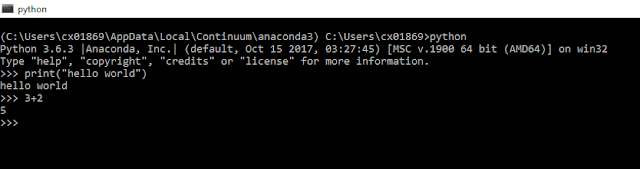
1. The Shell or Python interpreter, which can be launched from the Windows menu, is interactive (executes the commands as you write), and is useful for simple tests and calculations, but not for development.

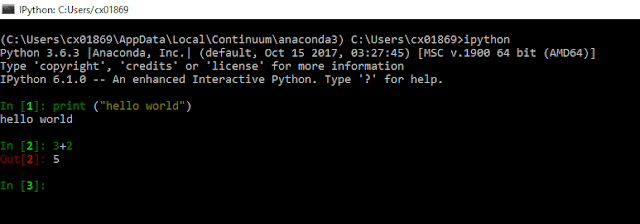
2. IPython: It is an extended version of the interpreter that allows highlighting of lines and errors by means of colours, an additional syntax for the shell, and autocompletion by means of a tabulator.

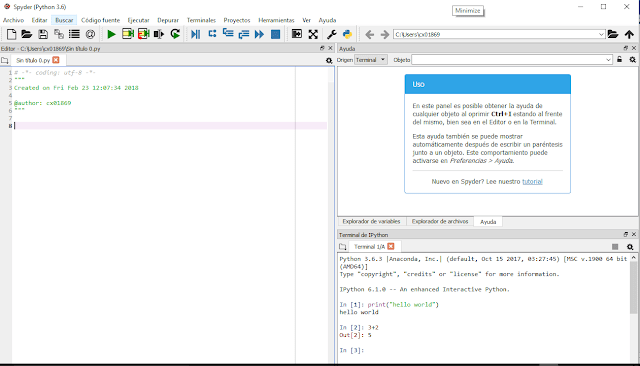
3. IDE or Integrated Development Environments such as Ninja IDE, Spyder, or the one we will work with, Jupyter. Jupyter is a web application that allows you to create and share documents with executable code, equations, visualization, and explanatory text. Besides Python, it is compatible with more than 40 programming languages, including: R, Julia, and Scala and integrates very well with Big Data tools, such as Apache Spark.

What steps are we going to take in this tutorial?

What steps are we going to take in this tutorial?

So that they are not too long, we are going to divide the work into different posts.

Don’t miss out on a single post. Subscribe to LUCA Data Speaks.

You can also follow us on TwitterYouTube and LinkedIn

The importance of labeling: spotlabel

Salmerón Uribes Marina    15 January, 2019

In an increasingly digitized world, technological innovation is a fundamental value. The adoption of new technologies and the possibilities of connectivity offered by Internet of Things can give a great competitive advantage for companies. A good example of this is spotlabel, a solution designed to revolutionize fashion, retail or distribution companies by converting them into smart stores.

spotlabel is a digital labeling system that is easy to install and self-managed, with which companies can create smart points of sale. The store that incorporates this solution thus becomes a communication channel of small format, dynamic and attractive, which immediately informs the genre that is in store, of the products displayed and promotions.

Customers find, when entering the store, screens placed over strategic areas, where they can see information related to the item they are interested in: the price, features or discounts. Assigning product information to a label or sending it to one of the multiple screens is simple and accessible to any of your employees from a web interface or from a smartphone.

spotlabel helps companies manage the products in their catalog and the way they are displayed in the store. It allows, for example, adding, editing or deleting items from the catalog in a simple way, exporting the catalog at any time, process promotions, configuring the store screens and organizing the labeling among other things.

The digital labeling is, in addition, another piece in the task of transforming the physical store as a purely transactional place in a space where the important thing is to generate an experience that emotionally connects the customer with the brand.

This IoT solution is especially aimed at distribution companies, fashion or Retail. GOCCO is an example of a fashion company that has already successfully incorporated this product, in the hands of Telefónica.

In 2016, the first fully connected children’s and youth clothing Flagship was presented in Madrid, which included spotengage among its IoT solutions.

The CEO of GOCCO pointed out that “the use of technology in the new generation of stores must be transparent for the customer and has a triple objective: to provide a much more pleasant shopping experience, facilitate the purchasing process by providing information from the different contact points of the client with the brand and provide product information that helps us improve our collections “.

The store was also equipped with smart testers, social wifi, piped music and dynamic marketing through a videowall.

The incorporation of spotlabel improves, both the customer experience, which has all the information of the product within its reach (even if there is no stock in the establishment), as well as that of the employee, who gains efficiency in his work and can offer personalized attention.

This new digital labeling system has innumerable benefits: it reduces the updating times of the exhibitors, eliminates the human errors that occur during the labeling and saves the cost of printing that is derived from the traditional paper system. The move to a digital and connected system also promotes an agile, dynamic, immediate and centralized update of the contents of the labels.

In addition, it takes advantage of the new communication channel formed by screens distributed throughout the store for the diffusion of dynamic and innovative content. This favors the consolidation of the brand image, on the one hand, and conversion of consumers, on the other, which increases sales.

Solutions such as spotlabel ensure that customers have an experience in the actual physical point of sale given that their true needs are met and their expectations are exceeded. Offers, promotions, launches, etc … are updated at the moment with an image that enriches the user experience at the point of sale and that offers the customer what he needs at all times thanks to the implementation of technology: the simplicity in the purchase provides the client with different shopping experience.

Detected an extension in Chrome Web Store, active from February, that steals credit cards

ElevenPaths    15 January, 2019
We have detected an extension for Google Chrome, still active, that steals data from web site forms visited by the victims. This extension, which is still available on Chrome Web Store –the extension market for Chrome– has been active from February 2018. It is hidden within the searches performed on the Web Store, and it can only be accessed through a link that the attackers are spreading by means of JavaScript injection attacks on web sites that make them to be redirected to that extension using that link.

Chrome web store Javascript cybersecurity image

The extension seems to be a ‘Reader Flash’ created by the supposed developer fbsgang.info. Once installed, it embeds a simple function within all the web sites visited by the user. Particularly, it exploits the API functionality webRequest.onBeforeRequest, so allowing to register a ‘hook’ which will be called just before the user may send a new HTTP request from the web site (for instance, by clicking on a link or submitting a form).

background extension cybersecurity image

This registered function monitors, by means of regular expressions, credit card numbers (if you look at the code you will realize that there are regular expressions for Visa (vvregex), MasterCard (mcregex), etc. That is, in case of any of the data included in the request is a card number, these numbers –encoded in JSON– will be sent to the attacker through an AJAX request. In particular, it uses the “sendFormData” function, which contains the base64-encoded end URL:

codification in base64 of URL cybersecurity image
aHR0cDovL2Zic2dhbmcuaW5mby9jYy9nYXRlLnBocA==

That, once decoded, is:

hxxp://fbsgang.info/cc/gate.php

As you can see, it is a simple extension that takes advantage of the huge scope of a single API call. When it was detected, this extension had been installed 400 times. The infrastructure has not been massively spread so far. It is available on the Chrome Web Store from February 2018, however, as the attacker only made public the extension to those who knew the link, it cannot be found through a ‘usual’ search.  

visibility options cibersecurity image


So, how is it spread?
Instead of targeting victims through searches or massive emailing –which would make this campaign much more successful but at the same time much more ‘detectable’– the attackers have opted for another method. They infect web sites (all the webs in the hosting, as observed) using a JavaScript that can detect if the browser is a Chrome one. In such a case, they just redirect to a web site indicating the users that they must install Flash, and then they are redirected to that extension.
In the following image you can observe the snippet of JavaScript injected on the web sites.

JavaScript fragment cibersecurity image

The point is that the authors have not correctly finalized the snippet yet (or they have disabled it for any reason), so the current content it presents is the index of server files:

server file index cybersecurity image

This doesn’t affect the extension, just its way of spreading. If we ‘go back’ on time, we can specifically see that its previous appearance was much more credible:

index files server previous aspect cibersecurity image

If we check its source code:

index server files source code cybersecurity image

The post-decoded JavaScript code has the following appearance:

Aspecto del código JavaScript, posteriormente a su decodificación ciberseguridad imagen

That is to say, it requests the users to install Adobe Flash or redirects them to Chrome extension market (specifically to the extension that we have remarked at the beginning). Closing the infection circle and the information theft,
we have alerted Google on this extension in order to remove it from the market as soon as possible. Among the web sites, we recommend looking for a JavaScript with the structure previously showed, so you will see if any of them is infected. Even if the attack seems to have been ‘stopped’, the extension is still a serious threat. Its hash is: 4d2efd3eebcae2b26ad3009915c6ef0cf69a0ebf.

We remind you that our tool NETO is available for analyzing extensions in general. Here you can find the result dumped by the tool.


NETO tool extensions cybersecurity image


Innovation and Labs

The best Data Science certifications

AI of Things    11 January, 2019

Over the last 10 years, the amount of data we have generated has soared to unprecedented heights. It is said that by 2020, each person will be generating 1.7 MB every second. This accumulates to over 44 trillion GB of data around the world, known as Big Data

Knowledge and understanding of Big Data has become extremely desired across all sectors, and so educating one’s self on this topic is highly recommended to increase employability. As with the big data boom, the number of big data certifications is expanding rapidly, and are in great demand.

These qualifications are offered across various platforms including from vendors, educational institutes and independent or industrial bodies.

Below we will show you some of the most popular and successful certification courses:

Vendor courses 

EdXData Science Essentials

Provided by Microsoft, this course forms part of the Professional Program Certificate in Data Science. Students should have an introductory knowledge of programming languages such as R or Python before starting the course. Students will develop an understanding of probability and statistics, visualisation, data exploration and Machine Learning (at an introductory level using the Microsoft Azure Framework). The course material is free, but students can opt to pay 90 dollars for an official certificate. 

IBMData Science Fundamentals

IBM´s rebranded online portal Cognitive Class, offers a program that covers data science 101, methodology, programming in R, and open source tools. 20 hours is the estimated time needed to complete all of these areas, depending on the students starting capability level. 

DataquestBecome a Data Scientist

As one of the few independent online training providers, Dataquest offers free access to the majority of its materials, although there is the option to pay for a premium service which includes tutored projects. It’s a good way to see if you would enjoy studying data science or not, as it offers three different career paths for consideration; data analyst, data scientist and data engineer.

CourseraData Science Specialization

Offered through John Hopkins University, Coursera is one of the longest-running data science education platforms. Although the course isn´t completely free, this amount can be waived for students who don´t have the financial resources. It is made up of 10 course and covers natural language processing, cluster analysis, programming in R and applications of Machine Learning. Students are encouraged to create a data product that can be used in the real-world to solve problems. 

The Open Source Data Masters

This course is comprised of a collection of free, open source resources. Natural language processing of the Twitter API using Python, Hadoop MapReduce, SQL and n SQL databases and data visualisation are covered in the course. Students can also develop their understanding of algebra and statistics needed to understand the fundamentals of data science.

Educational Institutes

Data Science Certification from Harvard University

This program covers the key data science essentials such as R and machine learning. It uses real-world case studies to help the learning process, spread across 9 immersive courses. It is one of the highest-rated online masters programs available. Students will learn all about probability, visualisation, inference and modelling, linear regression and machine learning (to name a few).

Data Science and Statistics Certification from MIT

Comprised of 5 courses, this program will help strengthen your understanding of the foundation of data science, statistics and machine learning. Students will have the chance to learn about big data analysis and learn how to make data-driven predictions through statistical inference and probabilistic modelling.

Here are some more platforms offering Data Science Certifications:

SAP Hana Certification

AWS Certified Big Data – Specialty

Micro Focus Vertica

MCSE: Data Management and Analytics

Introduction to R for Data Science

EMC Data Science and Big Data Analytics Certifications

Don’t miss out on a single post. Subscribe to LUCA Data Speaks.

You can also follow us on TwitterYouTube and LinkedIn

2019 Won’t Be the Year When Quantum Computers Replace the Cryptography That We All Use

Gonzalo Álvarez Marañón    9 January, 2019
 2019 won’t be the year when quantum computers replace the cryptography that we all use image

What would happen if a fully error corrected quantum computer of several thousands of logical qubits started working today? Public key infrastructures would fall down. The secrets of the world would be discovered. There would be chaos.
How far or close that day is? How would it affect our cryptography? What to do to protect our sensitive information ahead of the forthcoming arrival of quantum computers?

Scientists, politicians and businessmen from all over the world are worried about these questions as well. Last December, the publication division of the U.S. National Academies of Sciences, Engineering, and Medicine issued the first draft of the report Quantum Computing: Progress and Prospects. This document of more than 200 pages contains the consensus of the Committee on Technical Assessment of the Feasibility and Implications of Quantum Computing, whose members are several scientists and experts of the field. The report provides a judicious and scientific evidence-based exploration on what progress can be expected in the coming years, the actual threat they will represent and what strategy will need to be undertaken to be prepared for the clear arrival of the first fully functional quantum computer with thousands of qubits.

However, the question is not if there would be quantum computers or not, but when they will arrive and if they will catch us off-guard.
In this article I will summarize the most relevant conclusions reached by the committee. Of course, I encourage you to read the whole report.

The 10 most relevant findings on the near future of Quantum Computing

Key Finding 1: Given the current state of quantum computing and recent rates of progress, it is highly unexpected that a quantum computer that can compromise RSA 2048 or comparable discrete logarithm-based public key cryptosystems will be built within the next decade. 

Classical Computing works with bits, while Quantum Computing works with qubits. A classic bit has a well-defined value —‘1’ or ‘0’—, while a qubit is in a quantum superposition of states, that is, in a combination of both ‘1’ and ‘0’ at once. To achieve this, all the qubits need to be ‘entangled’, isolated from external environment and under an extremely precise control: What an engineering challenge!

Noise management differs greatly from one computational model to the other one. Since a classical bit is either ‘1’ or ‘0’, it is very easy to remove the noise that may be produced on logic gates. Nevertheless, considering that a qubit can be in a combination of ‘1’ and ‘0’, removing noise from physical circuits is very hard. This way, one of the greatest design challenges is the error rate: in 2018, the error rates for 2-qubit operations on systems with 5 or more qubits were higher than 1%.

Consequently, quantum error correction (QEC) algorithms are required to emulate a noise-free quantum computer (i.e. a fully error corrected quantum computer). Without QEC, it is unlikely that a complex quantum program, such as one that implements Shor’s algorithm to compromise RSA, would ever run correctly. The problem with QEC is that it requires:

  1. a higher number of physical qubits to emulate more robust and stable qubits, called “logical qubits” and…
  2. a higher number of primitive qubit operations that must be performed on physical qubits to emulate quantum operations on these logical qubits. In the short term, QEC incurs significant overheads, so we will only see ‘noisy’ computers.

Furthermore, it is far from simple to convert a large amount of classical data to a qubits’ quantum state. For problems that require large data inputs, the amount of time required to create the quantum input might exceed the computational complexity of the algorithm itself, so greatly reducing (or even removing) the quantum advantage.

Another challenge they face involves code debugging. Debugging methods for classical computers usually rely on memory examination, and the reading of intermediate states. However, a quantum state cannot be copied (because of the no-cloning theorem) for later examination. What if it could be directly read? Then, any measurement of a quantum state would collapse it to a specific value of classical bits, bringing computation to a halt. In other words, we are far from developing new debugging methods.

In summary, to build a quantum computer capable of successfully running Shor’s algorithm in a 2048-bit RSA public key requires building a machine that is five orders of magnitude larger than current machines and has error rates about two orders of magnitude lower, as well as developing a software development environment to support this machine.

Key Finding 2: If near-term quantum computers are not commercially successful, government funding may be essential to prevent a significant decline in quantum computing research and development.

Since quantum computing is on everyone’s lips, some of the most powerful companies all around the world have embarked on the development of the first high-powered quantum computer. However, the current enthusiasm might wane if commercial applications for the technologies under development are not found (beyond breaking RSA in the future). If disruptive breakthroughs enabling the development of more sophisticated computers are made, the expected financial returns will stimulate more major companies and more research on the field.

Nevertheless, if the first commercially useful applications required a very large number of qubits, interest would only be preserved by means of public funding. In such a case, there would be a risk to fall into the “valley of death”, as well as to see the departure of talent towards more favorable fields from both industry and academia.

Key Finding 3: Research and development into practical commercial applications of noisy intermediate-scale quantum (NISQ) computers is an issue of immediate urgency for the field. The results of this work will have a profound impact on the rate of development of large-scale quantum computers and on the size and robustness of a commercial market for quantum computers.

Given the overhead of QEC, the first quantum computers in the short term will certainly have errors: they will be noisy intermediate-scale quantum (NISQ) computers. Currently, there are no applications for NISQ computers. As long as commercial applications for NISQ computers are not developed, the virtuous cycle of investment will not start.

Key Finding 4: Given the information available to the committee, it is still too early to be able to predict the time horizon for a scalable quantum computer. Instead, progress can be tracked in the near term by monitoring the scaling rate of physical qubits at constant average gate error rate, as evaluated using randomized benchmarking, and in the long term by monitoring the effective number of logical (error-corrected) qubits that a system represents. 

The committee suggests monitoring the progress in this competition by the following metrics: the error rates of the 1-qubit and 2-qubit operations, the interqubit connectivity, and the number of qubits contained within a single hardware module.

Key Finding 5: The state of the field would be much easier to monitor if the research community adopted clear reporting conventions to enable comparison between devices and translation into metrics such as those proposed in this report. A set of benchmarking applications that enable comparison between different machines would help drive improvements in the efficiency of quantum software and the architecture of the underlying quantum hardware.

In this regard, the committee proposes using several metrics and milestones to help monitor the development of quantum computing. These milestones are illustrated in the following figure. 

milestone for quantum computer image

Key Finding 6: Quantum computing is valuable for driving foundational research that will help advance humanity’s understanding of the universe. As with all foundational scientific research, discoveries in this field could lead to transformative new knowledge and applications.

The work on the design of new quantum algorithms can help progress foundational research on computing. This way, we can expect that research on quantum computing will similarly lead to new advances in other fields, such as physics, chemistry, biochemistry, material science, etc. These advances may, in turn, enable future advances in technology.

Key Finding 7: Although the feasibility of a large-scale quantum computer is not yet certain, the benefits of the effort to develop a practical Quantum Computer are likely to be large, and they may continue to spill over to other nearer-term applications of quantum information technology, such as qubit-based sensing.

Quantum computing and information findings are believed to enhance other quantum technologies.

Key Finding 8: While the United States has historically played a leading role in developing quantum technologies, quantum information science and technology is now a global field. Given the large resource commitment several non-U.S. nations have recently made, continued U.S. support is critical if the United States wants to maintain its leadership position.

In fact, the U.S. is losing this leadership position, as it can be observed in the following figure, based on R&D investment.

image based on R&D investment


Key Finding 9: An open ecosystem that enables cross-pollination of ideas and groups will accelerate rapid technology advancement.

This competition for creating the first quantum computer could drive the field to be less open in publishing research results in scientific journals and forums. It is required to find a balance between the natural protection of intellectual property and the open flow of information to ensure further development in the field.

Key Finding 10: Even if a quantum computer that can decrypt current cryptographic ciphers is more than a decade off, the hazard of such a machine is high enough—and the time frame for transitioning to a new security protocol is sufficiently long and uncertain—that prioritization of the development, standardization, and deployment of post-quantum cryptography is critical for minimizing the chance of a potential security and privacy disaster. 

A quantum computer with around 2,500 logical qubits could potentially defeat 2048-bit RSA encryption in no more than a few hours. Cryptographers have been working for decades on algorithms that are (believed to be) quantum-resistant. However, the problem is not so much the lack of alternatives to the RSA and the elliptic curves, but the transition from the old algorithms to the new ones; not to mention what would happen with those secrets intended to be confidential for many years. Since this transition may need decades to be completed, starting it must be the main priority, before the threat becomes a reality.

In the next entry we will explain how quantum computing affects current cryptography, in particular: what would happen with RSA, elliptic curves, digital certificates, Bitcoin and hashes. We will also see the cryptographic alternatives that are being considered for the post-quantum age.

Gonzalo Álvarez Marañón
Innovation and Labs (ElevenPaths)
www.elevenpaths.com

Visual Object Detection Transforms Manufacturing Industries

AI of Things    8 January, 2019

The automation trend is being accelerated by daily advances in Artificial Intelligence and Deep Learning. In the manufacturing industry, the automation of tasks by machines has become one of the biggest technological revolutions in this field.

Object Detection is the component of Computer Vision that deals with locating a specific objective from images, which makes up a key part of manufacturing for automation.

Let´s start by understanding Computer Vision. It literally allows computers to ´see´ as humans do through the acquisition, processing, and analysis of digital images and videos. Many basic forms of this technology already exist that are able to use open and pre-source training to detect generic objects like trees.  But Object Detection requires a trained algorithm to identify specific details within an image, such as facial expressions.

There is a plethora of uses for Object Detection, from quality management to sorting and packaging. We will break these use cases down for each function to see how this technology can be applied to newer manufacturing practices.

Quality Management

The quality control process remains a task that depends on human visual understanding and quick adaptation. The AI can automatically distinguish faulty products at speed and allow time for corrective action to be taken, which is useful in dynamic environments where things are always changing, and precious time can be saved and dedicated to other tasks.

Inventory Management

Tracking items in real time can prove to be an incredibly complex task for an organisation, and capital and time can be wasted if this is not carried out properly. The automation of this task by AI diminishes the risk of human error, allowing inventory to be counted accurately and efficiently.

Sorting 

Manual sorting is a lengthy and costly process which is often accompanied by human error. Using AI powered Object Tracking, specific parameters can be selected and the corresponding statistics of the number of objects displayed. Not only does it make the assembly line more flexible, but it also reduces the number of abnormalities during categorisation.

Assembly Line

In the manufacturing industry, almost all assembly lines are fully automated. Whilst the use of robotics in this field is extremely useful, the use of AI technology to correctly locate and differentiate products to correlate with their movement will open doors to more efficient labour and higher output. AI powered objective detection allows for this possibility to become a reality.

Custom Object Detection 

Custom object detection allows for niche manufacturing set-ups to be catered to. Objects take a variety of forms and usually algorithms need thousands of training examples to learn to differentiate the products. With this technology programmers are able to use less than 50 of these examples to train the algorithm to perform with accuracy and efficiency.

Figure 1. Many manufacturing processes are carried out by automated machines 

Overall, with the advances in Visual Object Detection, we are able to create machines that are capable of identify objects from videos and images more accurately and more detailed than ever. The benefit to the manufacturing industry is huge, with automated tasks becoming more streamlined, and human error becoming more obsolete. By furthering the understanding ad therefore ability to react to faulty products, machines will be able to navigate through the environment for themselves, rather than requiring a constant scripted input.

Don’t miss out on a single post. Subscribe to LUCA Data Speaks.

You can also follow us on TwitterYouTube and LinkedIn

Sweet dreams with IoT

Cascajo Sastre María    3 January, 2019

The development of Internet of Things has changed our society and multiple sectors like Industry, Retail, construction or mobility in cities among others.

This technology makes life easier for people in many areas; one of them is comfort and rest. IoT helps us sleep better and, consequently, lead a fuller and more balanced life.

For example, Including IoT in the furniture and clothes we use at bedtime: from pillows to mattresses and even masks. All with the aim of making sure that the hours of sleep are of the highest possible quality and help us to rest, even if we do not sleep for too long.

IoT helps us sleep better

The first of these is the ZEEQ smart pillow, which monitors sleep to help us rest better. ZEEQ works connected to a smartphone and has eight built-in speakers with which you can play relaxing music at low volume to help you fall asleep.

This device is able to detect snoring and vibrate when they happen to make us change position. Also, it has an alarm-clock and built in sensors that detect our movements and the different sleep cycles we go through during the night. With this information it emits slow frequency waves modulated around the person: of less intensity during the REM phase of deep sleep and of greater intensity during the minutes prior to the time of getting up to facilitate the awakening of our brain.

All statistics generated on our sleep (duration, interruptions, snoring, different phases) are sent to the smartphones, providing a complete and precise analysis of our sleep patterns. If necessary the data can be provided to the appropriate medical personnel so they can implement whatever measures and / or treatments are necessary.

All statistics generated on our sleep are sent to the smartphones, providing a complete  analysis

The revolution IoT in the area of ​​rest does not end with the pillows. As mentioned before, there are other connective products that help us sleep better like the mattress SmartPick, which works integrated with a bracelet, a smartphone and a set of sensors that measure aspects such as the cardiac frequency or the temperature of the room, total hours of sleep and interruptions.

The great change that this mattress brought was that it incorporated the use of data to improve sleep routine and its quality, such as reflecting whether the user has woken up even if he is not conscious indicating it on the screen or if his sleep schedules are not adequate. It added the coach mode to provide new utilities like weekly challenges to encourage users to improve those routines.

Another product is Sleep Number 360 a smart bed that can change its position at night or synchronize with a thermostat to regulate the temperature of the room. In the same way, you can optimize the temperature of the foot area to avoid excessive cold. It also has a smart alarm that awakens the user in the phase of light sleep that is closest to getting up.

The application of IoT to the improvement of sleep includes sleeping masks. There are models of intelligent eyewear on the market that transmit to the smartphone the data collected by their sensors during sleep for your analysis.

The quality of sleep is a fundamental factor of our daily lives. The deficit of it has a negative impact on our health (increasing the chances of suffering stress or diseases such as obesity) and on labor productivity.

Hence the importance of IoT applications that improve the quality of sleep and facilitate rest. The development of this technology during the next few years will continue to be fundamental in improving our quality of life.

Leave a Comment on Sweet dreams with IoT

Your assets controlled with a click: Things Ready Link

Beatriz Sanz Baños    27 December, 2018

In an increasingly digital world, technology innovation is an essential value. The adoption of new technologies and connectivity possibilities of Internet of Things (IoT) provides a great competitive advantage for companies. A good example of this is Things Ready Link.

How does it work?

Things Ready Link offers companies the possibility of connecting any type of device to their Information Systems, from fridges to industrial equipment. Having all these devices connected, companies could access to their information in real time, and also provide E2E digitization in its business processes.

In this way, any company can monitor at any time their statistical data to know how their connected devices are working, optimizing the cost of their operational processes, offering the best service to their customers. For instance, a restaurant could have current information about the temperature of their fridges or the stock for the coffee makers. Also, “As a service” business models are enabled, so manufacturers could commercialize their equipment to other companies as a service, making digitization more available.

Things Ready Link is an optimal solution to provide connectivity to devices, because it allows mobile communications and devices which adapt better to requirements of systems as well as the information they have to convey. It allows managing jointly and in a single location Kite platform, both communications and devices, which can be monitored and, if needed, work on them by remote control.

Who is intended for?

Integrate companies who develop monitoring solutions, remote control of devices, process automation to end customers and companies who offer equipment as a service are the main target, as they have a new and only contact point for communications and equipment, making their operative and logistic processes easier.

It’s also targeted to end customers who have so many divided devices to connect, like containers, fridges, vehicles, vending machines, urban furniture, industrial equipment, heavy machinery or remote facilities working in any market (farming, mining, business…), so they can:

  • Locate devices
  • Monitor or remote control devices
  • Improve customer service, that will allow to improve their engagement as well
  • Create new business models
  • Reduce maintenance cost thanks to process automation

ASTI’s commitment

On industrial environments, both automation and digitization of processes is critical, so companies have a big requirement of connectivity and integral solutions that will allow them to move forward on innovation.

One of the pioneers on digitization is ASTI Mobile Robotics, who relied on Telefónica to deploy IoT application to his business model, connecting his AGV’s robots (automated guided vehicles), in order to offer them to their customers as a service.

Enrique Sierra, ASTI’s I+D Development Manager explains: “This technological solution will allow to store the data machines produce in a server, so you could check the information about production and maintenance of those machines, with failure prediction before fails happen, to avoid stops, also improving a real time control of AGV’s”.

This example may be the impulse many companies need to strengthen their bet on digitization and be fully aware of taking IoT to their business models will be essential for future success.

Open source maintainer burnout as an attack surface

ElevenPaths    26 December, 2018
Introduction
Software development has evolved greatly in the last decades. It is leaning towards an scenario based in third-party modules, components and libraries that help accelerate the development of our own software solving effectively frequently used tasks so that we do not need to reinvent the wheel.

While It is straightforward to see the advantages of this approach we need to realise that coupled with them comes a series of risks that need to be handled as well. To use a better known pattern that comes from the cloud computing world there’s a shared responsibility model regarding vulnerabilities and potential attacks as we can see in its different flavours: IaaS, PaaS or SaaS.

The main issue arises when a module or library that we depend on gets compromised, automatically the vulnerability propagates to our software project. It’s fair to notice that this propagation does not mean that we are thus affected by a potential attack but it remains a risk that we need to evaluate, control and mitigate and that it requires knowledge inside the organization that uses those affected software components.
Many third-party components are open source and its maintenance relies on a given community that can vary in sizes. In many cases the weight of the maintenance falls in the shoulders of one or two main contributors that keep the project up-to-date and make incremental improvements.
Here is where the burnout concept kicks in. Maintaining a popular library or module requires a ton of work from reviewing contributions, handling communication and analyzing the roadmap of the project to keep it moving forward in the right direction, but returns are often not at sight. When the maintainer sees that the library is widely used its maintenance it is not proportionally shared by the community, burnout increases and we head into a fertile field for an attacker to step in and offer help and gain the permissions needed to perform its attack.
Attack
The idea behind the investigation that we are presenting today comes from an attack performed in september 2018 towards the repository event-stream, event-stream is a popular library, that provides helper functions to work with streams in a Node.js application with more than 1.9 million weekly downloads in NPM.
open source maintaner Attack imagen
Even though the library is popular its maintenance fell mainly on the repository owner as you can see in the next figure that shows the repository contributions overall:
To give a brief summary of the attack, the attacker seeing the low maintenance of the repo by its community offered help and convinced its owner to give write permissions to the repo and to the published module inside the NPM platform NPM (Node Package Manager). After gaining those permissions the attacker added malicious code and published a new version inside NPM affecting indirectly to a significant volume of projects that relied on the event-stream library.
The details of the attack have already been covered in other posts so we point you to one of those here. We can not encourage you enough to check out that post so that you can see the nitty-gritty details on how it was performed and gain some valuable context information.
This attack was really targeted, oriented towards stealing bitcoins wallets from a parent software platform copay-dash that had event-stream as a dependency. Even though in this case the attack was targeted the underlying technique shows a broader scale problem: Managing software dependencies and the implications it conveys in terms of security in our software , specially when we rely on open sourced libraries where the responsibility becomes blurred on the underlying community.

With our investigation we want to dive into the mentioned bigger scale dependency issue.

Hyphotesis
The question that wondered our minds and that led to this investigation is: if we selected the most depended upon libraries in NPM, Is it frequent to see projects that have low maintenance, projects where the main contributor may be burnout and thus prone to buy into an attack like the one launched over event-stream?
To test our hypothesis we needed to follow these steps:
  • Find the libraries most depended upon in NPM
  • Define the characteristics that would indicate a low maintenance of the codebase
  • Analyze the results, obtain insights and provide recommendations that improve the current situation


Investigation
We focused on the 1000 most-depended upon libraries on the [NPM](https://www.npmjs.com/) platform. Using a python script foreach library we scraped characteristics that would be valuable to show the activity and use level of the module.
We also need to define a threshold of, what we are going to refer as “low maintenance” codebase, in order to do so we looked into the following features:
  • Repository that had 5 or less commits in the last year
  • Community size of 30 or less contributors
  • Participation percentage was low during last year: we compute this participation percentage as the commits performed by contributors other than the owner of the repo over the overall commits
The above definition is quite restrictive, even the event-stream library would not be included in the low-maintenance bucket since it had 16 commits and 34 contributors over the last year. though it is true that a big part of those commits are part of the attack itself.
open source maintaner investigation image
We have released the code on Github in the npm-attack-surface-investigation repo. It includes the python scripts need to reproduce our analysis in case it is valuable to someone in the community.
logo tegra image
This investigation has been conducted by TEGRA, an R&D Cybersecurity Center based in Galicia (Spain). It is a joint effort from Telefónica, a leading international telecommunications company, through ElevenPaths, its global cybersecurity unit, and Gradiant, an ICT R&D center based in Galicia. TEGRA also has the support from Xunta de Galicia.
Results
The results that we have obtained are shocking: 250 (25%) of the 1000 analyzed libraries fall into the low maintenance bucket following the aforementioned definitions. Those 250 modules accumulate almost 700M weekly downloads, so we are looking into libraries used globally and frequently in a worldwide scale.

Out of those 250, there are 129 libraries that showed no commit activity (12.9% of our analysis scope) at all in the last year, accumulating more than 330M weekly downloads.

open source maintaner results image
If we add to those 129 libraries with no activity (we can not compute community participation since there’s none) the libraries that were only maintained by the repository owner the number of libraries jumps up to 168, summing a total of more than 450 million weekly downloads.

This link  has the results of the analysis with more information so that you can verify the results of our investigation for yourselves.

Summary
After reviewing the results we think that our hypothesis has been proved and we can predict that the attack suffered by event-stream is not a one-of-a-kind event but more a signal of a trend that will continue to hit the open source community over the next years to come.

The use of third-party dependencies in software development has many advantages but attached to them come along some risks that need to be identified and managed by software developers, specially at a corporate level, to avoid being surprised by collateral vulnerabilities inside their projects, inherited from their dependency trees.

Even though open source software is a major trend nowadays, its maintenance is a tedious task, since the returns of it are not straightforward or measurable in the short-term. If we combine that with the fact that these projects are open, in theory, to anyone willing to contribute, we can find ourselves with a landscape where the responsibility becomes blurred, making the open source community more prone to attacks like the one described in earlier sections.

Even though our analisis has only covered NPM libraries, we think that the same conclusions might be found inside other programming languages and package managers where we make use of third-party modules.

Next we will go through some essential recommendations to mitigate the risks of using third-party software from the classic paradigm of cybersecurity: prevention, detection and response.

Prevention
Since the release of version 5.x.x, NPM creates a file named package-lock.json that specifies the dependency tree of a project at a given moment in time. It is important that we use and publish this file together with our project to ensure that others users of our software will find the exact same tree of dependencies during the installation phase when they perform “npm install” that way they won’t be affected by minor releases or patches that could potentially include malicious code if they were hijacked. This will allow us to control risks, given that in the moment of the file generation the dependency tree was sanitized.

Before we include a new dependency in our code we need to think whether that dependency is really needed, and if we conclude that it is, we need to verify if the library that we will be using has a strong community and activity behind.

open source maintaner prevention image


Detection
This section has a lot of potential growth we can see in the software world iniciatives that are worth exploring and integrating into our development cycle. The first step is to list the dependencies that our software has in order to be able to manage them, there are some open source projects that try to help in that area by automating dependency extraction from our codebase.

We are going to focus in two examples showcased by the BBVA labs in the XII STIC conference of the CCN-CERT in Madrid this december:

  • Patton: a project that uses fuzzy matching to find public vulnerabilities in our codebase or dependency tree.
  • Deeptracy: a project that automates dependency extraction for multiple programming languages.
open source maintaner detection image


Response
After making sure that we keep our software dependencies up-to-date, in many cases moving to the latest dependency does not imply any source code change on our software, so having a backlog task to review and upgrade our dependencies is a must-have in mature software environments.

Even though anyone who has worked on software development knows about the complexity of the task, is is important to note that an open source community implies a bidirectional flow and that if our software, critical or not, relies on other pieces of open source software we must try to contribute to the community behind it and keep it live and active.

Wrap uUp
Open source communities are not a panacea and we must not view them from a pure consumer perspective. Participating actively in those communities that we rely on in our own software development is the most direct way to remove maintainers burnout, manage the overall health of our software products and reduce the potential attack surface.
open source maintaner wrap up image
TEGRA cybersecurity center started within the framework of the mixed research unit IRMAS (Information Rights Management Advanced Systems), which is co-funded by European Union, within the framework of the Operational Program ERDF Galicia 2014-2020, to promote technological development, innovation and quality research.

Juan Elosua Tomé
Director por parte de ElevenPaths del centro I+D en Ciberseguridad TEGRA de Galicia
David Álvarez Pérez
Investigador de ciberseguridad del centro tecnológico Gradiant