Voluntechies, bringing virtual reality to hospitalized kids

Ana Zamora    8 February, 2017
One of the amazing aspects of working with technology is the potential social good you can do with it. Here at LUCA we strongly believe in the power of using Big Data for Social Good and that is why we are involved in different projects to help reaching the SDG goals.


Not related with Big Data but with technology is the initiative called Voluntechies. This organization aims to bring the latest technology to hospitals around Spain, so the kids that are hospitalized can forget for a while their diseases and have some fun using technology. In concrete, they organize virtual reality workshops so the kids can escape from their daily lives and go to a virtual world, meanwhile being at the hospital.


Video: Voluntechies initiative brings Virtual Reality to hospitalized kids.
 
Last week I had the chance to participate in one of the workshops, this time visiting the hospital of La Paz in Madrid. First we helped the kids building their own VR glasses (it was difficult even for me!), to afterwards being able to travel to the space, do an expedition on the dinosaurs era, swim with sharks at the aquarium of San Diego, and even getting inside a One Republic videoclip. This workshop was possible thanks to the foundation Voluntarios Telefónica, which partners with Voluntechies since they started.


Telefónica volunteers
Figure 1: Some of the Telefónica volunteers after the VR workshop at La Paz hospital.

The project, which only started a year and a half ago, has been recently nominated to the G5 Innova awards to social innovation. With the goal of reaching 100.000 people by 2020, Voluntechies keeps working so they can spread the network to other hospitals and schools, both outside and within Spain.

Want to help or sponsor the initiative? Find out more here.

 

Jam Session with Greg Day Madrid 2017 Roundup

Florence Broderick    8 February, 2017

Estrenamos el mes de febrero uniéndonos a nuestros colegas de Palo Alto para celebrar nuestra primera Jam Session del año en Madrid. Este año iniciamos nuestras sesiones de visión sobre temas de tendencia en el ámbito de la ciberseguridad con Greg Day, VP y CSO de Palo Alto Networks, experto en temas de normativa GDPR y Directiva NIS.

Este evento reunió a nuestros expertos, clientes y socios de Palo Alto donde compartimos pensamientos y buenas prácticas sobre los incipientes cambios en ciberseguridad para cumplir con la nueva legislación europea en la protección de datos.

¿Cómo adaptarse a la nueva normativa de Protección de Datos? ¿Sabías que el nuevo reglamento europeo en materia de protección de la información será de obligado cumplimiento a partir de mayo de 2018? ¿Sabes cómo puede afectar a la seguridad de la información de tu empresa?

Aquí te recomendamos la lectura de otro post sobre este tema de actualidad con la visión de nuestro experto Pablo Alarcón, para que puedas conocer todo lo que necesitas saber sobre el nuevo Reglamento Europeo en materia de Protección de la Información.

¿Te interesa conocer más sobre los eventos de ElevenPaths? Visita nuestra página de eventos para obtener más información.

LUCA to power data-driven decisions in Brazil’s tourism sector

AI of Things    7 February, 2017

Brazil’s tourism industry had a huge boost in 2016 with more than half a million tourists descending upon Rio de Janeiro for the Olympics – making it a record year with a total of 6.6 million internationals visiting the country, a 4.8% increase on 2015.

Injecting a total of $6.2 billion into the local economy, international tourism has become extremely important in the growth of the country – with Brazil now becoming the second most visited country in Latin America after Mexico.

Here in the LUCA team, we believe that data-driven decision making is fundamental in accelerating the tourism opportunity for Brazil and for this reason we are proud to have signed a deal with the state of Espírito Santo, alongside Telefónica Vivo Business Solutions this month.

Espíritu Santo
Figure 1: Data-driven decision making will enable tourism in Espíritu Santo to thrive.

With a population of almost 4 million and 40% of its territory on the coast, Espíritu Santo attracts a great number of national tourists from neighbouring states. This new agreement with Telefónica Vivo Business Solutions, powered by LUCA technology, will allow them to measure their progress and make decisions on its tourism offering based on Big Data – leading the digital transformation of the Brazilian tourism sector.

Our LUCA Smart Steps technology will allow them to understand the behavioural patterns of tourists as well as understanding the profiles of visitors in certain locations throughout the state. In turn, decision-makers will be able to provide new statistics on the direct and indirect impacts of tourism on the local economy – as well as taking actions such as optimized marketing campaigns to attract more visitors from certain locations and of certain profiles.

Espíritu Santo
Figure 2: The project will study 10 touristic events in the state throughout the period of study.

The project, which was contracted by Secretaria do Turismo do Estado de Espírito Santo, will focus on the analysis of 10 touristic events in the state, allowing them to understand which are more profitable for the local economy by looking at the times of day when most visitors attend and where they come from allowing them to compare year on year and make data-driven decisions about the organization of future events. The data will be used by the Tourism Observatory of Espírito Santo.

One of our Business Managers in Brazil, Verana Souza, said “This really positions us as pioneers alongside the public sector by providing this service to the state of Espíritu Santo. It allows us to unlock new business, providing more intelligence, innovative and efficient public services.”

Are you interested in using LUCA Smart Tourism insights in your country? Contact us here.

p.p1 {margin: 0.0px 0.0px 0.0px 0.0px; font: 11.0px Calibri; color: #1f497d}
span.s1 {font-kerning: none}
span.s2 {text-decoration: underline ; font-kerning: none}

LUCA partners with Pelephone to bring Big Data services to Israel

AI of Things    6 February, 2017
This week we are thrilled to announce our latest partnership with Pelephone, powering the Israeli telco’s latest product: Smart Data. Set to invest five million shekels in the next two years, Pelephone will provide a unique opportunity to private and public sector clients to accelerate their Big Data journey leveraging the know-how we have developed in the Telefónica and LUCA team over the past 5 years. 


This new alliance is further evidence of our world class capabilities. As with our joint venture with China Unicom, we will leverage our expertise to enable Pelephone to develop Smart Steps in Israel, a country which is already well-known for its advanced position in the world of innovation and entrepreneurship.

Partnership with Pelephone
Figure 1: Our latest partnership with Pelephone.


Ilan Segal, VP Marketing at Pelephone said: “We are committed to innovation, and as part of the development of new growth engines for the company has identified potential in Big Data, joining up with a leading company in this field – a field that is in accelerated development around the world. Our research shows that there is a huge demand in the Israeli market for data solutions, which will lead to better service for both consumers and users in Israel.”
With the world-leading expertise we have developed in Smart Steps and Smart Digits, we will be working alongside the Pelephone team to bring our unique capabilities to help them to realise their data monetization strategies – something which we have already enabled China Unicom to do over the past year as their technological partner. 
Our VP for Strategic Alliances at LUCA, Phil Douty, reflected on this new deal: “We are extremely excited to be working on this unique partnership with Pelephone. Big Data is an incredible opportunity not just commercially, but also for society, and this is a great chance for us to work together to bring such technology to Israel – which is already known globally as a hub for innovation.”
We are passionate about helping other telecommunications companies to exploit their assets by applying Big Data and Artificial Intelligence techniques and with experience in 4 continents already, we are excited to help more telco players to do the same. Want to find out more? Check out the partnerships section of our website. 

To see the full Pelephone press release, click here

p.p1 {margin: 0.0px 0.0px 0.0px 0.0px; font: 11.0px Calibri}
span.s1 {font-kerning: none}

p.p1 {margin: 0.0px 0.0px 0.0px 0.0px; font: 11.0px Calibri}
p.p2 {margin: 0.0px 0.0px 0.0px 0.0px; font: 11.0px Calibri; min-height: 13.0px}
span.s1 {font-kerning: none}

p.p1 {margin: 0.0px 0.0px 0.0px 0.0px; font: 17.0px Calibri; color: #454545}
span.s1 {font-kerning: none}

WiDS Madrid 2017 Roundup

AI of Things    6 February, 2017
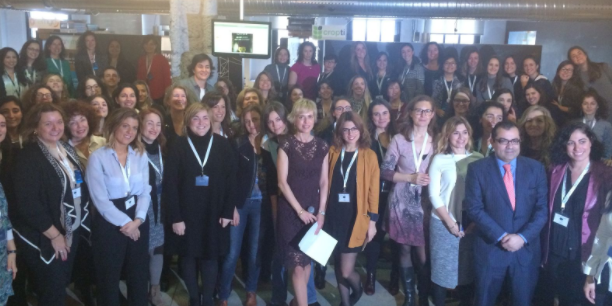
On Friday, we joined our colleagues from Synergic Partners to celebrate Stanford University’s Women in Data Science (WiDS) event for the first time ever in Madrid. This international event, which takes place in over 50 cities around the world simultaneously, brings together thousands of women from both academia and business to share thoughts and best practice – as well as hearing from world-class speakers and experts in Data Science, Big Data and Artificial Intelligence.

This year kicked off with a panel led by Carme Artigas (CEO of Synergic Partners) where the Data Science discipline was discussed by Angela Shen-Hsieh (Product Innovation Director at Telefónica I+D), Amparo Alonso (LIDIA Research Group Coordinator) and Concha Bielza (a professor from the Universidad Polítecnica de Madrid).

The second session looked at the role of Data Science in accelerating business, where Rosa María Sanz (Director at Gas Natural Fenosa), Elena Alfaro (CEO of BBVA Data and Analytics), Nuria Bombardó (Strategy and Business Analytics Manager at PepsiCo) and Marta Plana (General Counsel at Digital Origin) discussed the power of applying data in their sectors and the privacy issue surrounding such technologies.

WiDS event in Madrid
Figure 1: Over 100 women came together at #WiDS Madrid on Friday 3rd February.

The final roundtable focused on entrepreneurship and talent in the realm of Data Science, with Ana Segurado (Telefónica Open Future Director), Maria Barceló (Executive Master in Digital Business at ESADE) and Sira Pérez de la Coba (Founder and CEO of Shazura) coming together to discuss their experiences in data-driven talent.


Interested to find out about more events from Synergic Partners or LUCA? Visit our events page for more information.

LUCA Talk 1: Using Big Data to understand mobility and pollution

Ana Zamora    2 February, 2017
Last Monday we hosted our very first LUCA webinar with great success, with more than 140 people connecting to our live stream.

Technology, and more specifically Big Data, is enabling us to simplify the way we manage cities and in our talk we aimed to show a concrete example of this – demonstrating the full potential of such solutions. This is especially relevant in light of recent controversy around pollution in cities such as Paris and Madrid.
LUCA is fully committed to capturing the full potential of data to contribute to society, and this webinar was just one of our examples. Our Data Scientist, Javier Carro, shared with us how we can use our Smart Steps product alongside Open Data to understand mobility in cities (Madrid and Barcelona) and its impact on pollution.
In case you missed the webinar, you can watch it here:
       
Video: LUCA Talk 1 – Utilizando el Big Data para entender la movilidad y la contaminación.


Want to know everything about upcoming webinars? Sign up to our newsletter!

What’s the role of satellite connectivity in an IoT world?

Beatriz Sanz Baños    1 February, 2017

The European Space Agency (ESA) recently launched the Hispasat 36W-1 into space. This satellite begins the update of a platform that aims to renew the services offered by many operators. This is just an example of progress towards a connected world, no matter the barriers, something that is essential for the creation of an ecosystem suitable for IoT. Yet it is not the only satellite in orbit whose mission is to provide satellite coverage where cellular networks do not reach. More and more companies are focusing on mixed networks that are capable of reaching anywhere.

Satellite connections to reach anywhere

Satellite connections cover places that are completely impossible to cover by other physical means. It also unloads the network to avoid the saturation of the lines, or when bandwidth is limited. Under both circumstances, satellite connections play a fundamental role in an interconnected world that is ready for the Internet of Things. The areas that will benefit the most from this are undoubtedly the commercial and industrial sectors. However, users will too, albeit to a lesser extent. Asset tracking is one of the longest-running sectors with satellite connections. For example, a container crossing the ocean can only be monitored using this kind of technology. Due to the improvements in satellite constellations, we can now make the connection in both directions, which allows us to act remotely in case of emergency. This provides logistics companies many more possibilities to mobilize all types of products and monitor their status.

Satellites are also essential in scientific monitoring or production tracking in remote locations. Users can expand their use of services of all kinds, such as recreational, healthcare or professional, anywhere in the world, something that all connected objects take advantage of. Currently, mixed coverage and satellite connection coverage are targeted by large companies. Telefónica, for example, is working to provide connection services on trains and other means of transportation. Remote sites are another target, making it possible to lower costs and improve the quality of services. According to Northern Sky Research, by 2023 there will be more than 5.8 million M2M and IoT connections. In line with this report, satellite connections are still finding their niche among consumers, while industry is much more advanced.

The future of satellites in an IoT world

At the same time that satellite connections are changing the way we use the IoT, their presence is also affecting the M2M market that uses this type of connection. Thanks to substantial improvements in technologies used on land, satellite connections are allowing for increased operative efficiency of the sector, which sparks greater interest on the part of companies. This, in turn, leads to improvements and the creation of new use cases, which forces operators to seek better capabilities and more efficient hybrid solutions. It also necessitates the simplification of access to satellite technology, antennas and other technological factors that allow satellite connections to be used in all types of devices.

Currently, IoT satellite connections remain marginal compared to other traditional systems. But with the expansion of frequencies-assisted services in the Ku and Ka bands, thanks to the current improvements in satellite technologies, the M2M and IoT sectors will see significant growth. In addition to the potential for services, increased use of these bands will create new opportunities. For example, it will allow for more daily use cases, such as in connected cars or domotic homes in places that are difficult to reach. Experts predict that we will see this potentiality peak within the next decade.

Transport is still making the most of satellites

Although users will be able to access a whole new range of services, the industrial sectors will remain the biggest beneficiaries of this technology. And among them, transportation is the model that has the most experience and where this type of technology sparks the highest expectations. In the words of Mohammad Marashi, VP for Innovation and Service Architecture at Intelsat, improving the tracking system in asset monitoring could help save up to $13 billion a year in large container shipping by 2025.

Improvements in satellite connection services and the development of associated technologies, as explained during the last SATELLITE 2016 show, could allow operators to increase transport efficiency, generating a positive impact of between $4.5 and $9.3 billion by 2025. Along with transport, producers of raw materials such as mining and fuel will see a substantial increase in the efficiency of their sensor systems, which, together with more efficient transport, could lead to new opportunities and increasing revenues in these sectors.

Chema Alonso stars in “Big Data, Living with Algorithms”

Ana Zamora    1 February, 2017
Yesterday evening, RTVE launched the first in a series of documentaries entitled “Documentos TV”, showing just how digital our daily lives have become and how the control of these digital activities is one of the biggest battles of our time. The first episode, “Big Data, Living with Algorithms” (“Big Data: Conviviendo con el Algoritmo”)featured experts from the technology sector, including Telefónica’s CDO, Chema Alonso, who explained how the development of algorithms that predict our behavior bring us closer to a world of decisions made by Artificial Intelligence.

Chema Alonso in TV
Figure 1: Chema Alonso in the documentary: ‘Big Data, conviviendo con el algoritmo’.
The documentary covered important topics such as Internet of Things, which our CDO expanded on by discussing the cybersecurity matters surrounding the topic. Chema commented: “The rapid expansion of IOT across all sector is extremely complex, for this reason it is fundamental that we take security and ethics into consideration from the beginning  when designing systems, otherwise it will be difficult to control in the future.”
To see what else he had to say, watch the entire documentary online here.

5 Big Data and AI Startups to watch out for in 2017

AI of Things    31 January, 2017
Big Data may have fallen off the Gartner Emerging Technology Hype Cycle in 2016, but Big Data and Artificial Intelligence startups are however still in the spotlight. An increasing number of tech entrepreneurs are finding innovative ways to harness the power of analytics to bring value to a wide range of companies in many sectors.
Some of the “once-startups now-giants” of this world, such as Uber and Amazon, have made Big Data a core part of their strategy – but how many startups are creating the technology to enable this shift towards data-driven business models? On AngelList, 4372 Big Data startups are listed with an average valuation of $4.5m, whilst in the Artificial Intelligence category, there 1926 startups listed with an average valuation of $4.8m. 


The market for Big Data hardware, software and services grew 23.5% to $22.6 billion in 2015, according to market researcher Wikibon, and is expected to increase at a compound annual growth rate of 14.4 percent to $92.2 billion by 2026 – which make for enticing figures for startups looking to scale up fast.

So, which startups are we excited about in 2017? Who will the VCs be keeping their eyes on? Here are five that are on our radar:

1. Geoblink

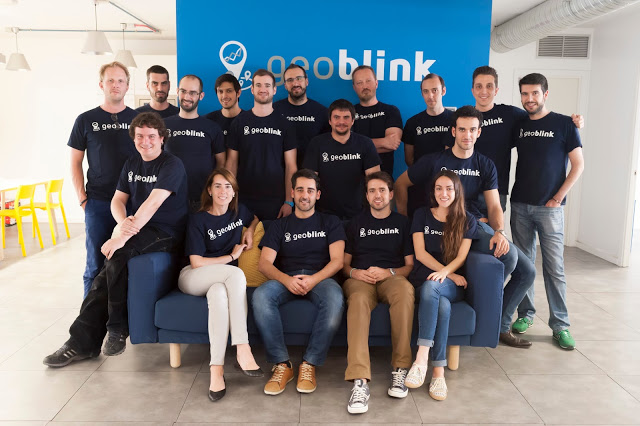
 Geoblink
Madrid-based startup, Geoblink, provides a geo-spatial intelligence platform which gives users instant access to powerful analytics features which allow them to extract insights to “fuel expansion and geomarketing strategies“. Its founder, Jaime Sánchez-Laulhé (a computer scientist and MBA from Chicago Booth with experience in management consultancy at McKinsey) has a clear vision – to empower SMEs in making data-driven decisions. The team have already closed their second round of funding ($1.1m) from Nauta Capital and have solid foundations having taken part in the Lanzadera accelerator programme in Valencia. 

2. Inbenta

 Inbenta

Inbenta provides a cloud-based, semantic search technology and specializes in natural language processing to optimize online customer experience through Artificial Intelligence-powered technology. Their solutions allow businesses to increase the efficiency of their customer service, call centers, e-Commerce, FAQs and social media platforms with support services such as dynamic FAQs, knowledge management and virtual assistants. Since starting their journey in 2005, this Barcelona-based startup has already worked with BBVA, Groupon and Ticketmaster and now has offices in the US, Brazil, France and Chile. 2017 looks to be an exciting year for Inbenta after sealing $12m in funding in 2016.

3. Big ML

BigML

BigML has had a very clear goal since 2010 – bringing Machine Learning to the masses. Since then, they have built an accessible platform to “uncover the hidden predictive power of data with ease”, providing sophisticated Machine Learning-based solutions which make it easy to solve and automate classification, regression, cluster analysis, anomaly detection and association discovery tasks. Headquartered in Oregon, with their second office in Valencia, they are helping thousands of analysts and software developers around the world to transform data into predictive models. Their founder, Francisco Martin, said in this interview that “BigML will enable Data Scientists to work a lot more efficiently than they currently do.”


4. Pixoneye

 Pixoneye

British-Israeli startup, Pixoneye, uses image understanding technologies to create analytical capabilities of mobile users for predictive personalization needs, based on users’ personal mobile photo galleries. Data mining on mobile devices still relies on primitive capabilities such as geolocation and browsing patterns and many companies attempt to create recommendations and predictions based on this primitive data. Pixoneye has created a technological solution that allows marketers and brands to analyze and personalize their mobile audiences based on their personal photo and video albums. After raising just under $3m in funding in 2016, the future looks bright for this Wayra-accelerated startup. 

5. CARTO 

CARTO

Spanish startup, CARTO, is a platform for discovering and predicting the key insights hidden in our world’s location data. Their powerful visualization tools have enabled them to grow fast with more than 200 employees between their offices in Madrid and New York, as well as closing a whopping €23m Series B funding round in 2015 to continue their expansion. Here at LUCA, we are also working with CARTO to unlock the insights in our mobile data as well as enabling our corporate customers to enjoy the benefits of geospatial intelligence.

It’s an exciting time to be an entrepreneur in the world of Big Data and Artificial Intelligence, but which startups do you think we should be keeping an eye on? Let us know in the comments section below. 

Big Data: What’s the economic value of it?

Richard Benjamins    30 January, 2017
How do we put an economic value on Big Data initiatives in our organizations? How can we measure the impact of such projects in our businesses? How can we convince senior leadership to continue and increase their investment? Today on our blog we share our perspective.

Most of us who are familiar with the Big Data boom,  are also familiar with the big and bold promises made about its value for our economies and society. For example, McKinsey estimated in 2011 that Big Data would bring $300bn in value for healthcare, €250bn for the European Public Sector and $800bn for global personal location data. Recently, McKinsey also published an estimation of what percentage of that originally identified value has become a reality as of December 2016, which is up to 30%, with an exception of 50-60% for location-based data.

These astronomic numbers have convinced, and are still convincing, many organizations to start their Big Data journey.  In fact, only recently Forbes and IDC have estimated the market value for Big Data and Analytics technology to grow from $130B in 2016 to $203B in 2020.
However, these sky-high numbers do not tell individual companies and institutions how to measure the value they generate with their Big Data initiatives. Many organizations are struggling to put an economic value to their Big Data investments, which is one of the main reasons why so many initiatives are not reaching the ambitious goals they once set.
So how can we put numbers on Big Data and Analytics initiatives? From our experience here at LUCA, there are four main sources of economic value:


Reducing costs with Big Data IT infrastructure

There are considerable savings to be made on IT infrastructure:
from propriety software to open source. The traditional model of IT providers of Data Warehouses is to charge a license fee for the software part and charge separately for the needed professional services. Some solutions, in addition, come with specific hardware.
Before the age of Big Data this model had worked well, but with the increasing amount of data (much of which is non-structured and real-time), existing solutions have been come prohibitively expensive. This, in combination with a so-called “vendor lock-in” (due to committed investments and complexity, it becomes very costly and hard to change to another vendor solution) has forced many organizations to look for alternative, more economical, solutions.
The most popular alternative is now provided by the Open Source Hadoop ecosystem of tools to manage Big Data.  Open Source software has no license cost, and is therefore very attractive. However, in order to be able to take advantage of the Open Source solutions for Big Data, organizations need to have the appropriate skill set and experience available, either in-house, or outsourced.
The Hadoop ecosystem software runs on commodity software, scales linearly and is therefore much more cost effective. For those reasons many organizations have substituted part of their propriety data infrastructure with Open Source, potentially saving up to millions of euros annually. While saving on IT doesn’t give you the largest economic value, it is relatively easy to measure in the Total Cost of Ownership (TCO) of your data infrastructure, and therefore it is a good strategy to start with.


Optimization of your business

There is no questioning that Big Data and Analytics can improve your core business. There are two ways to achieve such economic benefits: by generating additional revenues or by reducing costs.
 
Generating additional revenues means doing more with the same, or in other words, using Big Data to generate more revenues.  The problem with this is that it is not easy to decide where to start, and it can be hard to work out how to measure the “more”.
Monetary value of Big Data
Figure 2: Measuring the monetary value of Big Data in different areas of your organization.
Reducing costs means doing the same with less, or in other words, using Big Data to make business processes more efficient, while maintaining the same results.


External Data Monetization

Here, the economic value of Big Data is not generated from optimizing your business, but it is generated from new, data-centric, business. This is only for organizations that have reached a certain level of maturity in Big Data. Once organizations are ready to materialize the benefits of Big Data to optimize their business, they can start looking to create new business around data, either by creating new data value propositions, i.e. new products where data is at the heart, or by creating insights from Big Data to help other organizations optimizing their business. In this case, measuring the economic value of Big Data is not different from launching new products in the market and managing their P&L.
We believe that in the coming three to five years, the lion share of the value of Big Data will come from business optimization, that is, by turning companies and institutions into data-driven organizations that take data-driven decisions. And those are the kind of Big Data initiatives that organizations struggle to put an economic value on.
Savings from IT are a good starting point, but will not scale with the business, while revenues from data monetization will become huge in the future, but are currently still modest compared to the potential value that can be generated from business optimization.
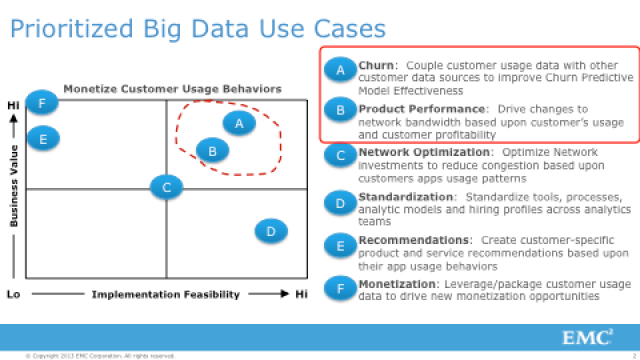
Most businesses start their Big Data journey the right way. They make an opportunity-feasibility matrix, which plots the value of a use case against how feasible it is to realize that value. Figure 2 shows an example from EMC. The use cases to select would be those in the upper right quadrant:
Opportunity matrix for Big Data Use Cases
Figure 3. Opportunity Matrix for Big Data Use Cases – value versus feasibility.
A good way to estimate the business value of a use case is to multiply the business volume with the estimated % of optimization. For instance, if the churn rate of a company is 1% (per month) and there are about 10M customers, with an ARPU (average monthly revenues) of €10, then the business volume amounts to €1M per month or €12M per year. If Big Data could reduce the churn rate by 25%, that is, from 1% to 0.75%, then the estimated value would be €250.000 per month. As an example of a cost saving use case, consider procurement. Suppose an organization spends €100M on procurement every year. Analytics might lead to a 0.5% optimization, which would amount to a potential value of €500.000 per year.
There are hundreds of Big Data use cases and the TM Forum gives an extensive overview of some of the most relevant ones in the telecommunications sector.
However, once the initial use cases have been selected, how should you measure the benefits? This is all about comparing the situation before and after, measuring the difference, and knowing how to extrapolate its value if it were applied as business as usual. Over the years, we have learned that there are two main issues that make it hard to measure and disseminate the economic impact of Big Data in an organization:
  1. Big Data is almost
    never the only reason for an improvement
    . Other business areas will be involved and it becomes then hard to decide how much value to assign to Big Data.
  2. Telling the whole organization and top management about the results obtained. Giving exposure to the value of Big Data is fundamental in raising awareness and creating a data-driven culture in your company.
With regards to point 1, Big Data is almost never the only reason for creating value. Let’s consider the Churn use case, and assume you use Analytics to better identify what customer are most likely to leave in the next month. Once the customers have been identified, other parts of the company need to define a retention campaign, and yet another department executes the campaign, e.g. through calling the top 3000 people at risk. Once the campaign is done, and the results are there, it is hard to decide whether the results, or what part of it, are due to Analytics, due the retention offer or due the execution through the call centres.
There are two ways to deal with this issue:
  1. Start with use cases that have never been done before. An example of such a use case would be to use real-time, contextual campaigns. Real-time campaigns are not yet frequently used in many industries, and require Big Data technology. Imagine you are a mobile customer with a data tariff, and watching a video. The use case is to detect in real-time that you are watching a video and that you have almost reached the limit of your data bundle. The usual things to happen in those cases are that you either are throttled or are completely cut-off from Internet. Either situation results in a bad customer experience. In the new situation, you receive a message in real-time telling you about your bundle ending, and asking you whether you want to buy an extra 500MB for €2. If you accept this offer, then in real-time the service gets provisioned and you are able to continue watching your video. The value of this use case is easy to calculate: simply take the number of customers that have accepted the offer and multiply it by the price charged to the customer. Since there is no previous experience with this use-case, few people will challenge you that the value is not due to Big Data and Analytics.
  2. Compare with what would happen if you didn’t use analytics. The second solution is a bit more complex, but applies more often than the previous case. Let’s get back to the churn example. It is unlikely that an organization has never done anything about retention, either in a basic or more sophisticated way. So, when you do your Analytics initiative to identify customers that are likely to leave the company, and you have a good result, you can’t just say that all is due to Analytics.  You need to compare it with what would have happened without Analytics, all other things being equal. This requires using control groups. When you select a target customer set for your campaign, you should reserve a small, random part of this set to treat them exactly the same as the target customers, but without the Analytics part. If you do so, then any statistically significant difference between the target set and the control group can be assigned to the influence of Analytics. For instance, if with this, you retain 2% more customers than the control group, you then calculate how much revenue you would retain annually, if the retention campaign would be run every month. Some companies are able to run control groups for every single campaign, and so are always able to calculate the “uplift”, and thus continuously report the economic value that can be assigned to Analytics. However, most companies will only do control groups in the beginning to make and confirm the case, and once confirmed they consider it business as usual (BAU), and a new baseline has been created.
Impact of Big Data in your organization
Figure 4: Sharing the impact of Big Data in your organization is fundamental.
With regards to point 2, sharing results of Big Data within the organization in the right way is fundamental. It is our experience that while business owners love Analytics for the additional revenues or cost reduction, at first they are not always willing to tell the rest of the organization about it. But evangelizing in the organization about the success of the internal Big Data projects is critical to get top management on board and to change the culture.
Why would individual business owners hesitate in sharing? The reason is as simple as it is human. Showing the wider organization that using Big Data and Analytics creates additional revenue makes some business owners worry about getting higher targets, but not with more resources (apart from Big Data). Similarly, other business owners might not want to share a cost saving of 5%, since it might reduce their next budget accordingly. Haven’t they shown – through Big Data – that they can achieve the same goals with less? This is an example of a cultural challenge. Luckily it is not sustainable to maintain such a situation for a long time, and in the end, all organizations get used to publishing the value. But, it might be a problem especially at the beginning of the Big Data journey, when such economic numbers are most needed.
For those organizations that in the end do not succeed to measure any concrete economic impact, don’t worry too much either. Experience teaches us that, whereas organizations at the early phase of their journey are obsessed with measuring value, more mature organizations know that there is value and do not feel the need anymore to measure improvements. Taking full advantage of Big Data has changed the way departments interact and that is one of the main value drivers. Big Data has become fully integrated with Business As Usual. Big Data = BAU.
2 Comments on Big Data: What’s the economic value of it?