Artificial Intelligence is disrupting the law as we know it

Richard Benjamins    19 April, 2017
Years ago, science fiction movies used to seem very futuristic to us – making us feel detached from the remarkable innovations we saw from scene to scene.  However, what once seemed impossible is now a reality and we’re slowly but surely learning to live with disruptive technologies. This quote perfectly encapsulates this:

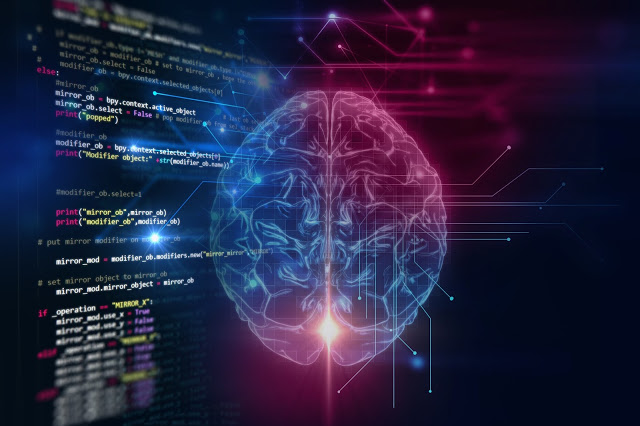
EU AI Legislation: Brain Image
Figure 1: What does AI mean for legislation? The EU are moving fast.

“humankind stands on the threshold of an era when ever more sophisticated robots, bots, androids and other manifestations of artificial intelligence (“AI”) seem poised to unleash a new industrial revolution, which is likely to leave no stratum of society untouched”

This could well be the introductory “Star Wars style” text of a science fiction film that is shown to the audience to understand the context of the movie. This quote could also be seen the same way:

“within the space of a few decades AI could surpass human intellectual capacity in a manner which, if not prepared for, could pose a challenge to humanity’s capacity to control its own creation and, consequently, perhaps also to its capacity to be in charge of its own destiny and to ensure the survival of the species”


Well, those quotes are not from any movie but rather from an official draft report of the Committee on Legal Affairs of the European Parliament. With the rapid changes taking place in technology and society, many of us sometimes complain about the European Commission being slow to react, with the consequence that when new regulations or laws come into force, the world has changed again already and adaptations are already needed. How long it took to get the GDPR in place is a great example of this, with the first proposal being released in 2012, 6 years ahead of its predicted launch date: May 2018.

However, this is not the case when it comes to legislation around Artificial Intelligence. The European Commission is ahead of time in thinking about how AI and the resulting Autonomous Robots might impact our society. And the impact doesn’t seem to be small, according to the report. For this reasons, the European Parliament states that our laws need to be adapted to deal with those changes as soon as possible.

The European Commission Building
Figure 2: The European Commission is taking the impact of AI seriously.

However, before we break this down, what definitions should be considered ahead of this process? What even is a “smart robot”? Well, according to the Committee on Legal Affairs a smart robot has the following characteristics:

  • Acquires autonomy through sensors and/or by exchanging data with its environment (inter-connectivity) and trades and analyses data.
  • Is self-learning (optional criterion).
  • Has a physical support.
  • Adapts its behaviours and actions to its environment.

Intuitively, this seems a very reasonable definition for a smart robot. From a legal (and above all) liability perspective, all characteristics are equally important: a smart robot can do things in the real world that have impact. From an AI perspective, the second characteristic about self-learning is the most important. Can a robot learn things during its “life” so that at the date of shipping (delivery to society) its behavior is unpredictable?

While the date that new laws ruling autonomous robots and AI come into force is still far away, the Committee refers to long-existing fundamental principles to respect with regard to robots, namely Asimov’s Laws of his book Runabout written in 1942:

  • (1) A robot may not injure a human being or, through inaction, allow a human being to come to harm. 
  • (2) A robot must obey the orders given it by human beings except where such orders would conflict with the First Law. 
  • (3) A robot must protect its own existence as long as such protection does not conflict with the First or Second Laws (See Runabout, I. Asimov, 1942) and
  • (0) A robot may not harm humanity, or, by inaction, allow humanity to come to harm.

It has a lot of merit that those rules defined in the first half of the previous century are still valid almost a hundred years later, especially given the enormous industrial and technological revolutions that have taken and are still taking place.

The Committee states that:

“until such time, if ever, that robots become or are made self-aware, Asimov’s Laws must be regarded as being directed at the designers, producers and operators of robots, since those laws cannot be converted into machine code”

Liability

The Committee goes on to talk about the impact of smart robots for society:

“The legal responsibility arising from a robot’s harmful action becomes a crucial issue.”

And this is true. What happens when an autonomous robot does something that is harmful? Who is to blame? Or, in legal words, who is liable? Are current laws still applicable?

“once technological developments allow the possibility for robots whose degree of autonomy is higher than what is reasonably predictable at present to be developed, to propose an update of the relevant legislation in due time

The draft report continues:

“whereas in the scenario where a robot can take autonomous decisions, the traditional rules will not suffice to activate a robot’s liability, since they would not make it possible to identify the party responsible for providing compensation and to require this party to make good the damage it has caused;”

In normal language, when a robot gets in trouble and causes damage or harm, who should pay the bill, go to jail, or apologize? The conclusion is that new rules are needed to deal with those autonomous robots:

“this, in turn, makes the ordinary rules on liability insufficient and calls for new rules which focus on how a machine can be held – partly or entirely – responsible for its acts or omissions”

And:

 “the current legal framework would not be sufficient to cover the
damage caused by the new generation of robots, insofar as they can be
equipped with adaptive and learning abilities entailing a certain degree
of unpredictability in their behaviour, since these robots would
autonomously learn from their own, variable experience and interact with
their environment in a unique and unforeseeable manner;”

What is clear is that it will be unclear how much the creator, designer or programmer can still be held responsible for the unpredictable behavior of autonomous robots. However, what kind of legal status do autonomous robots need to have?
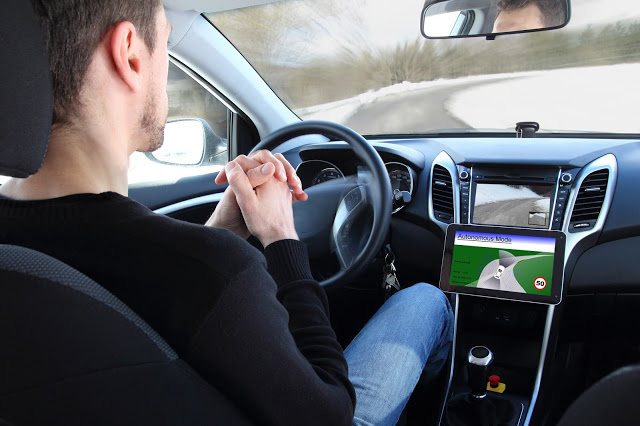
Driverless Vehicle
Figure 3: How will liability work when robots cause harm?

“robots’ autonomy raises the question of their nature in the light of the existing legal categories – of whether they should be regarded as natural persons, legal persons, animals or objects”

And:

“creating a specific legal status for robots, so that at least the most sophisticated autonomous robots could be established as having the status of electronic persons with specific rights and obligations, including that of making good any damage they may cause”

While it is unclear what legal status autonomous robots (powered by AI) should have, it is clear that current legislation is not sufficient. In fact, one suggestion for dealing with the potential damage robots can create is:

“Establishing a compulsory insurance scheme whereby, similarly to what already happens with cars, producers or owners of robots would be required to take out insurance cover for the damage potentially caused by their robots.”

While I agree that the massive appearance of AI powered robots is important for liability legislation, I think that the real distinguishing factor is the second (optional) characteristic of the Committee’s definition of smart robots:

  • “is self-learning (optional criterion)”

In my layman’s view, the liability of a non self-learning robot lies with the user in case of wrong use and with the manufacturer in case of errors. Compare it with the cruise control function that most cars have today. To some extent, it has all the same characteristics of a smart robot, except that it doesn’t learn.  If a driver falls asleep while using the cruise control and causes an accident, the driver should be held liable. If a cruise control fails – and in spite of the driver’s efforts to avoid – causes an accident, the manufacturer should be held liable.  It is the “self-learning” aspect that makes the difference.


Economic, labor impact 

There is also a lot of debate going on around smart robots taking away the jobs of people, and so far estimations diverge enormously. The Committee on Legal Affairs suggests that maybe corporations should contribute social insurance tax for the substituted employees by robots or AI. So, if without robots, 100 persons were needed to get a job done, and with robots or AI only 10 are needed, then the company still should pay social security for 100 employees. This is also referred to in the draft:

“possible need to introduce corporate reporting requirements on the extent and proportion of the contribution of robotics and AI to the economic results of a company for the purpose of taxation and social security contributions”

Or maybe corporations should be obliged to disclose the impact of their use of robots:

“Disclosure of use of robots and artificial intelligence by undertakings.  Undertakings should be obliged to disclose:
– the number of ‘smart robots’ they use,
– the savings made in social security contributions through the use of robotics in place of human personnel,
– an evaluation of the amount and proportion of the revenue of the undertaking that results from the use of robotics and artificial intelligence.

Job destruction by AI is already happening, for example, in Japan where an insurance company has substituted 34 claim workers with IBMs Watson. But how does this compare with the automation so far, that started with the Ford T and has increased since then on a continuous basis? Throughout the past 100 years, tasks have been increasingly automated and that has destroyed millions of jobs. What makes it different this time? The self-learning aspect? Its massive scale? All questions for which definite answers have yet to be given.


Code of conduct

Whatever the repercussions may be, it is clear that there will be a big impact, and the Committee proposes a code of conduct to ensure as much as possible that there will be no threat for humanity.

“The Code of Conduct invites all researchers and designers to act responsibly and with absolute consideration for the need to respect the dignity, privacy and safety of humans.”

And specifically for researchers it states:

“Researchers in the field of robotics should commit themselves to the highest ethical and professional conduct and abide by the following principles:

  • Beneficence – robots should act in the best interests of humans;
  • Non-maleficence – the doctrine of ‘first, do no harm’, whereby robots should not harm a human;
  • Autonomy – the capacity to make an informed, un-coerced decision about the terms of interaction with robots;
  • Justice – fair distribution of the benefits associated with robotics and affordability of homecare and healthcare robots in particular.”

Finally, to keep humanity and society safe, the Committee suggests to construct a:

  • “Code of  Ethical Conduct for Robotics Engineers
  • License for Designers
  • License for Users

All this becomes even more important when Technological Singularity is reached  This is the idea that the invention of “Artificial Superintelligence” will suddenly cause runaway technological growth, resulting in agressive changes for human civilization. Our world is changing rapidly – are you ready?
Leave a Comment on Artificial Intelligence is disrupting the law as we know it

Latch and IoT, a perfect symbiosis

ElevenPaths    19 April, 2017
The Internet of Things stopped being the future to become our present. It’s rare that on any given day we do not interact in one way or another with an IoT device: the radio we use in the mornings, the camera that “takes care” of our baby, the heart rate monitor/watch that we use when we go running or the car that takes us to work. IoT is almost everywhere.

Figure 1: Latch plugin video for Mosquitto


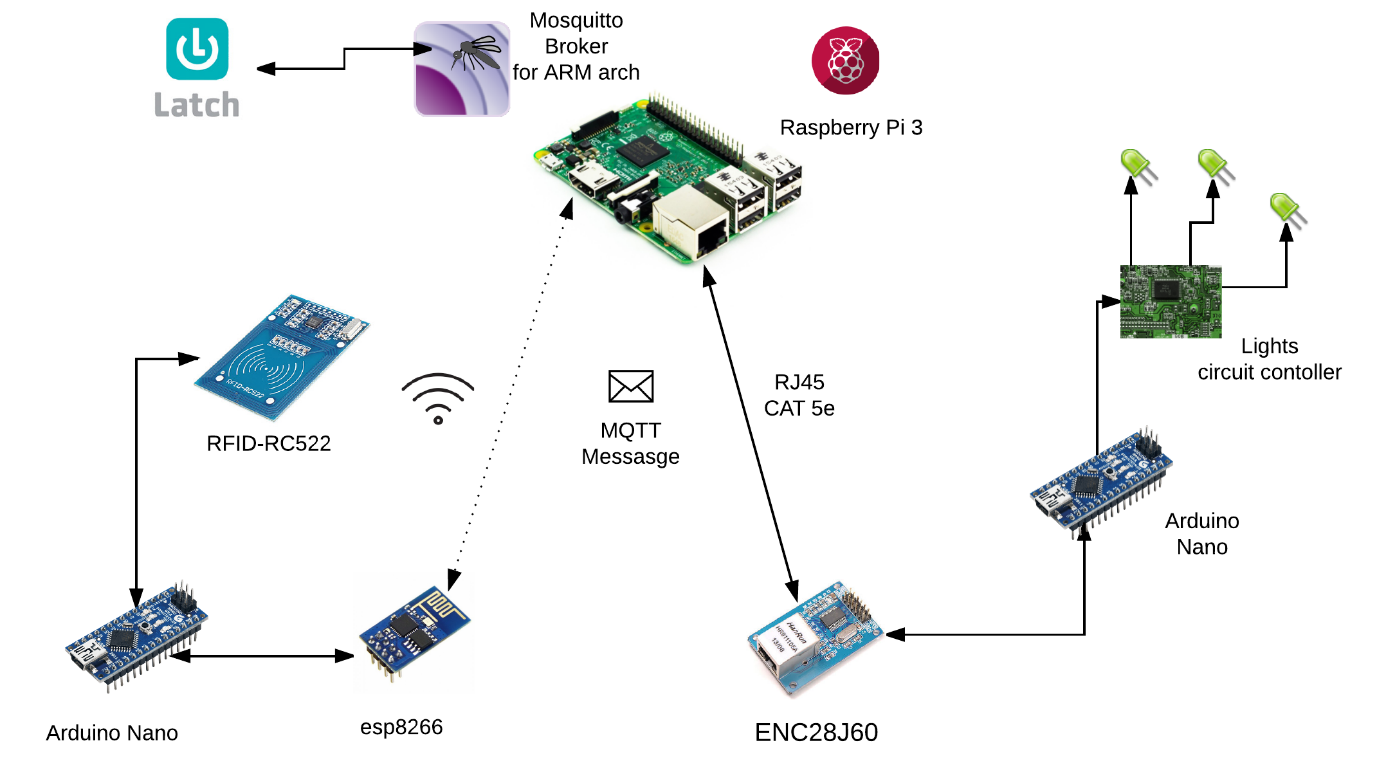
And Ms. Cat tried to show it to us with the Latch plugin for Mosquitto. Although what has really drawn our attention is its little container: different elements that we can find in hundreds of IoT devices interacting with each other. This is the scheme that was hidden in the container:

Figure 2: Latch plugin scheme for mosquitto. Alvaro Caso.

As you can see in the diagram, the idea was to use different components, as well as two different ways of connection: cable and Wi-Fi. We can see that there are several options available for communication in the IoT. All the components used can be found in hundreds of IoT devices: standard modules, affordable and can be easily integrated.
Ms. Cat showed us a direct and simple application of the MQTT protocol, but the possibilities that we can find today are almost unlimited. The use of the IoT for remote medical assistance is the application of the protocol that’s drawing the most attention nowadays. This presents us with an ideal opportunity to use the Latch plugin.
Just imagine a medical device, for example a sensor that measures our heart rate, and that sends data to a receiver through MQTT. This receiver will send the data to the hospital that is handling our treatment. In this solution, the Latch plugin for MQTT could be integrated from two different perspectives: the patient’s and the hospital’s,

  • From the perspective of the patient, we could control that data is only sent from the device when the patient decides so, and making sure that these data can only be accessed with their consent.
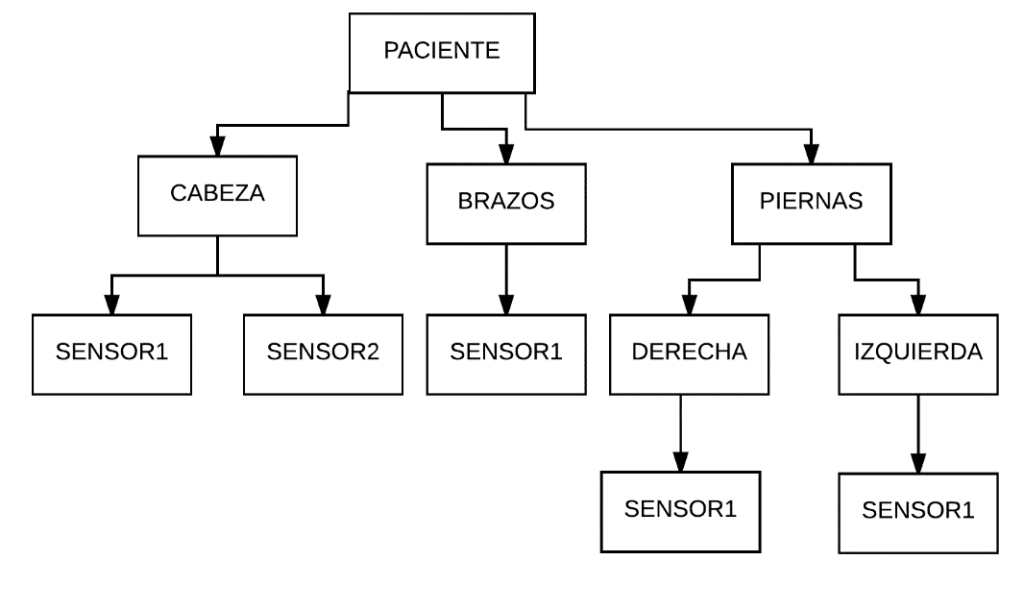
    Figure 3: Use hierarchy for remote assistance.

  • From the perspective of the hospital, we could control which devices are active and from which ones we want to receive data. That way, we could have the following hierarchy for a patient,and decide, thanks to Latch instances, which sensors are authorized to send information.

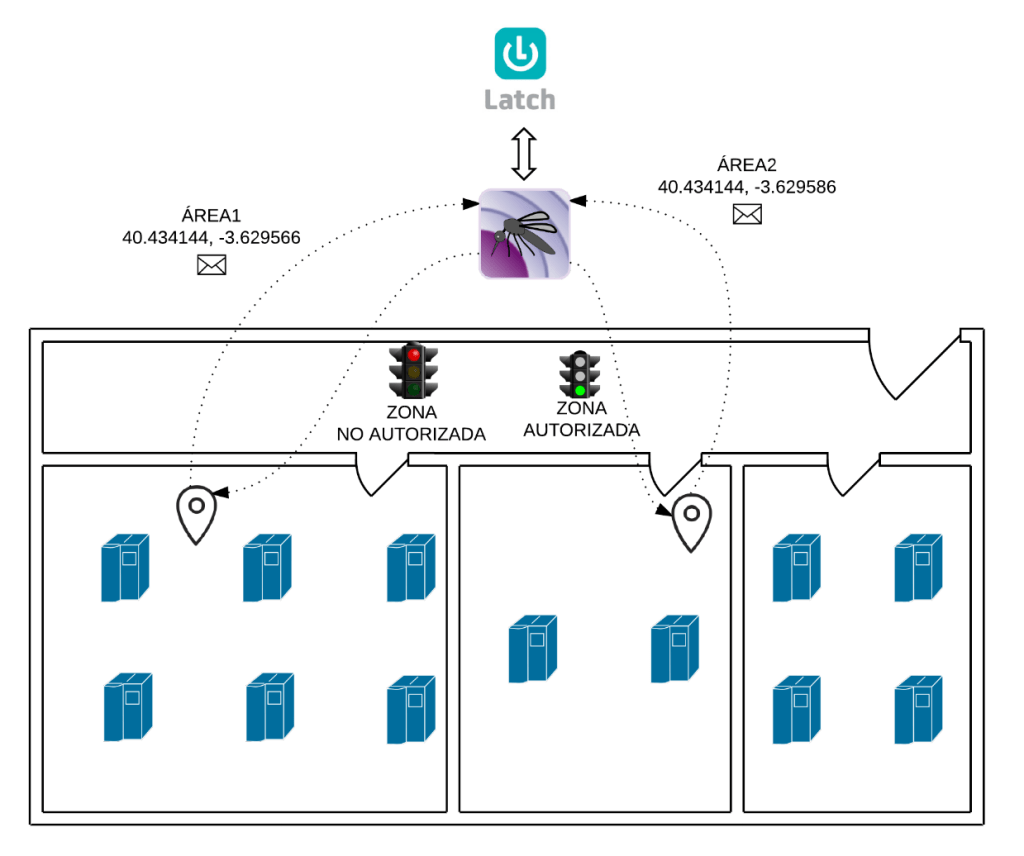
Another interesting situation in which we could use the Latch plugin for MQTT is in the “monitoring” of physical zones, for example, in a shared Data Center. The idea would be as follows:

  • When we register to enter a Data Center, we are given a smart card in which our identification is shown, as well as a small GPS module that tells us where we are.
  • This device permanently sends the location via MQTT messages.
  • Depending on the zones that we have activated in Latch, it will tell us if we are in a zone allowed in our profile or not.

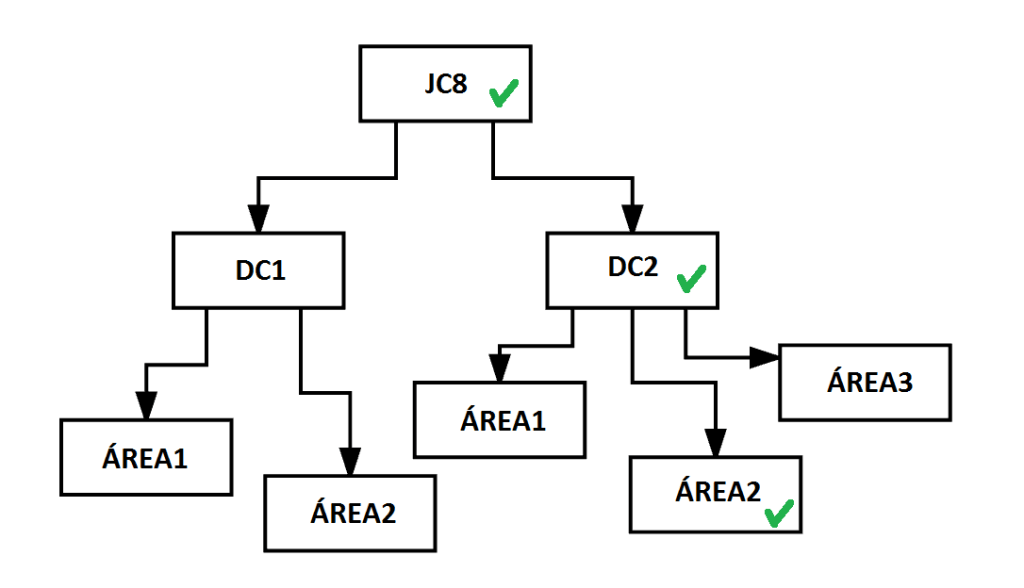
Thus we could have the following MQTT hierarchy with an agent that is subscribed and authorized to publish to topics: JC4, DC2 y ÁREA2.

Figure 4: Use hierarchy for zone access.

This would allow us to control at all times that only authorized zones are accessed:

As you can see, options are almost unlimited in the integration of Latch in the IoT world. The possibilities offered by Latch through the use of the MQTT plugin go far beyond a second factor authentication, providing a total and flexible control over our IoT devices.

Article by Álvaro Caso

Winner of the 2016 Latch Plugin Contest

More information about the contest winner is available in our community.

More information:

Mosquito MQTT Github

Plugin Documentation

When Michelangelo invented Big Data

Álvaro Alegría    18 April, 2017

They say that Michelangelo was asked about his impressive technique in sculpting the Pietà in just one piece, his answer was: “The sculpture was already inside of the stone. I merely eliminated the extra marble”. It is impossible to deny that, from a simplistic point of view, sculpting is about getting rid of the extra material. However, something must influence the artist, because, after all, if most of us were handed a block of marble, a hammer and a chisel, we would most likely not be able to sculpt anything recognisable.

The creativity of an artist, far more than his tools, is the true value that he brings to what he does and what makes the difference between a stone and a masterpiece.

The art of uncovering “use cases.”

The same can be applied, in my opinion, to the process of use case discovery in the framework of Big Data as, just as with Michelangelo, and his block of marble, the “blocks” of data are waiting for someone with a chisel to extract the information that has always been there.

And once again, in the same way, the creativity of Big Data professionals is a fundamental factor in the discovery of new use cases, as it makes a real difference between information that is merely stored and information that brings value to a company.

A technological and economic revolution is underway

We have the great fortune to be able to participate in the dawn of a technological and economic revolution; an era in which almost everything remains to be discovered and in which there is no limit of possibilities but rather a giant blank canvas if discovery.

Due to all of this, it is very important for companies to have the best blocks of marble, the best hammers and the most precise chisels.  However, it’s important to remember that they will be of very little use if they don’t have a true artist who knows how to extract value from them.

Also, you have to let artists do their thing. You have to trust in the final result, without trying to understand the process. Not only should we not set them limits, but we should also encourage some craziness, because disruption produces changes, is abrupt, radical and even sometimes painful. It’s never the fruit of an organised, clean and pre-established process. I wish I could  say I came up with this concept, but I didn’t. Warren Buffet already said that businesses should:

Hire the best and let them do what they know. Or hire the cheapest and tell them what they have to do.

Warren Buffet

Big data and companies: the challenges

But many traditional businesses are resistant to this new culture. It’s difficult for them to accept that, nowadays, many advances are achieved because of trial and error; that processes are living and can vary along the way; that many things are done “just to see” and that talent doesn’t wear a suit (or maybe it does, but it just depends on the day).

I sincerely believe that the biggest and most important change that a business must accept when it comes to facing Big Data is cultural: accepting that no one knows what’s coming and that uncertainty is not a threat but rather a spectacular opportunity. And the way to take advantage of that opportunity is to count on the Michelangelo of the present, the people who combine technical and business knowledge with creative abilities, which allows them to see and extract value where others see only stone.

According to Mr. Niedźwiedź, many of the problems that companies encounter from a business point of view can be solved today using analytical techniques, but companies are not aware of this and, more so, analysts do not know the problems that need to be answered, so they cannot help.

Conclusion

I therefore encourage them to find their artists and, if they don’t find them, train them. Sit down with your analysis and your business experts, invite them to create together and let them “make a mess”, break things and fail, until one day they will surprise the world with a masterpiece. That is what will allow them to overtake their competitors.

What companies are doing today does not necessarily bring value. Often, you already know how to do it, and your competitors do, too. The thing that will bring you value is waiting inside of your blocks of marble, because, as Aristotle said:

The goal of art is to give form to the secret essence of things, to to merely copy their appearance.

Aristóteles

To keep up to date with LUCA visit our website, subscribe to LUCA Data Speaks or follow us on TwitterLinkedIn or YouTube .

Leave a Comment on When Michelangelo invented Big Data

5th Annual CDO Forum in London will see Chema Alonso take to the stage

AI of Things    17 April, 2017
The role of the CDO in today’s business environment has been further cemented by the creation of events like the CDO Forum. This event gives a platform for the promotion of good practice and keeps the business community informed and accountable for the latest actions in their field. 


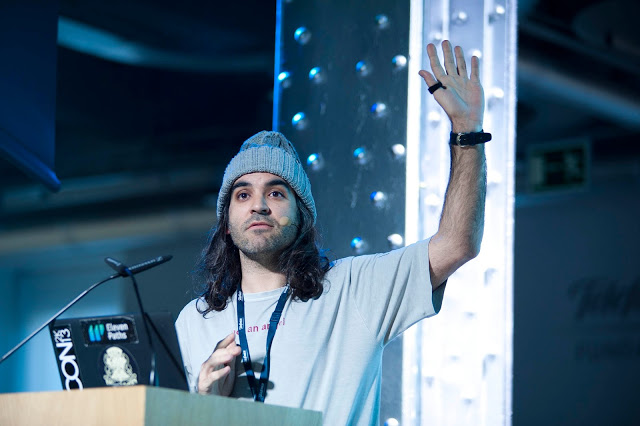
Our very own CDO Chema Alonso will be presenting at the 5th Annual Chief Data Officer Forum in London betweenthe 3rd and 4th of May.Chema Alonso will be meeting with Europe’sleading CDOs to help come up with innovative ways to improve data strategy, achieveimpactful data governance and turn your businesses decision making process onits head. If you want to find out some information about the other speakers joining Chema follow this link.

 
This event gives those in attendance theopportunity to network with Europe’s leading senior-level data officers andalso gives an insight into other various business roles that have stemmed fromBig Data.

Each day will include engaging activities with informative talks given by the various CDOs from each of thesponsor companies. Alongside Chema Alonso (representing Telefónica and LUCA) there will also be other CDOs including Lynn Watts from Lloyd’s Bank, Barry Green from Bank of Ireland, Marzena Kowalska from AA, Peggy Barthes-Streit EE and Sanjeevan Bala from Channel 4.
We’re excited to take part in this year’s CDO Forum so keep tuned by following us on Twitter for the latest updates live from London.


How can AI enhance Cancer treatment and detection?

AI of Things    12 April, 2017
The medical sector is constantly trying new medicine and drug combinations to help lead to the most effective cancer treatment. There are an endless number of new cancer drugs in development and new research published daily, with the intention of helping treatment through personalized combinations that target specific building blocks of their disease. There is so much for both patients and doctors to process regarding the best option for each case that the introduction of AI to this process is a blessing to using technology for societal benefit.


Firstly, Algorithm technology has improved dramatically over the past few years and medical algorithms have shown tremendous progress and promise in “working behind the scenes to aid in diagnosis, treatment, short- and long-term prognosis, care management and claims processing.” Various organizations have confirmed the importance of this step forward in healthcare however what should be noted is that bodies like Cancer Research UK have said, “it could become a useful toll for doctors”. This tells us that it is important to remember this this kind of AI isn’t about hospitals being taken over robots it’s about developing an intelligent algorithm that can spot complex patterns and detect cancerous tumours.
 
Until this point cancer surveillance relies on manual analysis of clinical reports to extract important bimarkers of cancer progression and outcomes. The use of AI will be to generate new information as well as better utilizing existing information. In addition, it will help researchers sift through massive amounts of data and uncover subtle patterns and relationships. That information will help researchers determine the best treatment for a particular person. The three following businesses are using AI and technology to improve cancer survival rates, diagnosis and disease management.


1. CureMetrix

 
CureMetrix logo
Figure 1: CureMetrix logo


CureMetrix is focusing on perfecting a powerful image analysis platform which aims to create a precision tool for mammography. This is very much a piece of technology aimed at helping an already solid medical team giving them data driven answers they need to support patients and their healthcare team as they make decisions about breast cancer screening, treatment and diagnosis. Through the use of the most advanced technology they will hopefully lead to improved clinical outcomes, reduced healthcare costs and increased assurance that patients are getting the highest standard of care available from screening through to post-biopsy follow-up.

2. Cyrcadia Health


Another collaborative piece of technology that can give women more control over their health. The iTBra features two wearable, comfortable intelligent breast patches which detect circadian temperature changes within breast tissue. This information is then processed through a smartphone or PC, and then forwarded to the Cyrcadia Health core lab for analysis. They then employ machine learning predictive analytic software, a series of algorithms to identify and categorize abnormal circadian patterns in otherwise healthy breast tissue, and the results are then passed on to health care providers. They focus on dense breast tissue as an issue for normal mammograms and how their technology can give a much more effective reading, with 1 out of 8 women being affected by breast cancer this development is most certainly worthwhile.

3. Project Hanover


Hoifung Poon
Figure 2: Hoifung Poon who is helping to lead Project Hanover


This project is striving towards an AI-powered decision support for precision medicine as there will be a huge growth in cloud-based health analytics and they are aiming to do this through three different areas: 
  • Machine reading: They are firstly developing NLP technology for converting text into structured databases which will allow them to build a knowledge base by automatically reading millions of biomedical articles. 
  • Cancer decision support: like CureMetrix they are working to develop AI technology for cancer precision treatment, with a current focus on developing a machine learning approach to personalize drug combinations for Acute Myeloid Leukemia, where treatment hasn’t improved in the past three decades. 
  • Chronic disease management: They have a long term aim to cut the cost in caring for cancer and other chronic diseases by developing predictive and preventive personalized medicine. 
At LUCA we love to see the use of AI and Big Data for social good and hope that businesses and data scientists alike continue to strive for solutions in the medical field! 


Limiting the use scope of our secrets in Latch with “Limited Secrets”

ElevenPaths    12 April, 2017
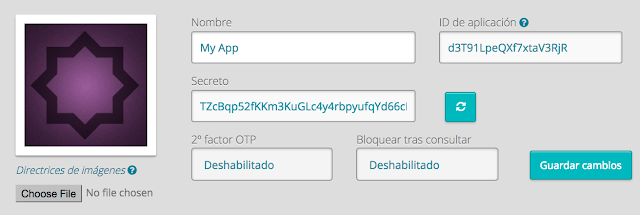
When creating a Latch app as a developer, Latch provides us with an application identifier (appId) and a secret.

These two keys allow us to sign the requests sent to the API, in order to ensure that we are the legitimate owners of that app.

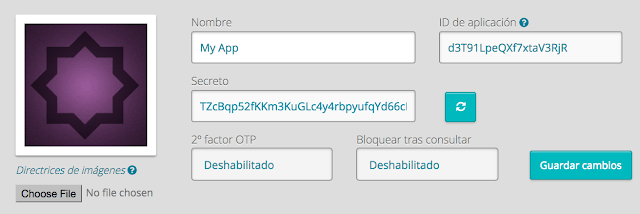
Example of app ID and secret in an application.

However, there are multiple scenarios where that secret can be compromised by a third party: desktop applications, mobile apps, etc.

In these scenarios, a compromised secret could allow a potential attacker to perform API operations not wanted by the developer. To prevent this and to be able to continue offering Latch functionalities in these scenarios, “Limited Secrets” are born.

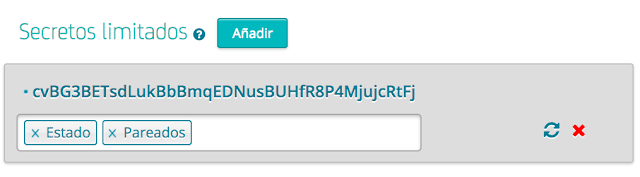
For each app, a maximum of 3 secrets with a limited scope can be created from the settings of the app itself. These secrets are used in the same way as the master secret, but can only be used to sign those requests for which they have been configured.

Limited secrets may contain one or more of the following permissions:

  • Status: It allows the performance of status calls to the API in order to find out the status of a Latch.
  • Pairing: It allows the use of a user’s pairing and unpairing calls.
  • Support: It allows the use of API support calls to lock and unlock “latches”.
  • History: It displays the action history of a service.
  • Operations: It provides access to perform operation management calls. This management makes it possible to create, edit, query and delete operations.
  • Instances: It provides access to perform instance management calls. This management makes it possible to create, edit, query and delete instances. The ‘STATUS’ permission is used to check the status of an instance, and the ‘SUPPORT’ permission is used to modify that status.

Example of secret, only with “Status” and “Pairings” permissions.

So if we have a software component that we want to distribute, that includes the Latch functionality and that will only perform Pairing/Unpairing actions or check the status of a Latch, we can distribute a Limited Secret with permissions for these functionalities only.

It is worth mentioning that even if secrets are distributed with these permissions, in order to make calls such as unpairing a user or knowing the status of their Latch, we would need another additional factor: their “Account ID” with Latch.

Therefore, we encourage you to use this type of secrets whenever you carry out integrations in software components that are to be distributed and that can be easily compromised. Do not hesitate to visit our community if you have any problem while using them.

Strata Data Conference London 2017

AI of Things    11 April, 2017
The upcoming Strata Data Conference London 2017 event aims to bring together the best data scientists from across the world, presenting the most innovative trends and solutions related to Big Data and data science. The event is taking place between the 23rd and 25th of May at the Excel Convention Centre at the Royal Victoria Dock.

Synergic Partners, the Big Data consultancy company which is part of LUCA, will be the only Spanish company to feature amongst the sponsors and speakers at the Strata Data Conference London 2017. CEO and co-founder Carme Artigas will lead the participation on one talk whilst Arturo Bayo will also feature on May 24th. Carme Artigas will present the “Analytics Centers of Excellence as a way to accelerate Big Data adoption by businesses”. This will focus on the creation of data-led businesses instead of only one department focusing on data that there is an overall data focus for each business. Arturo Bayo will present “The multitenant ecosystem for efficient Big Data solutions”, which will focus on efficient ways for businesses to exchange IT resources. Other speakers at the event range from Google and Uber through to Santander UK and DataKind UK.

Carme Artigas
Figure 2: Carme Artigas CEO of Synergic Partners.
The event will give participants the possibility to gain training and insight making it a truly worthwhile and beneficial experience. It provides attendees with the chance to network but within a more casual and relaxed environment taking the pressure that sometimes comes with events off.
Keep up to date with our social media feed to make sure you can receive a full debrief from the LUCA team, on both Twitter and Linkedin.

World Health Day: Using Big Data to address depression

AI of Things    10 April, 2017
Last week was World Health Day, sponsored by the World Health Organization (WHO). This year, the day is focused on raising awareness about the prevalence of depression through the “Depression: Let’s Talk” campaign. As with many different areas of global health, Big Data and Artificial Intelligence are being used in innovative ways to help address depression.


big data, depression, big data for social good

big data for social good, big data
Figure 1: WHO’s Campaign focuses on raising awareness about depression.

According to the WHO, over 300 million people worldwide live with depression, making it the world’s leading cause of poor health and disability. It is also on the rise, as the number of people with depression increased almost 20% between 2005 and 2015.
Despite its prevalence, though, depression and other mental health disorders received very little support. WHO research shows most governments only allocate between 1% to 5% of their total health budgets for mental health, which must address a variety of other concerns in addition to depression. Even if there were funding, though, most people would still miss out on treatment. In high-income countries, half of adults living with depression do not seek treatment, as depression still carries with it a negative social stigma many parts of the world. The number is even higher in low-income countries, where depression treatment is viewed as a frivolous or unnecessary expense.
Researchers around the world are using Big Data to try and understand the genetic causes of depression. In 2016, a team of researchers from the University of Pennsylvania and Massachusetts General Hospital released a report detailing their findings of 15 different genetic locations that identified people as at risk for major depression. For their study, the team relied on data supplied by the genetic testing company 23andMe. Customers send saliva samples to 23andMe to get genetic tests and an ancestry map, and some also agreed to let the company anonymously use their genetic data for research. The University of Pennsylvania and Massachusetts General Hospital team were able to use this aggregated data set to identify the genes indicating depression risk.
Because the way depression manifests itself in different people widely varies, having more precise information about its root cause can help doctors administer more precise treatment. Although there is still much to be done to actualize the results of this study in terms of treatment, the findings are an important step. Additionally, they also help address the stigma issue by showing that some depression is linked to biology.
Big Data can also be used to identify depression symptoms. Using Instagram posts from subjects in their research group, a research team from the University of Vermont and Harvard University developed an AI tool that can help identify whether users are depressed by the photos they share. Based upon the content and even specific filters or colors users selected for their photos, the program could detect potential symptoms of depression.

big data, depression, big data for social good
Figure 3: Researchers are using AI to detect whether people are depressed based upon photos shared on Instagram. 
Facebook, which owns Instagram, is also using AI to try and go a step further than identification to intervention. After numerous people used the livestream feature to livestream their suicide, the company increased its suicide prevention initiative. They use an AI-based algorithm to flag high-risk users and send them to community managers, who can reach out with resources for help. Facebook hopes this algorithm will help them intervene and help people who need it most.
Depression is not something that can be cured solely through leveraging Big Data and Artificial Intelligence. It is a complex problem with many different factors at work. However, these technologies can be valuable tools for improving treatment, identifying and monitoring those in need and hopefully reducing the stigma surround depression so more people reach out to get help.
If you would like more information about depression, check out these WHO resources.

ElevenPaths is now a NoMoreRansom.org associated partner

Florence Broderick    10 April, 2017
Ransomware has a severe impact for IT companies and users. The increasing popularity of this security threat along with the profitable business for criminals make ransomware one of the most urgent and complex cybersecurity challenges nowadays. In this context NoMoreRansom (NMR) initiative has gained prominence and nine months after the launch it has received considerable attention from law enforcement and private partners belonging to the cybersecurity sector.

Normal
0

21

false
false
false

ES
X-NONE
X-NONE

/* Style Definitions */
table.MsoNormalTable
{mso-style-name:”Tabla normal”;
mso-tstyle-rowband-size:0;
mso-tstyle-colband-size:0;
mso-style-noshow:yes;
mso-style-priority:99;
mso-style-parent:””;
mso-padding-alt:0cm 5.4pt 0cm 5.4pt;
mso-para-margin-top:0cm;
mso-para-margin-right:0cm;
mso-para-margin-bottom:8.0pt;
mso-para-margin-left:0cm;
line-height:107%;
mso-pagination:widow-orphan;
font-size:11.0pt;
font-family:”Calibri”,”sans-serif”;
mso-ascii-font-family:Calibri;
mso-ascii-theme-font:minor-latin;
mso-hansi-font-family:Calibri;
mso-hansi-theme-font:minor-latin;
mso-fareast-language:EN-US;}

The www.nomoreransom.org platform has a clear mission: on one hand, to support and enable ransomware victims to get
their files back without paying the criminals. On the other hand, share information among security forces to legally track attackers. ElevenPaths brings the expertise in this field, devloping and offering
a tools to the NMR alliance. Thanks to the innovation and lab area, has allowed the company to become part of the alliance, as one of the seven associated partners with
Avast, Bitdefender, CERT de Polonia, Check Point, Emsisoft y Kasperksy.

Normal
0

21

false
false
false

ES
X-NONE
X-NONE

/* Style Definitions */
table.MsoNormalTable
{mso-style-name:”Tabla normal”;
mso-tstyle-rowband-size:0;
mso-tstyle-colband-size:0;
mso-style-noshow:yes;
mso-style-priority:99;
mso-style-parent:””;
mso-padding-alt:0cm 5.4pt 0cm 5.4pt;
mso-para-margin-top:0cm;
mso-para-margin-right:0cm;
mso-para-margin-bottom:8.0pt;
mso-para-margin-left:0cm;
line-height:107%;
mso-pagination:widow-orphan;
font-size:11.0pt;
font-family:”Calibri”,”sans-serif”;
mso-ascii-font-family:Calibri;
mso-ascii-theme-font:minor-latin;
mso-hansi-font-family:Calibri;
mso-hansi-theme-font:minor-latin;
mso-fareast-language:EN-US;}


Cofounded
by the Dutch National Police, Europol and Intel Security in July 2016. It
introduces a new level of cooperation between law enforcement and the private
sector to fight ransomware together.

Normal
0

21

false
false
false

ES
X-NONE
X-NONE

/* Style Definitions */
table.MsoNormalTable
{mso-style-name:”Tabla normal”;
mso-tstyle-rowband-size:0;
mso-tstyle-colband-size:0;
mso-style-noshow:yes;
mso-style-priority:99;
mso-style-parent:””;
mso-padding-alt:0cm 5.4pt 0cm 5.4pt;
mso-para-margin-top:0cm;
mso-para-margin-right:0cm;
mso-para-margin-bottom:8.0pt;
mso-para-margin-left:0cm;
line-height:107%;
mso-pagination:widow-orphan;
font-size:11.0pt;
font-family:”Calibri”,”sans-serif”;
mso-ascii-font-family:Calibri;
mso-ascii-theme-font:minor-latin;
mso-hansi-font-family:Calibri;
mso-hansi-theme-font:minor-latin;
mso-fareast-language:EN-US;}

The platform is
available in 14 languages and contains more than 40 free decryption tools. Statistics
show that most visitors to the platform come from Russia, the Netherlands, the
United States, Italy and Germany. Without hesitation, the interests to address
this endemic problem will gradually allow the NMR platform to grow, adding new
languages and tools thanks to the ongoing struggle against ransomware.
NMR is becoming a valuable meeting place between supporting partners approaching the platform and associated partners that provides free tools, as in the case with ElevenPaths. Thanks to all these contributors, since December of 2016, 15 tools have been added to the platform, offering new decryption possibilities to the victims of ransomware:
  • AVAST: Alcatraz Decryptor, Bart Decryptor, Crypt888 Decryptor, HiddenTear Decryptor, Noobcrypt Decryptor and Cryptomix Decryptor.
  • Bitdefender: Bart Decryptor.
  • CERT Polska: Cryptomix/Cryptoshield decryptor.
  • Check Point: Merry X-Mas Decryptor and BarRax Decryptor.
  • ElevenPaths – Telefonica Cyber Security Unit: Popcorn Decryptor.
  • Emsisoft: Crypton Decryptor and Damage Decryptor.
From December 2016, 30 new partners have also decided to support the project bringing the
total to 76. Composing a strong front against ransomware.
New to join
from the law enforcement side are Australia, Belgium, INTERPOL, Israel, South
Korea, Russia and Ukraine; others are Acronis International GmbH, Crowdstrike,
Cyber Security Canada, DataGravity, Deloitte, eco – Association of the Internet
Industry (eco e.V.), ENISA, the Global Cyber Alliance (GCA), the Japan Cyber
Control Centre (JC3), KUERT Datenrettung Deutschland GmbH, KÜRT Data Recovery
and Information Security Co., mnemonic AS, Neutrino S.r.l., Portugal Telecom,
Secura Group Limited, SentinelOne and Verizon Enterprise Solutions. There is
also a strong support from the CERT community, represented by AfricaCERT,
BA-CSIRT (CSIRT of Buenos Aires City Government), Centro Nacional de Cibersegurança,
Certego Incident Response Team, Cybersecurity Malaysia and the Japan Computer
Emergency Response Team Coordination Center (JPCERTCC).

PopCorn Decryptor and Latch ARW

RecoverPopCorn is a utility developed in the innovation laboratory at ElevenPaths, created to fix the PopCorn ransomware infection With this contribution, it joins NMR as an associated member of this platfrom that since 2016, has helped more than 10.000 victims from all over the world.

For more information about ransomware you may visit ElevenPaths, www.nomoreransom.org and use our prevention tool Latch ARW.

Innovation and lab
www.elevenpaths.com

Are you ready to become the CDO? Applying Analytics to the CDO role

Richard Benjamins    7 April, 2017
As we have seen from an earlier post on CDOs, Chief Data Officers are becoming more popular. Increasingly more organizations are understanding that data is a strategic asset and an essential ingredient for their digital transformation. As a consequence, CDOs are the target of many “headhunters” or, as they call themselves, “executive search” agencies.

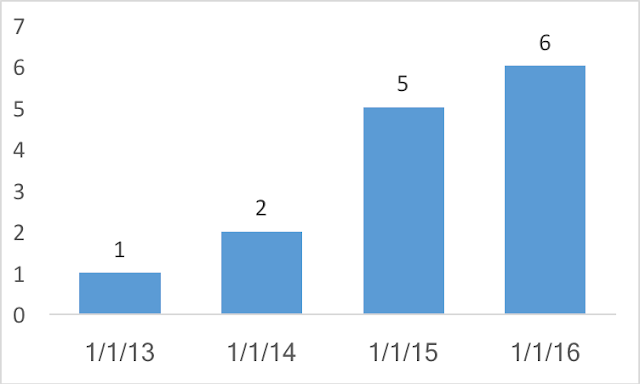
In the last 4 years (2013-2016), I have been contacted many times by headhunters, and have received 14 job descriptions of a CDO, or similar position. The advantage of receiving CDO job descriptions is that it allows you to understand how the data world is progressing, what other large organizations are doing, and -why not- understand the market value of your knowledge and experience.  You can learn a lot about different industries just by listening and having a conversation. The figure below shows clearly that the need for senior data professionals is increasing.
Number of CDO descriptions received by year
Figure 1: Number of CDO job descriptions received (by year).
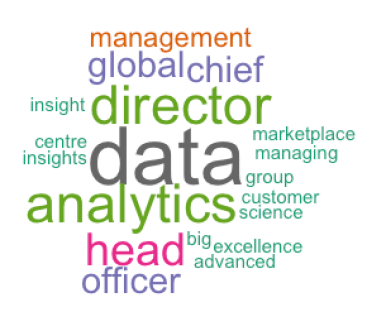
CDOs are not always called Chief Data Officers. Many of the titles are made up of a small set of terms including data, analytics, director, head, etc. The figure below shows a wordcloud with the most used terms.
Terms used in the title of senior data professionals
Figure 2: Terms used in the title of senior data professionals.
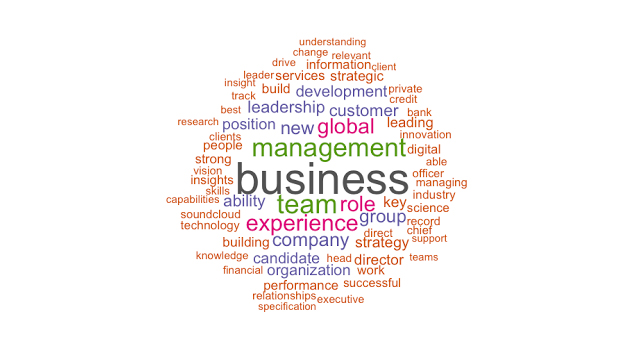
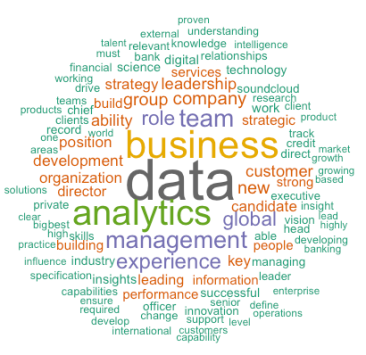
But what kinds of qualities are companies looking for in a CDO? We have used a simple R program to parse the job descriptions and create wordclouds, and this has resulted in some interesting insights. If we analyze all 14 job descriptions, we get the following wordcloud.
14 jobs descriptions
Figure 3: Wordcloud of analyzing all 14 job descriptions.
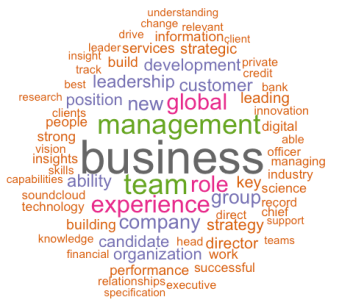
We see no surprises: “data”, “business”, “analytics”, “management”, “team”, “experience” are among the top words used.  If we now look at the same job descriptions but we don’t visualize the words “data” and “analytics” we get a slightly different view, giving more importance to other accompanying relevant words.
Job descriptions, without words "data" and "analytics"
Figure 4: Wordcloud of analyzing all 14 job descriptions, but without the words “data” and “analytics.
Indeed, any job description for a CDO will be about data and analytics. But it is interesting to know what else is relevant for the job. Therefore, in the rest of our analysis, we will remove the words “data” and “analytics” from the wordcloud to highlight more the differences than the commonalities.
Consultancy firms
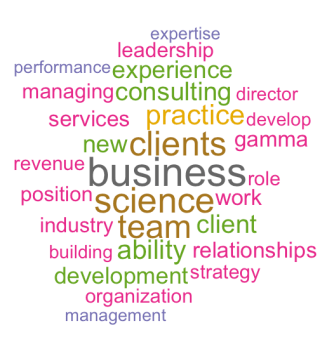
Some of the job descriptions were from consultancy companies, while others (the majority) came from client organizations (those hiring consultants for Big Data projects). Below you can see the wordcloud for those consultancy companies.
Job descriptions CDO
Figure 5: Wordcloud of job descriptions for CDO of consultancy firms.
There is much focus on clients, practice, development, relationships and consulting, which is what one would expect for consultancy companies.
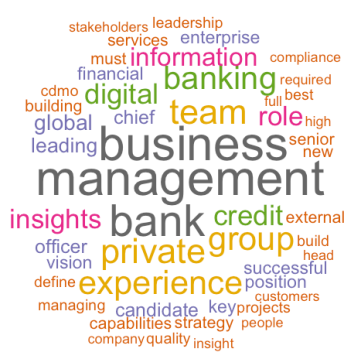
Now, let’s look at some different industries. We begin with the financial industry. Below we see the wordcloud (again we have removed the words “data” and “analytics”.
CDO job descriptions
Figure 6: Wordcloud of CDO job description for the financial sector.
“Bank”, “management” and “business” are the most relevant words, but also interesting are “digital”, and “group”, “team”. Almost all banks (multinational groups) are frenetically working on becoming more digital, and data is a large part of that strategy.  Team work is key for that.
Next we analyze the CDO job descriptions for the Insurance industry:
 
Job descriptions insurance sector
Figure 7: Wordcloud of CDO job description for the insurance sector.
Here we see much more emphasis on “international”, “leadership”, “team”, “global” and “demonstrated”. This may reflect the fact that many insurance companies are global companies operating in many countries across the world. This gives an additional complexity for a data strategy. It is curious that “technology” only appears small.
Let’s have a look at the telecommunications industry:
 
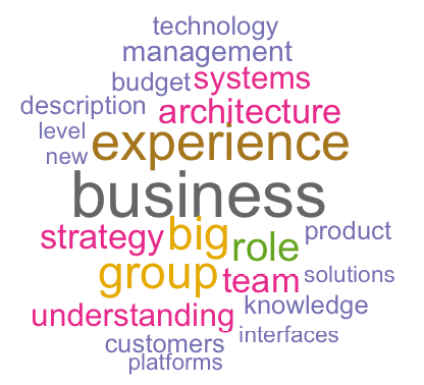
Figure 8: Wordcloud of CDO job description for the telecommunications sector.
In the telco industry there is a lot of emphasis on business and experience, but also on technological terms like “architecture” and “systems”. “Strategy” seems also to be relevant. Telco’s indeed are very technological companies (complex mobile and fiber technology), and Big Data forms part of their current strategy.
The publishing industry is as follows:
Job description publishing sector
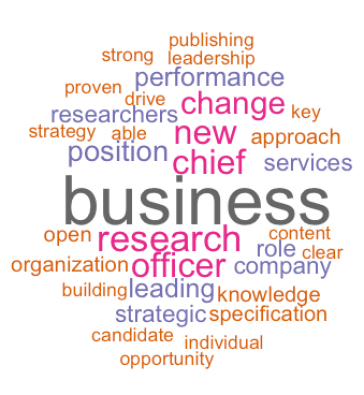
Figure 9: Wordcloud of CDO job description for the publishing sector.
Relevant here are words like “business”, “research”, “change”. Many publishing companies are active in the field of research publications. And the sector is undergoing a profound change of its traditional subscription business model.
The Pharmaceutical industry:
Job description pharmaceutical sector
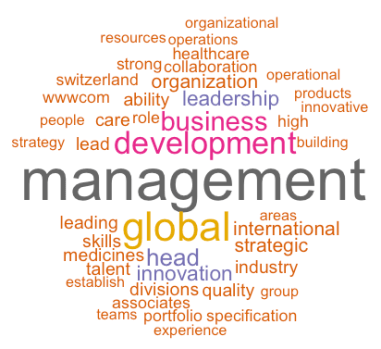
Figure 10: Wordcloud of CDO job description for the pharmaceutical sector.
The importance of the word “development” distinguishes the pharmaceutical industry from others, probably because one of the main applications of Big Data in this industry is to develop new drugs.
The Automotive industry:
Job descriptions automative sector
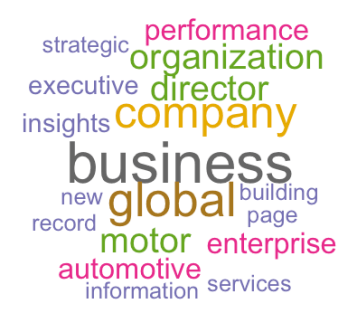
Figure 11: Wordcloud of CDO job description for the automotive sector.
A CDO in the automotive industry is focused on serving the business from a global perspective. Performance is also relevant.
Conclusions
For almost all sectors -apart from Data and Analytics- Business is very important. But after that, different sectors highlight different aspects of the CDO role, as summarized here below:
  • Insurance: global, team, leadership
  • Telecommunications: technology and strategy
  • Finance: (data) management
  • Publishing: change
  • Pharma: (drug) development
  • Automotive: business, performance
So, for data professionals interested in leading the strategy, execution and value creation with Big Data, make sure you have the right experience and knowledge.
And, remember, if you are a CDO, and you need help to transform your organization in to a more data-driven one, LUCA is here to support you.
Leave a Comment on Are you ready to become the CDO? Applying Analytics to the CDO role