Expert Systems in the World of Medicine

AI of Things    22 October, 2018

Written  by Sergio Sancho Azcoitia, Security Research en ElevenPaths 

Since its appearance a few years ago, expert systems have been applied in different fields. Due to their effectiveness they have inmproved projects that need their application in the clinical field. We will briefly remind you what expert systems consist of and some of their possible applications, in this case associated with the field of medicine.

An Expert System (ES) is a program that uses a series of acquired human knowledge to solve problems or perform tasks that would normally be solved by expert humans. In many cases, these programs work better than any human expert because of their effectiveness and speed when making decisions.

At present, the expert systems constitute the area of application of AI with greater success in the world of medicine. Expert systems allow the storage and utilisation of knowledge of one or several human experts in a specific applied domain. The use of advanced tools such as expert systems increases productivity and decision-making efficiency, which is essential for solving problems when experts have doubts or are not present.

Below, we will briefly introduce you to some of the expert systems that have triumphed in the world of medicine:

  • MYCIN: Designed at Stanford by Edward Shortliffe, it is capable of diagnosing infectious diseases in the blood and prescribing the appropriate antibiotics.
  • PUFF: Designed in the late 70’s with the collaboration of Robert Fallat, (specialist in pulmonary diseases), able to diagnose lung diseases.
  • CADUCEUS: Originally from the University of Pittsburgh, it is used for the diagnosis of internal medicine.

These expert systems are very useful and can greatly facilitate the work of professionals. Despite this, many experts in the world of medicine have expressed their concern about the idea that in the future the entire decision-making process could be in the hands of machines, rendering the role of doctors irrelevant.

However, it must be clarified that expert systems in medicine are not designed to replace  doctors, but to complement their work. At the moment there is no machine capable of simulating the behavior of a doctor or his clinical eye (series of knowledge acquired by a professional throughout his practice).

Don’t miss out on a single post. Subscribe to LUCA Data Speaks.

You can also follow us on TwitterYouTube and LinkedIn

A story about two minds: the vast difference between real and perceived risk

ElevenPaths    22 October, 2018
“In our society it is generally not considered justifiable to make a
decision purely on an emotional response. We want to be considered scientific
and rational, so we come up with reasons after the fact to justify our choice.”
—Raj Raghunathan, McCombs School of Business, The University of Texas at Austin

Look carefully the following figures. Which one is the largest for you? The
figure on the right or that one on the left?

Ebbinghaus visual illusion image

Yes, indeed they are identical. However, even if you know it, or even if you try to measure it with a ruler, you cannot avoid seeing the right one larger, right?


It is the well-known Ebbinghaus visual illusion and I’m sure you have seen many
more like it. Anyway, did you know that not all the illusions that captivate us
in our everyday life are visual? There are other much more dangerous: the
mind or “cognitive” illusions
.

These cognitive illusions make us to be more afraid of taking a flight than
driving a car, or to think that there are more people who die of accidents than
of heart disease. We are awful at assessing risk. According
to psychologists
, we lead ourselves astray by different ways:

  1. Distortion
    of Habitus:
    the more familiar you are with a
    risk, the more exposed you are to it and the more used you are to mitigate
    it, so it seems to you less risky. Nothing happens if you are using your
    mobile phone while driving, right? Conversely, you tend to overestimate an
    exceptional or unexpected risk. 
  2. Time
    distortion:
    you under-react to a slowly
    growing risk or to a long-term risk. These cigarettes you know you
    shouldn’t smoke… but one by one they seem to be less harmful. You know
    what I am talking about, right? Conversely, you tend to overreact to immediate risk. 
  3. Distortion
    of spirit:
    people overreact to risks that are
    personified, intentional or mediatized. Am I right if I say that your
    reaction is different when someone intentionally throws a stone at you
    than if this stone hit you because it detached from a cornice, or because
    of the wind? Conversely, you under react to hazard or natural risks.

If we are rational animals, the apex of Evolution, why are so awful
at assessing risk and then can we make such bad decisions? Because we aren’t
as rational as we think. Because indeed, we don’t have a mind: we are two
minds!
Dionysus and Apollo
coexisting in the same brain
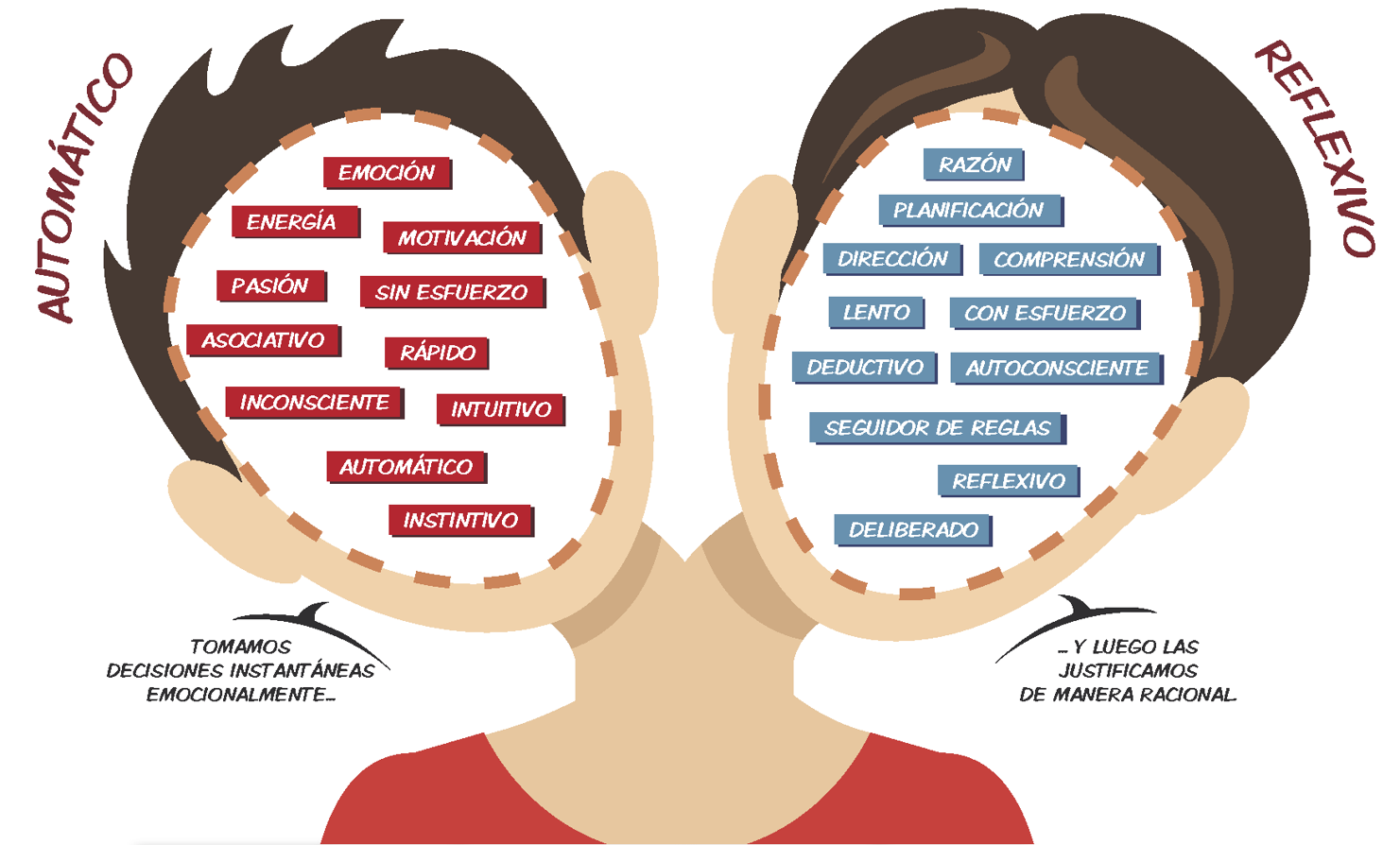
We have two modes of though: the first one is intuitive and automatic,
the other one is reflexive and rational. They are named AUTOMATIC and REFLEXIVE
or SYSTEM I and SYSTEM II.  
 Thinking, Fast and Slow: image

As explained by Daniel Kahneman in his great book Thinking,
Fast and Slow
:

System 1 operates automatically and quickly, with little or no effort and
no sense of voluntary control.

System 2 allocates attention to the effortful mental activities that demand
it, including complex computations. The operations of System 2 are often
associated with the subjective experience of agency, choice, and concentration.

When we think of ourselves, we identify with System 2, the conscious,
reasoning self that has beliefs, makes choices, and decides what to think about
and what to do. The automatic operations of System 1 generate surprisingly
complex patterns of ideas, but only the slower System 2 can construct thoughts
in an orderly series of steps.”

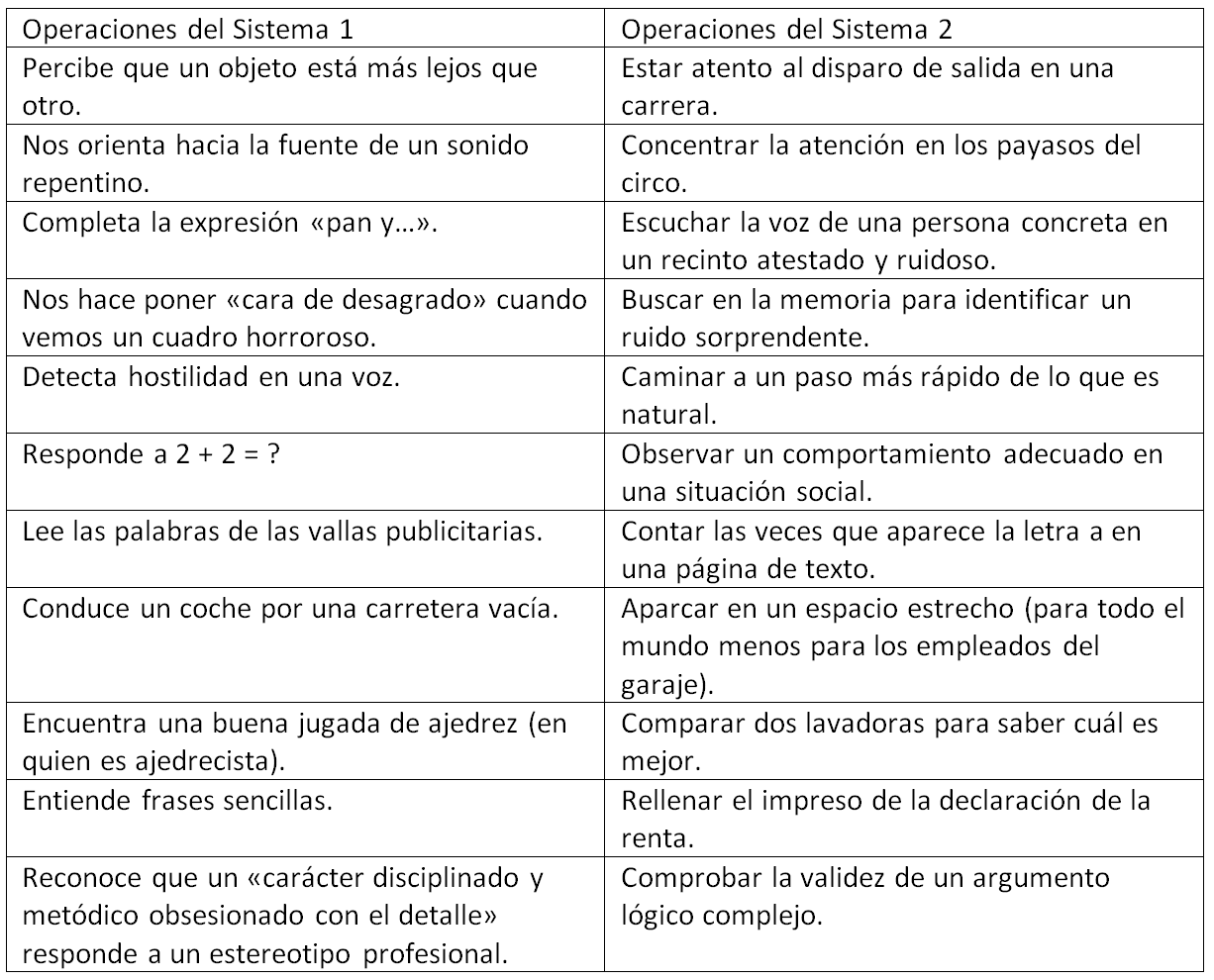
The following table includes several examples of operations from both systems:

There is no dichotomy between System 1 and System 2: they are not two homunculus
sit on our shoulders and whispering in our ears. We are not perfectly rational,
nor completely emotional and instinctive. We are both, all the time.
They are the intertwined components of a unique system. It is true that
sometimes we use one more than the other, but both are engaged in risk
assessment.

If you can’t answer a difficult question, just replace it
with an easy one
Why must our
brain evolve towards this work division between System 1 and System 2? Just
because it is really efficient: it minimizes effort and optimizes execution.
Most of the time we do very well with this task division because, as conveyed
by Daniel Kahneman in Thinking,
Fast and Slow
:

“System 1 is generally very good at what it does: its models of familiar
situations are accurate, its short-term predictions are usually accurate as
well, and its initial reactions to challenges are swift and generally
appropriate. System 1 has biases, however, systematic errors that it is prone
to make in specified circumstances.”

Where do these biases come from? Answer the following Yes/No questions and it
will become clearer to you.

  1. Do you think that cyberterrorism is a big threat to citizen security?
  2. Do you think
    that crypto mining represents a serious threat to citizen security? 
  3. Do you think
    that using a smartphone with Internet connection is a grave threat to
    citizen security?
  4. Finally, the
    most important one: do you have at your disposal the required data and
    facts to give a full, critical and reasoned answer for the first three
    questions?

I don’t know your answers for the first three questions, but I would bet
that you answered the third one with a resounding NO.
No one thinks they
have all the necessary facts to answer them! In spite of it, you answered with
Yes or NO to the first three ones because you have an intuitive knowledge
thanks to your experiences and readings on the risk of the mentioned threats.  

This is how we work most of the time in our lives: we must continually make
judgements and take decisions, even if we don’t have all the necessary data and
facts, the time to collect them, nor the intellectual ability to process them
completely. Our rationality is limited or “bounded”, as named by Herbert Simon.


The modern world is so complex and our minds too limited to be able to process
all the information before taking a decision. This is why, instead of
seeking optimal procedures to maximize utility functions, we use heuristics!
When
we face a difficult question, we often tend to answer to an easy one, generally
without realising it. It is a simple procedure that helps us find the
appropriate answers, even if often imperfect, for difficult questions.

That is where the origin of our biases thrives. That is why there is often a
vast gap between our risk assessment and the real risk. Our Systems 1 and 2
were developed in an environment where threats were relatively easy to
understand:
a predator leaping on you, a fire spreading, or a member of
another tribe looking at you with a grim face while holding a hidden object.
When assessing risk in the context of our modern society, System 1 often fails
miserably, while System 2 is unable to gain control. Our brains are stuck in
the heuristics from hundreds of thousands of years ago, appropriate for
primitive life of the small social groups living in Nature. They haven’t had
time to update a version for the 21st century.
We need to execute a new operating system in a hardware
of over 100,000 years
This old software riddled with bugs and poorly patched is
error-prone. When a heuristic fails, our security feeling moves away from
security reality. Sometimes we pay more attention to the media or most
threatening risk, instead of to the most prevalent but less newsworthy or
striking one. Or even we create new risks when trying to avoid the old ones.
Security is always a compromise. If the risk severity is misinterpreted,
then the security will be inadequate
. This is why it’s important to learn
to overcome cognitive biases when taking security-related decisions.
To sum up, risk perception is a unique system, but multifaceted:
each complex face contributes to our judgments about the threats hanging over
us. In next blog entries we will explain why it’s so difficult to think
statistically and, consequently, we are so awful at assessing risk, which leads
to take bad security decisions
. We will take a closer look to brain
functioning, in order to understand the limits of our bounded rationality and
be on guard against our most devastating thought errors.
Gonzalo
Álvarez de Marañón

Innovation and Labs (ElevenPaths)

Artificial Intelligence – Five Fears Explained

Richard Benjamins    19 October, 2018

While there are many great applications of Artificial Intelligence, a disproportionate amount of attention is given to concerns about AI such as robots taking over control, losing our jobs, malicious use, bias, discrimination and black box algorithms.  While we agree that some of those concerns are legitimate, others are unrealistic or not specifically related to AI. Moreover, we should not look at AI in action in isolation, but in comparison with how things are happening without AI. Why are we afraid of AI? And should we be?

No technology is without risk. The fear for Artificial Intelligence is partially based on legitimate concerns, and partially on movies and limited understanding

Fear 1 is about humanity losing control to robots who will take over the world. This fear comes from science fiction movies, and from confusing narrow AI (a machine that performs one specific task very well) with general AI (able to perform a wide range of tasks, being conscious). Today and in the foreseeable future, we are in the era of narrow AI. No need to fear that machines will take over, unless you believe in technological singularity, or think that we, humans, are machines ourselves …  

Fear 2 is about AI taking over our jobs by automating many tasks that currently are carried out by people. History has shown that any large technical revolution (electricity, motorised transportation) will affect jobs. Part of the jobs will disappear, but mostly, jobs will change nature and new jobs will be created (many of those new jobs are still unknown to us). Part of this fear is legitimate for those workers whose job will be mostly automated while not being able to develop the skills needed for the changing and new jobs.

Fear 3 is that increasingly more decisions about people are taken or supported by AI: decisions about hiring, acceptance by insurers, granting of loans, medical diagnosis & treatment, etc. Such AI systems are trained on large data sets, and those data sets can contain undesired bias or sensitive personal data. The concern is that this might lead to discriminatory impact. Moreover, sometimes the algorithms of AI systems are black boxes, which justifies the concern that decisions are taken without people being able to understand them. Those fears are justified and creators of AI should be aware of, and transparent about those concerns, and do everything they can to remove them. If unsuccessful, then the AI systems should not be used for decisions that significantly impact people’s lives.

Fear 4 is that sophisticated AI systems can cause huge harm in the hands of malicious people: think about AI-based cyberattacks. This is definitely true, but is not specific to AI and applies to any powerful technology.   Fear 5 is based on losing one’s privacy, caused by all kinds of apps and companies that collect massive amounts of personal data, often in a less than transparent manner. This is a well-recognised issue and one of the reasons the GDPR exists. However, this fear does not only apply to AI systems, but to most digital systems that operate with personal data. We warn against an unfounded fear of AI. There are so many more good uses than bad uses.

As we can see, while two of the five fears of AI are legitimate (jobs & discrimination/transparency), they have limited scope and solutions can be foreseen, either societal/organisational (fear 2) or technical/organisational (fear 3). Fear 1 (super-intelligence) is more a philosophical debate as well as the topic of movies. It is not a reality. Fear 4 (malicious use) and fear 5 (privacy loss) are very real and will happen, but are not specific to AI.

It is human nature to pay attention to fear; that has contributed to putting us on top of the evolutionary chain. But let’s also not forget that AI can be used for an infinite number of good things to improve our world. Think about AI for Social Good to help achieve the UN’s Sustainable Development Goals (no poverty, no hunger, peace, health, education, equality, climate, water, etc.)  

Sometimes we think that we humans are a great species, but we shouldn’t forget that the majority of the misery, pain, destruction, wars, etc. in the world has been and is created by humans. We need to worry about machines becoming more intelligent and autonomous, but sometimes we could ask ourselves whether the world would be a better place, if less humans and more machines made decisions. 

Don’t miss out on a single post. Subscribe to LUCA Data Speaks.
You can also follow us on TwitterYouTube and LinkedIn

Leave a Comment on Artificial Intelligence – Five Fears Explained

IoT Solutions World Congress

Mirian Martinez Varas    18 October, 2018

More than 40,000 million devices connected in 2023. This is the data, according to a report by Business Insider, under which the IoT Solutions World Congress was held at the Fira de Barcelona, between October 16 and 18. The event has already become an essential appointment worldwide that connects large IoT providers with industry members.

With more than 300 exhibitors, the fourth edition of IoTSWC has shown visitors the latest innovations in digital transformation that this industry offers. They have already been established as a great help to increase productivity and offer better services.

Connected transport, healthcare, energy, construction and infrastructure, open industry, manufacturing and IoT facilitating technologies have been the protagonists of the event.

IoT is a reality

Telefónica has taken advantage of its presence in the IoTSWC to show its wide range of IoT products and solutions, as well as its innovation plans around this disruptive technology. A fundamental element of these solutions is Kite Platform, Telefónica’s managed IoT connectivity platform. In addition to managing all IoT connectivity, including NBIoT and LTE-M, it provides transparency, security, analytics and self-management of all the IoT devices and products of the client. With it you can develop the IoT verticals, either B2B: (Mobility, Retail, Energy, Industry and Smart Cities) or B2C solutions.

Together with Kite Platform, Telefónica offers the essential tools to develop all its capabilities: devices integrated with the solutions, the best IoT connectivity, integration with IoT cloud players and end-to-end security from the design phase.

In line with the concept “Take things further”, Telefónica has shown its commitment to continue innovating in a quick way, adapting to changes and offering customers solutions with the most advanced technology. In this sense, we always seek to keep the customer at the center of the design process, be it a business client or a residential customer. This spirit of solving the needs of our customers with the help of technology is in the very DNA of Telefónica’s IoT proposal.

As an example of this, it has displayed demonstrations related to Blockchain, antifire drones or the IoT Activationprogram, which offers a toolkit with key elements for validation by startups of different verticals of IoT technologies, including specialized devices for prototyping, LPWA IoT connectivity, exclusive access to the validation laboratory and all the support of the specialized equipment of Telefónica.

At the Telefónica stand, visitors to the IoTSWC have also been able to witness solutions in areas such as mobility, energy efficiency, retail or IoT security. Likewise, a virtual reality experience has been offered (in collaboration with Altran) and devices such as a sound level meter, an intelligent coffee machine and a connected bicycle have been exhibited as examples of high performance applications for sports.

IoT is now a reality and the success of the IoT Solutions World Congress proves it. Connectivity providers, software developers, hardware manufacturers, reference companies in different sectors or technological influencers know their potential to transform the economy.

As described in the panel “Enabling IoT”, presented by Carlos Carazo, Global Director of Technology IoT of Telefónica, together with executives of ENGIDI, SUBEX and FICOSA, IoT is experiencing a perfect storm, a concurrence of different factors (ecosystem of devices, connectivity, information analytics, security, etc.) that in the short term will produce an exponential effect in terms of adoption, massification and transformational impact in different industries.

Innovation is the way forward to take advantage of the wide range of possibilities it offers us.

Great IoT Developments in Spain

Cascajo Sastre María    16 October, 2018

Internet of Things is revolutionizing the global technology sector and Spain is not far behind. In fact, it is the fifth European country when it comes to investment in this technology.

The best example of this is Telefónica’s position in the sector. The multinational is listed as ‘Leader’ of the prestigious Gartner Magic Square of M2M services, placing itself at the forefront with its offer of services for companies and institutions.

Due to the enormous potential of Big Data for the improvement of sustainability, Spanish cities are also adopting this technology. Next, we can see some of the great Spanish advances in IoT:

  • Madrid

The capital of Spain has launched a series of IoT measures to improve mobility and combat pollution, including applications that report public transportation, smart traffic lights, air quality detectors, sensors that monitor traffic and parking spaces or the intelligent management of lighting and water resources.

  • Barcelona

The installation of around 20,000 sensors that measure air quality, traffic or public transport has placed Barcelona as a global example in IoT. Among other actions, the municipality saves resources by telemanaging automated irrigation infrastructures and has installed smart lifts in the metro. In addition, it has a specific plan for digital transformation: Barcelona Ciudad Digital.

  • Valencia

The capital of the Valencian Community has centralized all its municipal information through the VLCi Platform(Valencia Ciudad Inteligente), a unique connection technology solution that has managed to optimize the management of areas such as transport, energy, environmental services and open government.

  • Málaga

The Smart City Malaga plan has implemented equipment such as photovoltaic and wind lamps that take advantage of the energy provided by sun and wind efficiently, mobile environmental sensors, smart buildings that save energy, charging points for electric cars and sensors in car parks that indicate available parking slots.

  • A Coruña

Coruña Smart City aims to establish a more efficient and sustainable city model. The plan includes telemanagement of the sanitation and water supply network, of electricity meters and of intelligent irrigation systems. At the same time, a network of sensors controls air quality, noise levels and systems for optimizing traffic and intelligent parking.

  • Santander

Santander has been one of the pioneers in the implementation of smart models based on Big Data. The Santander Smart City plan has provided the city with an advanced network of sensors that give constant information on waste, water or traffic management. Likewise, an app allows citizens to report any incident to the consistory.

  • Bilbao

The Bilbao Open Data project offers citizens useful information for their day to day activities in real time. It has applications such as GeoBilbao or iBilbobus, which monitor the traffic status, the municipal bus network, the existence of construction places or the occupation of parking lots.

  • Ávila

Through Smart Patrimonio, Ávila controls important environmental factors to keep an eye on the state of its monuments, such as the level of humidity, temperature or light. Damage prevention is achieved, which improves efficiency and reduces costs in the preservation of important historical and cultural buildings and monuments.

These are just some examples of the implementation of IoT in our country. In total, the Spanish Network of Smart Cities currently has 81 municipalities. Even so, it is a technology in constant evolution that has a lot of further development and testing ahead. Everything seems to indicate that investment will continue to grow in Spain in the coming years.

The advances of the IoT and its application in the daily life of the cities not only have an impact on the benefit of society as a whole, but it also improves the quality of life of individual citizens. Its applications, so often aimed at the efficiency and sustainability of cities, also make life easier for people: time saving, access to information from their devices or personalized assistance that allows better decision making are only some of its many advantages. In conclusion, an IoT at the service of cities is an IoT at the service of the people.

Leave a Comment on Great IoT Developments in Spain

AI Powering the IVF Revolution

AI of Things    15 October, 2018
Get ready, an IVF revolution is on the way.

Scientists have discovered that an Artificial Intelligence machine, when shown images of hundreds of embryos, can predict which will result in live birth with an unprecedented accuracy rate of 85%. Not only would it reduce the risk of damaging the embryo as microscopic inspection is not needed, but it could also increase the percentage of women able to have a baby through IVF.

Researchers from Imperial College London and Cornell University USA, led by Nikita Zaninovic, presented their findings to the American Society for Reproductive Medicine last week (10th October 2018), and are now in the race to patent their algorithms and enter the $7.5 billion market of AI.

Their papers included information on how this technology could dramatically lower the risk of complications (70% of which are caused by embryo abnormalities). Currently, doctors are implanting multiple embryos to maximise the chance of fertilisation, which poses the risk of initiating preterm birth, preeclampsia, and many other costly and painful childbirth complications.

How would this work?

Embryologists have the task of deciding which blastocysts to implant by assessing the normality of their appearance and the regularity of their growth. The studies suggest that by training AI to understand what looks normal and to identify regular growth rates, we could achieve much more reliable results than we can obtain from the human eye.
When embryos are standardised by experts, methods of categorization change from lab to lab, and even from person to person. By using over 50,000 images to train AI, researchers were able to establish a 97% success rate at categorizing embryos into groups depending on quality. AI also correctly selected which embryo had the best chance of making it to live birth 85% of the time.
 
Will this make human jobs redundant?
A study by MIT in 2017 found that, when comparing human teams and robot teams, the most efficient team was the one the combined humans and robots, being over 85% more efficient than the other groups. We have spoken previously about the power of human-AI collaboration, where we have discussed Superpowers and Data Scientists, and how we can harness the power of AI to improve our areas of weakness, and viceversa.Rather than making people redundant, the type of work demanded will be different. If successfully implemented, it is likely we will see the demand for IT support roles increase greatly.

image of an embryologist working on IVF
Figure 2, Embryologists are tasked with assessing embryo states

The power of this technology extends beyond percentage success rates. Its use has the ability to prevent agonising distress. Around half of all miscarriages that occur in IVF patients are caused by an abnormal number of chromosomes in the embryo. Having the ability to select the best embryos for tranfer is considered the key to IVF success.

To elaborate, by having a more accurate analysis of results, doctors will be able to give more reliable information to patients seeking treatment. If an embryo is not developing successfully, they will be able to tell patients straight away, rather than extending a costly and emotional process.

Doctor S. Zev Williams of Columbia University, who was once a fellow in the Cornell lab that developed one of the new AI techniques, commented that: ‘Things like miscarriage and infertility are some of the most ancient diseases. I think there’s something poetic about solving that with some of the newest technology.’When you consider that over 200,000 couples try IVF a year, with around 2/3 of these couples experiencing failed cycles at least once, the scale and reach of this revolution comes to light.

As we have seen, AI´s capabilities extend much farther than data anlysis and robotics. This is a monumental shift into the world of medicine for AI and with rapid advances expected, the future of a human-AI collborative medicial team looks more than promising.

Written by Lucy Beardsley

You can also follow us on TwitterYouTube and LinkedIn

Human Intelligence driving AI: Demand for Data Scientists

AI of Things    8 October, 2018

Many industries today are data-driven. The amount of data, its variety, and the speed at which it is collecting means that it needs to be analysed scientifically if any intelligence is to be extracted.

A few years ago, the demand for Data Scientists was limited to research purposes. Nowadays, their expertise is in high demand throughout many industries because of the Information Explosion we have experienced in recent years. This extreme influx in demand has resulted in a profound increase in the development and acquisition of Data Scientists to deal with the data deluge.

The role of a Data Scientist is to analyse various data and extract knowledge and insights that can be used to gain information about a demographic or individual. They are responsible for performing a prescriptive analysis of the data history of the company, so that you can not only anticipate what will happen in the future and when, but also give a reason why. In this way you can establish what decisions will have to be made to take advantage of a future business opportunity or mitigate a possible risk, showing the implication of each option as a result.

To create functioning AI, a combination of Data Scientists and Machine Learning is required. Machine Learning is based on the idea that machines can be built to provide systems with the ability to improve and learn automatically, without being specifically programmed or supervised. It´s main focus is to access the data and use this data to learn, acting as a connection between Data Science and AI.

Put simply, AI means machines that can perform tasks intelligently and adapt to changing situations.  For both processes, large amounts of data need to be collected, stored, and then used intelligently to generate performance.

Although AI is effective, it is still nowhere near human intelligence. As humans, we use data all our lives from past to present to assess everything we do. We are able to sense and feel, experience and think, and most importantly we are able to use understanding, logic, and reasoning, to make decisions; intuition, an ability AI does not yet possess. As the amount of data AI needs to perform simple tasks such as recognising letters is enormous, human intelligence is needed to sort, analyse and link this data efficiently so that AI can use it appropriately in the future. If we compare the two, Human Intelligence and AI, we can see that humans have had thousands, if not millions, of years of evolution, whereas AI has only been around for 50 years.

The assumed reasoning behind the creation of AI is to improve our human capabilities. If we consider a human´s ability to recognise a person in a photo, it is something the majority would perceive as simple. But for AI, thousands of data sets need to be analysed to carry out this same task and very little accuracy has been achieved so far. However, if we look to a human´s ability to multiply large numbers, it becomes a difficult task for our brains, but relatively simple one for AI.

By creating AI that mimics human cognitive functions but can also carry out tasks we find hard, we are able to create an extremely powerful tool. As highly social animals, we are able to communicate with others and establish connections- wether this be in the workplace or in the street. AI does not have this capability or anything close to it. It has been said that this creation is a ´Team Effort´, that ultimately serves to aid us.

Figure 2, AI can be brilliant, but only as brilliant as the minds that create it

As we look to the near future, demand will continue to increase for Data Scientists as the technological race continues. Due to the mainly unpredicted rise in demand for data and the amount that it has reached, caused by the big data boom, Data Scientists are often able to earn a high salary due to the basic principle of demand exceeding supply and the unique knowledge they bring.

With many universities and other education platforms offering education and training in this field at an increasing rate, some experts have predicted this run of demand will begin to decline in 10 years, and along with increased education and talent development, Data Scientists will experience more average salaries due to a greater equilibrium between the supply and demand of Data Scientists.

Overall, the need for human intelligence remains fundamental in our development of AI. A combination of the Big Data Boom, the Information Explosion, and the technological advancements that are taking place every day have led to a significant increase in the demand for Data Scientists. We now live in a world driven by technology, and it´s the people who are able to create and aid the production of this technology that we need the most. Our brains continue to be the most valuable and powerful asset we have, and we must ensure we respect that fact. AI can be brilliant, but only as brilliant as the minds that create it.

Read this related article to find out more and discover the ´Superpowers¨ we may be creating!

Don’t miss out on a single post. Subscribe to LUCA Data Speaks.

You can also follow us on TwitterYouTube and LinkedIn

Artificial Intelligence: a “very human” technology

Paloma Recuero de los Santos    5 October, 2018

What makes us human? The answer to this question is not simple, it’s not easy to define what makes us human.We can try to find the answer from a scientific point of view, from a philosophical one, or choose an area in between. All of these areas lead us to ask ourselves questions such as: Is it language that makes us human? Is it our spiritual side? our creative or cognitive abilities? the fact that we are social beings?

What is clear is that humans are social beings, with all that this implies in terms of language, collaboration, transmission of culture and knowledge, empathy and much more. We have a brain that, thanks to its extraordinary plasticity, has allowed us to extend our cognitive abilities far beyond our neurons and develop a culture and technology thanks to which we have managed to adapt, to survive all kinds of changes in our environment to the point of even becoming able to modify it.

What would those homo Sapiens that fought to survive in the African Savannah 300.000 years ago say, if they knew that one day they would be the ones capable of populating an entire planet! And not only that, but that they would be able to move quickly by land, sea and air, multiply their life expectancy and send missions to outer space and create systems based on Artificial Intelligence that would convert them into “superhumans”

Superhumans?

It is funny to talk about “Superhumans”, because the truth is that from a biological perspective we are nothing too wonderful. We are not especially strong or fast, we do not have “eagle eyesight”, nor are we especially resistant … However, our intelligence, and our social skills have allowed us to develop technologies to eliminate barriers, and overcome our biological limitations. This is how we started to tame and domesticate animals that allowed us to be “stronger and more resilient”, move faster, and then to even “fly” with vehicles we created ourselves; also to create machines that allowed us to produce more food, and machines capable of working in conditions that humans would not be able to resist…

Once we have overcome our physical limitations, we have taken a step further. Current technologies have allowed us to connect our physical environment with the digital space through the Internet (yes, Internet of Things or IoT), and offer us an improved version of our sensory organs through a large number of sophisticated, ubiquitous and today, already affordable devices that offer us valuable information about our environment.

Finally, leaving aside the physical and sensorial barriers, why not the cognitive ones? In order to overcome the latter, progress has been necessary on different fronts. On one hand, the most tangible thing, the development of the transistor, the integrated circuits and the data storage devices, has allowed us to have necessary hardware, at an affordable price. The reduction in price and the availability of suitable hardware has allowed the development of Big Data technologies, such as Hadoop, which allows large volumes of information to be captured, stored and efficiently processed.

These technologies are what has made the “Golden Age”of Artificial Intelligence possible, which is not something new (it actually emerged in the 1950’s), but has experimented spectacular growth in the last couple of years, among other accelerators, these technologies.

Fundamentally, AI is based on the idea of getting a computer to solve a complete problem in the same way as a human would. Thus, in the same way as in the Neolithic period humans began to domesticate animals and learned to take advantage of their strength and resistance to cultivate their fields more efficiently, today we use Artificial Intelligence in so many areas of human activity, sometimes we are not even aware of it. Not only it is easy to identify in robots that are used in heavy industry, or in autonomous cars, but AI is also used to diagnose diseases, organise staff rotations and assign hospital beds, to make decisions and perform high-speed stock trading, to support users as virtual assistants, optimize the emergency aid that reaches populations displaced by natural catastrophes, discover exoplanets, to control epidemics, to improve sports performance, detect trends and “feelings” in social networks, offer personalized offers, dynamic prices, perform preventive maintenance of all kinds, optimize consumption, automatically translate any language … The list is never-ending, but the important thing is that technologies based on Artificial Intelligence allow us to perform virtually any task with much more efficiency than we would with our (limited) human capabilities. It’s as if Artificial Intelligence gave us superpowers.

Overcoming our biological and cognitive limitations…Superpowers?

Almost everyone likes superheroes; fictional characters capable of overcoming classic heroes thanks to their superhuman powers. Many of them emerged in the late 1930s in the American comic industry, and were later adapted to other media, especially film. The character of Superman, created by the American writer Jerry Siegel and the Canadian artist Joe Shuster in 1933 was one of the first.

Let’s remember it’s story a bit to set us up. Superman was born on the planet Krypton. Shortly before the destruction of his planet, when he was still a child, his parents sent him in a spaceship to Earth to save him. There he was found by the Kents, a couple of farmers in Smallville, Kansas, and raised with the name of Clark Kent, who imparted on him a strict moral code. Soon, young Kent begins to discover his superhuman abilities, his superpowers, where upon reaching adulthood, he would decide to use for the benefit of humanity.

And what are superman’s powers? Despite changing over the years, we more or less remember his great speed (“faster than a bullet”), his super strength (“more powerful than a locomotive”), his super- vision (“X-Ray, Infrared”), and above all, his ability to fly. The image of Superman flying over the city with his red cape fluttering in the wind, still forms part of the collective image of those who first saw the film at the end of the 70s.

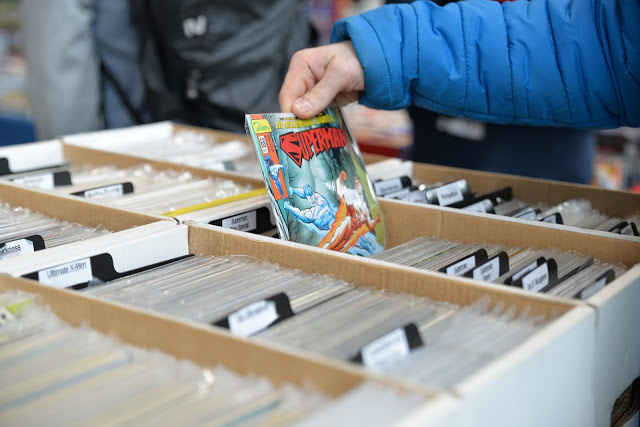
Figure 2. A Superman comic

Why do we love Superheroes?

The thing we love the most, of course, is their superpowers, their ability to do things that are inaccessible to the rest of us mortals. Also, the mythical aura that gives them their vocation to “do good”, to work for the good of humanity. And if we think about it, that is precisely what Artificial Intelligence allows us to do. It allows us to overcome our human limitations, and yes, gives us “superpowers”. For us, if we were to have an elevated ethical sense like Superman, we would choose to use them for good. On the other hand, we could also use them exclusively for our own benefit, even with the risk of harming others and joining the long list of “Supervillans”. For this reason, it’s crucial to define an ethical code and regulatory framework for the use of AI.

AI gives us “Super powers”, we become Superheroes 

Thanks to AI, we can therefore, like Superman “be faster than a bullet” (a lot faster!), do calculations, tend to our clients at any time using a Bot, or analyse enormous volumes of data to detect, for example, anomalies. We can also boast our “super-vision” and process a large number of images at high speed to identify a face or a possible tumor in a medical test. And flying …also an experience that can be improved thanks to AI. From the use of autopilots that take all types of flight data to optimize parameters, to systems that optimize trajectory calculations in highly saturated airspaces, fuel consumption forecasts, prediction models of adverse weather conditions, etc.

What can´t AI do?

Superpowers without a superhero who decides what to do and how to use them, have no meaning. In reality, they are just tools that humans created to make life easier. They may be so sophisticated and powerful that we sometimes forget that, in the end, without human intelligence deciding how they should be used, they have their limitations.

Thus, an IA-based application can translate a text into another language but cannot understand it. They cannot read between the lines. They can calculate the number of times certain words appear that are considered positive or negative and thus assign a “feeling”, but cannot understand the deep meaning of the words, or the real emotions behind them.

Another example: One of the most widely used Deep Learning techniques for image recognition (computer vision) is the convolutional neural networks CNNs. These systems classify the objects that appear in an image based on the detection of patterns that match those learned in previous training processes with many tagged images. So far, so good. AI algorithms will look for the pattern that best fits the image in question and will offer a result. But this AI is not able to realize if the result it offers makes sense or not. Any human would have immediately detected a known error from Google, where they labelled an image of an African-American couple as “gorillas”. The AI gave its best result, as learned from their training data. But this is where the “limitations” of AI that we have mentioned above come into play. Is this data adequate or is there a bias? In this example, there was a clear racial bias. By not having enough images of African-American people in the training data, the algorithm was not able to give an adequate result.

Conclusion:

In conclusion, Artificial Intelligence is one of the most powerful tools that the human being has created as it can be applied to almost any field of human activity. Like other previous advances in Human Science and Technology, it allows us to go beyond our biological limitations, and for that reason, it turns us a little into Superheroes. But Artificial Intelligence is a tool created by man, for man.

Without human intelligence to define its objective, choose which is the most appropriate “superpower” for each situation, know its limitations, define boundaries, discard the “exact” but absurd results … it does not make any sense.

To add to this, there is a part of human nature that can never be “optimized” by AI: our social dimension, our emotions, empathy and creativity. A “companion” robot can remind you to take your medication, but it can´t give you a hug, or generate a smile, or have that crazy and original idea that solves the problem or at least prompts a laugh.

Don’t miss out on a single post. Subscribe to LUCA Data Speaks.

You can also follow us on TwitterYouTube and LinkedIn

IoT Activation: the IoT Program for Startups

Luis Simón Gómez Semeleder    4 October, 2018

Telefónica launches the IoT Activation  program to help startups develop their Internet of Things products. Thanks to IoT Activation, companies will have access to Telefónica’s exclusive services and tools to minimize the launching time of IoT solutions in the market.

The program allows testing solutions with all kinds of connectivity and performing from initial functional tests to larger scale pilots. The startups will be able to validate their connections and be part of Telefónica’s digital ecosystem.

Who is it for?

IoT Activation is a tool thought for entrepreneurs to help startups become global, connected and efficient companies. With IoT Activation it is possible to access to exclusive services that make possible optimizing customized solutions depending on the needs of your company.

If you want to promote the development of IoT solutions, increase productivity and expand your business, with IoT Activation you can be part of the innovation ecosystem of Telefónica.

You can sign up for free here.

What is IoT Activation? 

It is a set of technological tools that can be combined to test and improve your solution, connecting it much more efficiently, with all the power of the IoT. The program includes: 

1. Toolkit 

It is the pack of tools to which Telefónica guarantees access, including:

  • SIMs with 6 months of free global connectivity to test and validate your IoT solutions.
  • Modules and devices to test your solution with the connectivity you need: 2G, 3G, 4G, NB-IoT, LTE-M.
  • From Plug & Play devices to more complex equipment for more elaborate use cases.

2. Access to The Thinx

The Thinx is the laboratory that Telefónica has created to test new applications and devices in a network that simulates real conditions. In this innovative and collaborative space companies can:

  • Test end-to-end solutions from NB-IoT and LTE-M.
  • Have access to basic engineering support.
  • Have support in the certification process of your devices.

3. Access to the Kite platform

Kite is Telefónica’s IoT connectivity platform that allows you to control and manage all your IoT solutions:

  • Connectivity management: inventory, real-time expense control, alarms, business rule configurations and automatic reporting.
  • Remote device management: APN configuration, firmware update remotely, rebooting remote devices and remote diagnostics.
  • Cloud connectors that facilitate integration with the main platforms and applications of the public cloud.

Additionally, thanks to the collaboration between Wayra and Amazon, members will have access to the Amazon AWS Activate, which offers credits to grow and scale in the cloud.

The time of connectivity and the Internet of Things has arrived, and Telefónica makes it available to the most innovative companies with this innovative program, IoT Activation, with which Internet of Things will no longer have secrets for the development and evolution of products and the business strategy of startups.

Leave a Comment on IoT Activation: the IoT Program for Startups

Worker’s Diary IoT II

Beatriz Sanz Baños    3 October, 2018

9:10 Daniel crosses the building entrance with his employee card and presses the elevator call key. The small screen announces that your elevator will be number 4. Already with that small gesture the building is more efficient, because depending on the people that are waiting and what plant they want to go, it reorganizes traffic in the most efficient way.

9:15 Entering the office has never been so rewarding. Upon entering the door of the third floor of Telefónica IoT, the living room videowall announces that the company congratulates him for being the employee of the month. What a pleasure! It was ready (and connected) to surprise him, with a team like that it’s nice to go to work.

9:30. After turning on the computer and checking the mail, Daniel receives a notice on his smartphone for the meeting he has in 20 minutes. He still has time to have his second coffee of the day before the meeting. Thankfully, they digitized the office and now he can access the coffee machine with his employee card and get whatever he wants, even though he just realized that he forgot his wallet when leaving home. The good thing about the new office is that the work sites are not fixed and as he knows today will be a busy day, so he chooses to sit in the bench area, which allows more mobility and doesn’t bother your colleagues.

9:50. Before the meeting, Daniel sends the reports for the meeting to the printer closest to The Thinking room, the space enabled for videoconferences, from the office. This way he can take advantage and prepare the reports and contents that he has to present more easily. He arrives at the room five minutes before the meeting, and then he prepares his computer and his presentation to have it ready just in time. His correspondent connects to the video call on time when he receives the meeting start notice.

11:00 After the meeting, it’s time to leave the office and visit several new clients. His partner Marta has just sent all the information about them to his mobile. With this information in hand he gets the most efficient route which reduces travel time and fuel consumption of the company car.

13:00. After a morning of visits, it’s time for lunch. The clock vibrates to warn him that he has fulfilled his goal of steps for today, and he still has the afternoon! Daniel usually takes a tupperware with his food, however, today he has forgotten and he is starving. Thankfully, with his mobile he can access his restaurant tickets and pay in the office dining room.

15:30. Back in his desk, he begins to hear a rumor that is becoming stronger. It seems that the sound comes from The Big Living, other partners are already approaching the area. It’s good news, a new agreement has been reached with a partner to help him digitize his merchandise tracking.

16:00. “What an intense day!” Daniel thinks as he sees a new meeting alert on his mobile. This time it will be in the The Meeting room, since The Storming was busy, to update the department team with the news. Daniel has reserved the room through his mobile and has sent all the information he needs to the computer in the room, so he can keep his hands busy with the sweets he has bought on his way out of the office to celebrate with his team being the employee of the month.

17:00. Daniel has to take one last task head on. In order to be more focused and close the day, he prefers moving his things to The Diving to finish the last documents and make the last calls. Once installed, he realizes that he has left his jacket in the chair of one of his companions, but he does not need it, the rooms are regulated intelligently and the temperature is very pleasant, without peaks of cold or heat, which helps avoid the fights over the temperature that his wife tells him she suffers daily in her office.

17:30. After a final review of all the tasks of the day, Daniel schedules his agenda for tomorrow and shares it with all his colleagues, so they can be aware of the planning and to better fit the meetings and activities of the next day. He turns off the computer, takes his forgotten jacket, and say goodbye to the office by passing his employee card through the exit. In the garage, his car detects the keys in his pocket and opens automatically. He has his belt placed and again on route, according to the one indicated by your GPS, to pick up the children and spend the rest of the afternoon with them.