BD4SG: A new way to understand Big Data

AI of Things    23 May, 2017

Recent years have seen a large public debate surrounding the technology behind Big Data and how it can help optimise organizations, maximise profits and bring companies closer to their consumers. However, data can also be leveraged to develop a social element that can use the large amount of information for a societal benefit. We recently hosted the first Big Data for Social Good in Action event with the aim of bringing together the people who wanted to transform Big Data for Social from “storytelling” to “storydoing”.

Elena Gil (LUCA CEO) started the event explaining the concept of Big Data for Social Good and the potential societal impact it can have. She highlighted three situations in which data was used to help with emergency calls in Colombia and how through further work with LUCA, data scientist measures for future natural disasters could be developed. She also encouraged all attendees to take part in projects that could have a global impact.

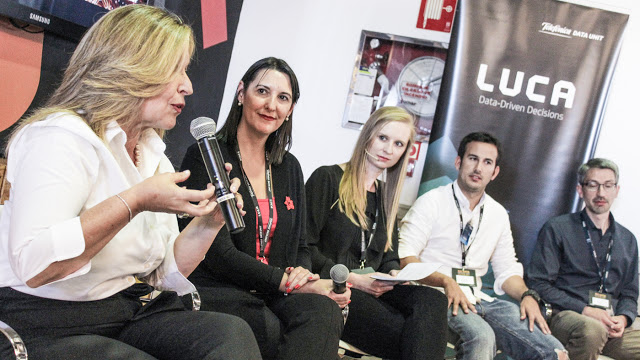
Continuing on from her introduction, Elena was then joined on stage by Trinidad Jimenez ( Global Director of PR at Telefonica), Javier Carro (Data Scientist at LUCA) and Alberto Asuero (CTO at Geographica). Together, they discussed the importance of open data, the future power of Big Data for societal purposes and the evolution of this technology, amongst other topics.

ponentes BD4SG mesa redonda
Figure 1: Debate in full swing at the #BD4SG event

Following the discussion panel, we had the privilege of hosting different specialists from various sectors presenting real cases of the application of Big Data for Social Good. The director of digital communication at UNICEF, Nelson Leoni, presented an investigation carried out by the organisation analyzing the impact of Zika on the Brazilian population using mobile data.

David González (CTO and founder of Vizzuality) presented his Global Forest Watch project. It involves a web application with open code that allows the global monitoring of forests in almost real time. This data surrounding the change in volume of forests allows people to monitor the global rates of deforestation and detect illegal activity.

Elena Gil presenting BD4SG
Figure 2: Elena Gil presented a general overview to the Big Data 4 Social Good attendees 

The last case study was presented by Juan Murillo (Urban Data Services & Applications BBVA). Juan talked about the impact of Hurricane Odile on the population of the peninsula of Baja California. Using a model that measured the activity registered to credit cards used by the citizens throughout the natural disaster, they could measure the economic impact on different segments of the population.


The event was followed by an informal cocktail time that consisted of Mexican food in a relaxed environment in which partnerships could be formed. Attendees had the opportunity to clear up any doubts with the speakers and share valuable insights from their own work with peers. 
 
Figure 3: Some highlights from the event.
 
We at LUCA want to thank both the guests who joined us for the event and also the speakers for sharing their experience. Positive momentum and joining forces through collaboration are key to achieve the objectives of sustainable development goals through tools like Big Data, Data Science, Artificial Intelligence and Machine Learning.


Responsible data usage for effective advertising

AI of Things    19 May, 2017

Written by Liao Yin Tung 

Recently The Economist stated that “The world’s most valuable resource is no longer oil, but data”. With the rise of mobile technology, traditional advertising has unsurprisingly evolved into digital, therefore holding aspects of consumer behaviour. Mobile advertising converts customer’s impulsive buying into rational, informed purchases, changing how brands appeal to users while extending publisher reach by including new channels.

From the end users perspective, there remain three big questions on Mobile Ads: Data Collection; DataValue; and Data protection.

Continue reading “Responsible data usage for effective advertising”

Telefónica WannaCry File Restorer: How can we recover information deleted by WannaCry?

ElevenPaths    18 May, 2017


When cyberattacks occur in large organizations, it is crucial to remember where duplicate files are stored, as this information is also subject to infection by a malware virus or more importantly in this case, by ransomware. Best practice involves first tracking where the information is located and then starting the data clean up, both for Wannacry and other future incidents:
  • Files that are not encrypted were not affected by the malware because the malware did not have time to affect them. There are ways to partially recover files affected by Wannacry, which will be shown throughout the course of this article.
  • It is important to always have backups and security copies that are available offline.
  • Information surrounding the shared units and the cloud units.
  • Information from Office365 email and the data units.
  • Information from removable devices, i.e. Pen drives.
  • Temporary Office files (Word, Excel, PowerPoint). If the infection was present when a document was open, a temporary file will also have been generated. These files will not be on the radar of Wannacry, meaning these files will not become encrypted. Once the files have been cleaned up, Office files can be recovered to the point they were at when Wannacry started. Once the system has been cleaned up, the temporary files generated at the time of infection can be restored.
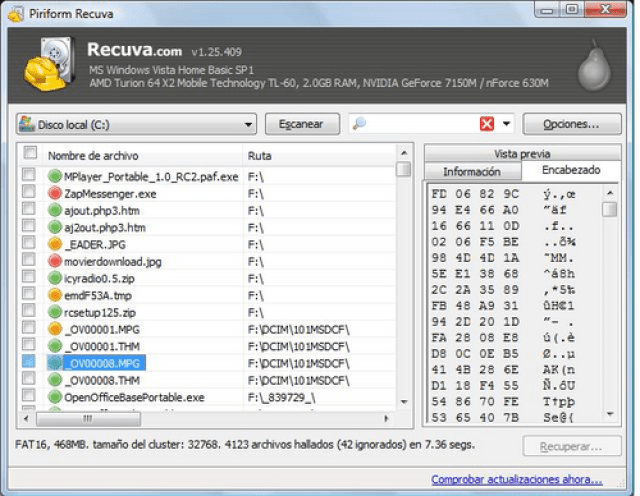
Another recommendation for all systems is to include a restoration function to allow you to return to the original version of the system. Following this step will give the user access to their system pre-infection and they can patch up the weakness without losing data or suffering damage to the data. Along these same lines of prevention, the RECUVA tool is another way to recover data.
In order to fully understand the effects and weaknesses of the Wannacry ransomware, we have been conducting continuous tests for the past few days. Through these tests, we have learned key steps so that we can continue the fight against this issue troubling our users and organisations. These tests should only be carried out by a member of the IT department of the organization.
There are two ways in which the ransomware encrypts files. In both ways, Wannacry uses a temporary file to control the selected files with the malware. Thanks to this, it is possible to recover the files that were affected by the ransomware.
In the first instance, the malware will identify that the system has a partition with the data and use the %userprofile%appdatalocaltemp route to move the files so Wannacry can encrypt them. The first file that is moved will be renamed as 0.WNCRYT, the second, 1.WNCRYT, following this pattern successively. Wannacry will start to encrypt each one of the files to correspond with the WNCRYT title and instantly delete the infected file. The data that has been saved in the %userprofile%appdatalocaltemp location is a temporary file and is not encrypted. The location and name of the data has only been changed so that the content can be recovered, as it has managed to avoid encryption.

Not all files are moved by the ransomware as it is a random process in which the temporary and encrypted files are created. Due to this, not all files can be recovered.

In the second instance, the malware identifies two data partitions in each system. The malware then creates a second partition at the root of a file named $RECYCLE, which should not be confused with $RECYCLE.BIN. The $RECYCLE file follows the same pattern as before in which files are moved across with the aim of encrypting them. When a file is categorized under the WNCRYT extension, the content has not been lost as it has not been encrypted. As soon as Wannacry encrypts the archive as WNCRYT and it has been converted to the WNCRY format it is officially encrypted.

Unfortunately, it is not always possible to find this sort of file. When Wannacry encrypts a file, the corresponding temporary file is deleted, which means that the information is lost. However, if the user turned off or hibernated their system before the process of encryption or infection, the process would be prevented. This would prevent all the temporary WNCRYT files from being encrypted and the previously eliminated files would then be retrievable. These temporary files that are kept under the %userprofile%appdatalocaltemp or $RECYCLE will be available depending on the previously discussed conditions. They will simply have a different file extension.

However, if the ransomware finishes the encryption process for the archives, there would be no temporary files left, which would then stop this recovery process. On the other hand, if the ransomware does not complete the encryption process or the computer is turned off or on sleep mode, this would allow for partial retrieval of information.

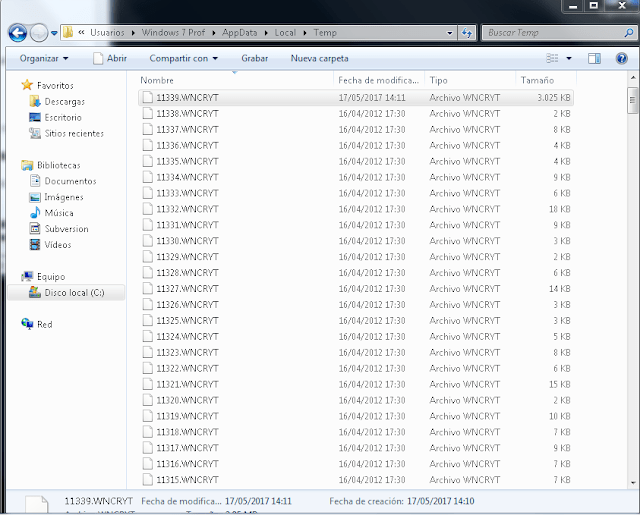
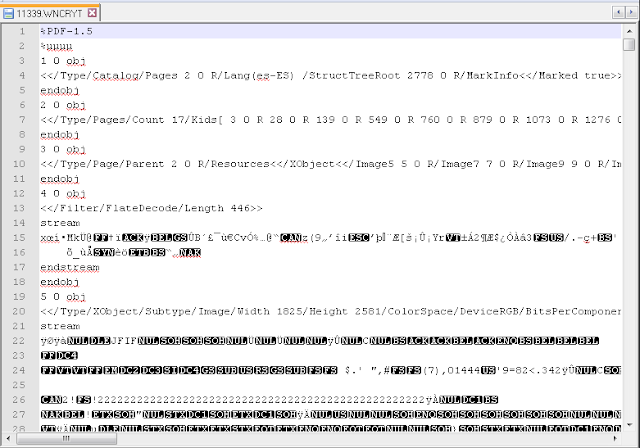
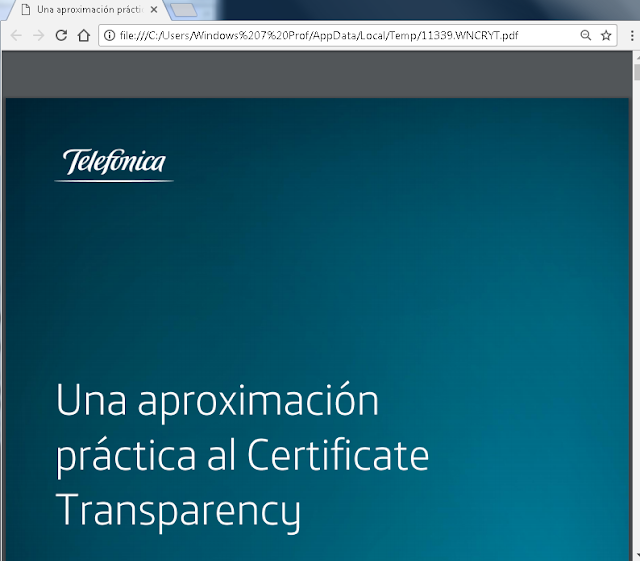
For example, the previous image shows a large amount of temporary files that Wannacry was unable to encrypt. These files would be opened as a PDF file with a heading.

By simply renaming the file extension, the file and its content can be recovered. These files are recognisable by the heading of the file, as the original name is no longer available.
The following image, shows how to access the renamed files. This file name was changed from 11339.WNCRYT to 11339.WNCRYT.pdf and is now able to be opened through Windows, when the file is opened with the default application associated with the extension. The image below shows that the file is intact.
 

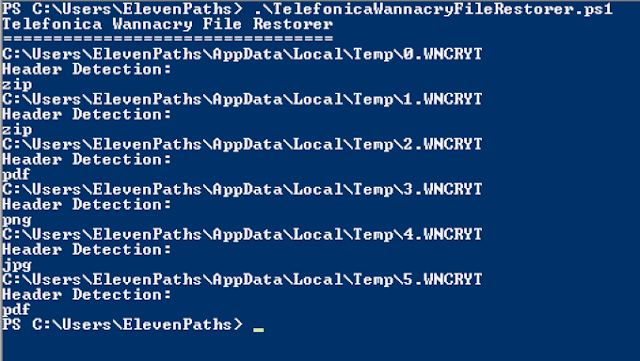
With this background information, here is a useful Telefónica WannaCry File Restorer script to use. This was developed in the labs of Telefónica with the objective of being able to retrieve and restore corrupted files.

Telefonica Wannacry File Restorer v0.1 Alpha
You can also find on our GitHub the Alpha Version script which we will be updating constantly.
Another important tip to prevent this or any other sort of future ransomware from infecting your PC or encrypting files is the Latch Antiransomware software developed by ElevenPaths. The following video highlights key programme features:

Latch Antiransomware instalation and configuration

Latch ARW: an AntiRansomware TOOL

WannaCry WITH Latch AntiRansomware

LUCA chooses Hortonworks from Hadoop as its platform to offer Big Data as a service for Spain

AI of Things    17 May, 2017

As each business sector is becoming increasingly competitive, data has become a key asset to success. In order to best leverage this asset, though, businesses need to ensure that the data that they generate and receive on a daily basis is optimised. Through aiming to do this, businesses can improve their use of resources and business processes. Businesses can also address new challenges that face them and streamline their decision making process. These predictive analysis models are essential if they want to be part of the digital transformation that is currently taking place across various markets.

Unfortunately, not all organizations are willing to or have access to the resources to invest in the necessary infrastructures and consultation to analyse their data. Businesses are well aware of the process of data extraction, management and analysis, however, the majority of them struggle to embark on Big Data projects due to their complexity and the ever-changing nature of the technology in this sector.

LUCA (tbe Big Data unit within Telefónica) has been working with HPE (Hewlett Packard Enterprise) to bring their clients in Spain the Big Data Hortonworks by Hadoop platform, which is underpinned by HPE technology.

hortonworks
Figure 1: The platform allows large sets of data to be processed and stored in clusters.
Hortonworks by Hadoop data platform has two essential functions: it lets organizations collect and store all types of information in a data repository and it facilitates data transformation, predictive and prescriptive analysis which can be carried out on said stored information. These benefits are essential to businesses are carrying out Big Data functions.

The most important part of the data analysis for clients should be the ease of the process: ensuring that they can quickly extract the most value without worrying how the platform makes it possible, whether that’s the deployment, updating or development of the platform. Each client has diverse needs and this platform facilitates these needs with the possibility to increase or expand as the volume of data that needs to be processed varies.

Hortonworks from Hadoop data platform has become the most committed platform with an Open Source Apache Hadoop ecosystem. It has been developed with HPE equipment (as they are the leaders in this sector) and is based at the Alcalá Data Centre. This is the only centre of its kind in Spain that is used for non-privative data with a TIER IV Gold certification. Telefónica is involved in the operations, monitoring, and administration of the infrastructure.

alcala
Figure 2: This platform is located in the Alcalá Data Centre where the infrastructure is monitored and operated.
Our services use an independent platform to ensure top quality performance and security, created in a first-in-class architecture which allows on-demand use without affecting performance.

HPE and LUCA (Platinum HPE Partner) have joined forces to provide a digital transformation strategy for big businesses, aiming to give them the necessary tools to tackle their digitalization. Keeping this aim in mind, Telefónica created Living Cloud, a global proposal that encompasses all essential technological and methodological parts to this process, where Big Data is an indispensable building block.

LUCA Talk 5: Transforming the Tourism Industry with Dynamic Insights

AI of Things    17 May, 2017

It is already common knowledge that tourism is one of the biggest successes for the Spanish economy. Travelers are now more informed than ever before, instantly sharing their experiences whilst travelling and having the ability to have a much more extensive knowledge of a city before stepping on a plane.

The fifth LUCA talk will be taken by Senior Data Consultant at LUCA, Elena Diaz. Elena will highlight the ways in which LUCA Tourism can help businesses more acutely execute their marketing plans and lead them to make more optimized decisions based on the benefits of Big Data.

The webinar will take place on the 25th of May between 4pm and 5pm, do not hesitate to register here. Elena will be more than happy to answer questions surrounding this topic.

Mum, when I grow up I want to be a hacker

AI of Things    17 May, 2017
The hacker concept is most often associated with male ‘techies’ and ‘geeks’. But why is it so difficult to find female role models in the world of technology? A passionate and lively TED talk was given by Christopher Bell, media studies scholar and father of a Star Wars-obsessed daughter, addresses this question by highlighting the alarming lack of female superheroes in the toys and products marketed to children, and how this impacts their view of the world. According to various studies, at the age of 11 many girls feel drawn towards technology, science and mathematics but they lose interest when they turn 15.

Figure 1: Telefónica launches a campaign to promote diversity for Mothers Day.

Telefónica wanted to respond to this challenge. The data units led by Chema Alonso, including Aura (Cognitive Intelligence), ElevenPaths (Cybersecurity) and LUCA (Big Data) want to address this crrent trend and decided to “hack” diversity.

We wanted to make a stand for change, to eradicate this perception and change the course of history. We knew that a strong reference point was needed to drive this change, so we decided to take a poignant day like Mother’s Day to move forward with a new culture to make things work effectively in the future for women. Within our team, we are also looking for reference points of talented women who are capable of creating technology, who are from different backgrounds, each with their own story that makes them unique.

We don’t want to stop at just these stories. We want you to be part of this process in changing history. We want to break societal norms with inspirational stories from women in the realm of technology and change the course of history. 
We plan to compile 20 of the best stories. Share this video and fill out the following form and tell us how you have became a hacker. If you have any suggestions or questions email us at [email protected] or fill out the following form.

Be sure to keep with us on our social media: @LUCA_D3 @Telefonica @ElevenPaths

Datacloud Europe is nearly here!

AI of Things    16 May, 2017
The importance of the data cloud storage method has taken prevelance in the market and for this reason the Datacloud Europe event was created to harbour and share good practice. Chema Alonso will be talking about how companies can stay relevant in the ever changing field of cyber security.

 
Chema Alonso continues with his presence at events across the globe by attending the Datacloud Europe event. This event is the leading place for businesses and customers alike to make deals and network. If you want to find out who else will be joining Chema to give advice and insight at the event follow this link.


This years agenda will include; cloud challenges and data centre infrastructure giving the event the pull factors to attract both investors and their customers. Those in attendance will be able receive high quality information from the talks and also take their questions further with the beautiful city of Monaco as their backdrop what looks like it is set to be even more a success this year.
 
It is also worth noting that on the 7th of June the talks will focus on Africa, highlighting the continents progress with Cloud storage and the future for the development and deployment in cities in Africa.
 
Take a look at what happened last year in the video below:


Join the LUCA team through our Twitter account to keep up with the latest action from the event this August, we hope to find the insights just as useful as you do too!

Humanities in a Big Data World

AI of Things    11 May, 2017
A lot has been said about the future of workforce. We have seen many “prophets” claiming the end of jobs how we know them today. Oxford University has claimed that tech could steal around 47% of the existing jobs nowadays. The OECD isn’t so pessimistic and calculates that 10% of the world population will remain unemployed because of technological development. And it could become true someday. Maybe.

In the last few years we have seen the boost of tech roles, degrees, and specialties as an answer to concerns about changing workplace trends. It seems one of the safest ways of ensuring your future is being a data scientist, developer or a computer engineer.

And those highly specialized roles are the profiles we need to make our world a better place. Indeed, some tech lovers working on innovation and new developments have found something was missing in this whole new era of tech-jobs. And what they are turning to in order to fill in that gap might surprise you: a liberal education.

Some people are coming to realize we shouldn’t forget the importance of humanities, social sciences, art among others disciplines in the education of technical profiles. And why is that?

First of all, as science and tech philosopher David Casacuberta points out a liberal education is key “because many of technological developments where first in philosophers minds and then became true in the hands of engineers.” In an article at El País, Casacuberta and other experts on the field bring up many areas in which a humanistic approach has been and will be indispensable. These include examples such as the Turing test and linguistic development of Artificial Intelligence. In the article, they claim that the philosophic thinking is essential when it comes to the designing of our future world.

96

Normal
0

21

false
false
false

EN-US
ZH-CN
AR-SA


/* Style Definitions */
table.MsoNormalTable
{mso-style-name:”Tabla normal”;
mso-tstyle-rowband-size:0;
mso-tstyle-colband-size:0;
mso-style-noshow:yes;
mso-style-priority:99;
mso-style-parent:””;
mso-padding-alt:0cm 5.4pt 0cm 5.4pt;
mso-para-margin:0cm;
mso-para-margin-bottom:.0001pt;
mso-pagination:widow-orphan;
font-size:12.0pt;
font-family:Calibri;
mso-ascii-font-family:Calibri;
mso-ascii-theme-font:minor-latin;
mso-hansi-font-family:Calibri;
mso-hansi-theme-font:minor-latin;
mso-ansi-language:EN-US;
mso-fareast-language:ZH-CN;}


One might think that these are two worlds, humanism and technological development, are irreconcilable because of the gap that separates them. Nevertheless, many experts point out the need to embrace both worlds in the creation of the Third Culture. This term has been proposed by John Brockman, businessman and editor of Edge Magazine, and attempts to include and unify both cultures. This also means that humanists have to make an effort as well and become interested in what science and tech has to offer to our world. The concept here is about merging the best of both areas.

Figure 2: John Brockman created the term “Third Culture” aiming to close the gap between numerical and technological disciplines with social sciences.

96

Normal
0

21

false
false
false

EN-US
ZH-CN
AR-SA


/* Style Definitions */
table.MsoNormalTable
{mso-style-name:”Tabla normal”;
mso-tstyle-rowband-size:0;
mso-tstyle-colband-size:0;
mso-style-noshow:yes;
mso-style-priority:99;
mso-style-parent:””;
mso-padding-alt:0cm 5.4pt 0cm 5.4pt;
mso-para-margin:0cm;
mso-para-margin-bottom:.0001pt;
mso-pagination:widow-orphan;
font-size:12.0pt;
font-family:Calibri;
mso-ascii-font-family:Calibri;
mso-ascii-theme-font:minor-latin;
mso-hansi-font-family:Calibri;
mso-hansi-theme-font:minor-latin;
mso-ansi-language:EN-US;
mso-fareast-language:ZH-CN;}


Brockman is not the only one advocating this fusion. Susan Etlinger has been working in Big Data for a while now as an industry data analyst for Altimeter Group. In her Ted Talk, Susan explains how we’ve developed an immense power to process tons of exabytes very quickly. For that reason, we are able to make decisions that damage our world faster, more efficiently, and with far more impact. History proves that we humans tend to go the wrong way when we don’t take into account critical or long-term thinking. And that is exactly what Susan embraces: a culture of technical profiles with an attention to fields such as humanities, ethics, and philosophy. It doesn’t matter if your hypothesis is made out of words or numbers, it needs to be right and free of assumptions. Therefore, to find mistakes in our reasoning we must question our work. In her words, “we must show the math” behind our problem solving and inquire ourselves if we are asking the right questions. And you can gain that ability learning from the humanities.

Figure 3: Susan Etlinger has given a world famous Ted Talk on the importance of taking into account critical thinking when developing technology.

William Cronon, awarded with a Pulizter prize in history, is a good thinker to investigate if you would like to learn more on this topic. In his article “Only Connect,” he goes through the characteristics of what he thinks a liberal mind should be. Cronon defines the word “liberal education” to be an “educational tradition that nurtures human freedom in the service of human community, which is to say that in the end it celebrates love.” It is important to keep this definition in mind, because our goal to be leaders of the world’s technological development will never make a positive impact if we do not take into account this definition of a liberal mind.

We don’t want people passionate for tech feel neglected. On the contrary, they have the tools to make our world a better place with technology development. And adding some love for humanities makes the perfect mix to fulfill this important mission.


Whatsapp is down, now what?

AI of Things    10 May, 2017

Written by Raúl López and Luis Suárez, LUCA interns.


Very few people use their mobile phones without installing Whatsapp. The application gives thousands of millions of people the possibility to share their lives daily with their friends and family worldwide. Therefore, any kind of disruption to this service is capable of provoking a chain reaction. Once one method of communication fails, people will always manage to find another one to take its place. As soon as problem arises with this network the first reaction is sign in to another form of social media.

On the 3rd of May of this month, that is what happened exactly (and for some people it really was a disaster). Whatsapp’s service was stopped for 3 hours, between approximately 9pm and 12am at night. This loss of service gave us at LUCA the chance to carry out a small study to find out how users feel the need to communicate and the big move towards another massive social media platform, Twitter. This was followed by people sharing their reactions with the general public. The study also provides a sentiment analysis for the tweets that were written overnight.

whatsapp tweets
Figure 1: The increasing quantity of tweets including the term ‘whatsapp’ during the service problems.

We focused on the tweets shared in Spain that included the term ‘Whatsapp’. In order to enable a more in depth analysis from the lack of service we used tweets that were taken from the early morning of the 3rd of May until the afternoon of the 4th of May. The final dataset therefore includes information about the sentiment, country and the autonomous community from which it was sent and final the language used for the tweet.

Quantative Vision

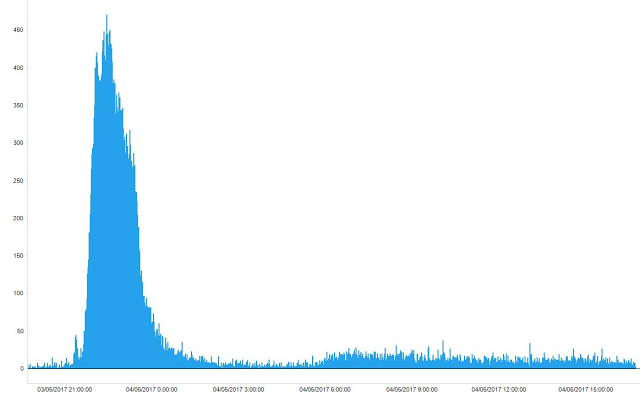
By completing an analysis surrounding the numer of tweets that were sent before, during and after the service problems, we can clearly visualize the time in which the highest number of tweets were registered per minute.

twitter dashboard activity
Figure 2: Twitter Dashboard activity from the early morning of the 3rd of May until the afternoon of the 4th of May.

At a quick glance it is possible to observe various patterns. During the day of the 3rd of May, tweet levels were considerably low before the service problems. This can be considered as the normal amount of tweets relative to the use of ‘whatsapp’ in the body of the tweet. At around 9m we find the first spike in tweets which coincides with the service problems. Following this initial increase, we can then observe a snowball effect, at ten thirty that evening we saw 874 tweets sent in one minute. Throughout the entire period of problems with Whatsapp a total of over 74,000 tweets were sent. This leads us to the conclusion that 75% of tweets were sent during the period of problems with Whatsapp.

The effect of the lack of Whatsapp coverage continued to be commented on social media throughout the morning of the 4th of May. Comparing both the morning of the 3rd and 4th, we can observe an increase in tweets by 800%.

autonomous regions
Figure 3: Twitter activity with relation to autonomous region

Qualitative Vision

As for the impact of the drop in service on the users of this application, we have obtained an analysis of the sentiment of the tweets issued by each user. A ranking algorithm is responsible for categorizing each tweet by assigning it with a positive, negative or neutral label.

With Figure 4 we focus on the highest spike in activity with which we have previously commented. We first note that the number of tweets flagged as neutral is significantly more than the rest. In theory this may indicate that the drop in service may not cause as much damage as previously thought the reputation of Whatsapp.

data visualization
Figure 4: Sentiment analysis of the largest spike in Twitter activity

It is still worth noting that the number of negative tweets exceeded the number of positive tweets, which is predictable given the widespread use of the application.

Once the service ws restored and the users in Spain began their new day, the activity surrounding the term ‘whatsapp’ remained relevant as we previously mentioned above. This second stage seen a mostly neutral commentary, although the difference between tweet with negative and neutral feeling is much lower.

data visualization
Figure 5: Sentiment analysis once Whatsapp re-established their service

The tweet with the greatest impact was shared by the National Police, inviting users to stay calm and enjoy the opportunity to talk to the people who live in their homes.

national police
Figure 6: The most shared tweet during the service problems with Whatsapp

Indeed, from this small study we can conclude that with the fall of one communication service as used as Whatsapp, other networks will then echo this fall and establish a mass conversation. Another interesting analysis would be to find out which users were regular tweeters before the creation of this hashtag or with the service problems signed in to Twitter as an exception. Humans are social animal by nature, even it is to communicate that there are problems with communication.

Security Day 2017_ Cyber Security beats

ElevenPaths    9 May, 2017

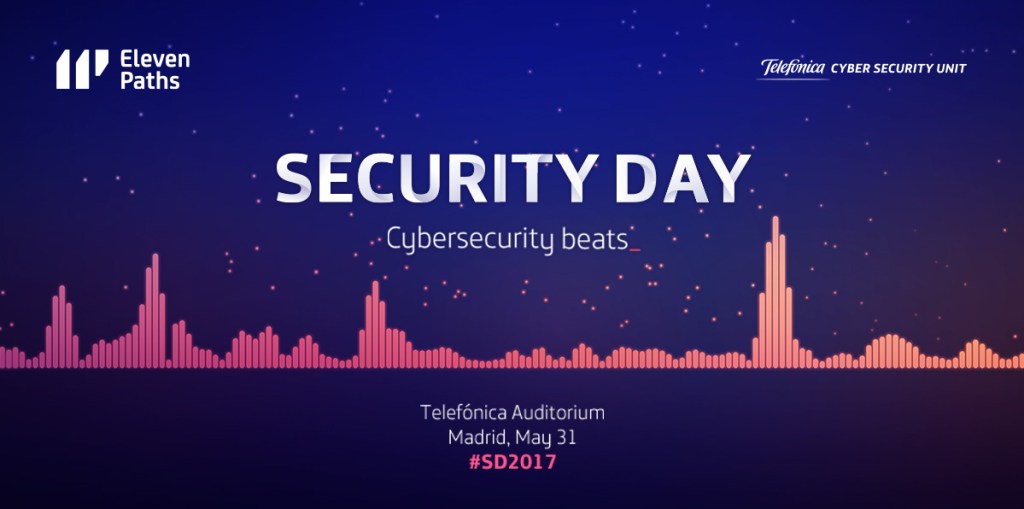
The motto of the fourth edition of our Security Day is Cybersecurity Beats. A conference about security and technology where this year we will teach how our security tools get a feel for your company’s information systems. Some of the topics we have chosen for this day are the mandatory compliance with the GDPR regulations as of May 25, 2018, and how to be prepared with our SandaS GRC platform, the latest additions to the ElevenPaths alliances and partners program, and the integration of security solutions to help companies fight cyber attacks against their technological infrastructures. In addition, some of our partners will actively take part, with whom we will be on stage to show you the latest integrations that we have jointly carried our, for example with Check Point MTP and Tacyt. This year, as new features, we will present our Path6 (it finally has a name!), which we will unveil to you, some of the cyberattacks in which we have taken part this year, awards ceremony of the winning plugins and hacks of our annual Latch Plugins Contest, hosted by Chema Alonso and much more.

Agenda

09:30 Guest list
10:00 Global Security Keynote

  • ElevenPaths Partners. Together we create a safer digital world.
  • GDPR regulations: Is your company prepared to comply? SandaS GRC is ready!
  • Startups and entrepreneurs in cybersecurity. Technological innovations of cybersecurity startups.
  • Hack Your Attitude! Winner plugins and hacks of the Latch Plugins Contest.
  • Panel technology experiences: how to fight cyber attacks when protecting your company’s information systems. Real examples.

Do not miss out on the chance to spend with us a morning full of experiences, security and networking. The registration web of the event is now available, book your seat today!

The seating is limited, so we suggest that you register as soon as possible.

¡Sign up now!

More information on
securityday.elevenpaths.com